Get Full Government Meeting Transcripts, Videos, & Alerts Forever!
Get email alerts on the Student Health And Equity topic
No spam. Unsubscribe anytime.
Students urge PPS to enforce state law after survey finds menstrual supplies often unavailable
Summary
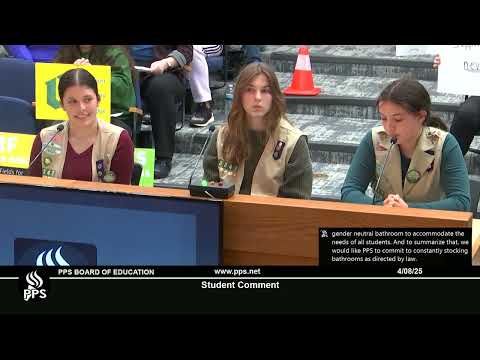
Students, led by members of Girl Scout Troop 12347, told the school board that menstrual products are inconsistently stocked at Portland comprehensive high schools and asked the district to publicize stocked bathrooms and ensure supplies in at least three restrooms per school.
Annika Houghton, a member of Girl Scout Troop 12347, told the Portland Public Schools Board of Education on April 8 that a student survey found menstrual supplies are frequently unavailable at district high schools and that the lack of products is causing students to miss class. "We would like PPS to commit to constantly stocking bathrooms as directed by law," Houghton said.
The students said they surveyed students at PPS comprehensive high schools and found 73% reporting bathrooms were "never stocked or are constantly being destroyed." The group cited Oregon House Bill 3294 — enacted July 1, 2021 — which the students said requires public education providers to provide tampons and sanitary pads at no cost to students and to fund those supplies through the state.
Nut graf: The student testimony put a statutory requirement and local practice in direct tension. The students asked the district to follow state law by ensuring reliable supplies, publicizing which bathrooms are stocked and keeping at least three bathrooms constantly stocked (they recommended male, female and at least one gender-neutral bathroom per school).
Students and multiple student testimonials recounted personal incidents: one student told the board she missed about 50 minutes of class while searching for supplies; another said she had to ask 15 people for a tampon. The testimony also said student-run clubs sometimes restock supplies but that relying on clubs is "not a sustainable nor equitable solution" because it places the burden on students.
Superintendent José L. Armstrong responded that the district has begun addressing the problem at specific schools. Armstrong said Lincoln and Roosevelt had recent problems — dispenser jams and inconsistent stocking in male restrooms — and that those issues had been resolved or were in process. Armstrong also said students at Roosevelt were volunteering to help restock there and that the district would provide updates.
The Girl Scouts asked the district for teacher training to increase staff awareness when students leave class for menstrual needs, signage or Trivory postings to publicize stocked bathrooms, and a district commitment to keep supplies available in the specified bathrooms.
Ending: Board members thanked the students; staff said they would follow up and report progress. The board did not take a formal vote on the requests at the meeting; staff signaled they will provide updates to the board and public as they implement fixes and monitor compliance with state requirements.