Get Full Government Meeting Transcripts, Videos, & Alerts Forever!
Get email alerts on the Special Education topic
No spam. Unsubscribe anytime.
Quincy School District outlines shift to more inclusive special-education supports
Summary
Special-education staff presented a district plan to reduce replacement classroom placements and increase in-class supports, citing staffing levels, program counts and quarterly data checks.
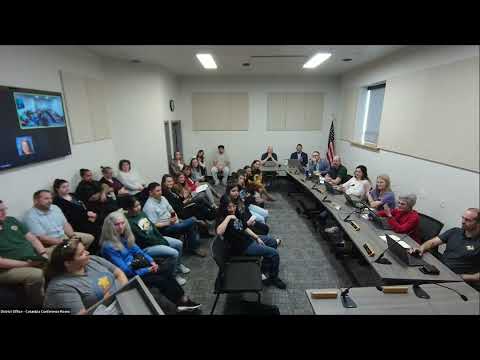
Quincy School District special-education staff outlined a plan to increase students' time in general education classes and add targeted in-class supports, saying schedule structure rather than student need had been pushing many secondary students into separate replacement classes.
The presentations at the board meeting centered on the district's resource rooms and life-skills programs and a proposed continuum that ranges from full inclusion with push-in supports to limited replacement classes for students with substantial foundational needs. "The resource room is an amazing place," said Christina Amadio, special-education teacher at Monument Elementary School, describing the room as "a safe place to land" where teachers scaffold instruction and address social-emotional needs.
District special-education coordinator Lisa Martinez said the district has already reclassified and placed students for next school year based on the new continuum. "We've already placed them, so that part's been done," Martinez said, and staff will follow up by amending IEPs and reviewing data quarterly to confirm placements. Mindy Burns, high-school special-education teacher in the Life Skills room, described the program's focus on "personalized learning, daily living skills, and social skills training," and said community job sites are used three days a week to build vocational skills. "They always come back with a cookie or a donut," Burns said of students returning from community work sites.
Why it matters: Martinez said a schedule issue — replacement classes for math or ELA that remove students from core content — had inflated the number of students categorized in more restrictive settings at the secondary level. The proposed response keeps more students in grade-level classes while adding regular push-in support (30–45 minutes per week) or more sustained in-class support (four days per week) as needed. Martinez presented staffing and caseload numbers: the district reports 22.5 certificated special-education staff, about 52 classified staff (mostly paraeducators), 3 teletherapy assistants, 0.6 FTE PT/OTs, and that the program serves 434 students. She described three paraeducator tiers (para 1, para 2, para 3/one-to-one) and said the district has two registered behavior technicians and is using para pairing to reduce burnout on intensive assignments.
Supporting details: Presenters described current placements by least-restrictive-environment: at middle and high school the district expects to move many students from replacement placements into a supported-inclusion model, with the goal of limiting students who spend most of the day outside general education. Martinez said that, after reviewing actual placements for next year, middle-school supported placements are projected to be the largest group and noted that over time she expects that number to shrink as incoming cohorts remain more in inclusion. The district plans quarterly progress checks, targeted para training, and professional development focused on inclusive practices.
Questions and next steps: Board members asked about transportation and community internships for graduates; Martinez said she has meetings scheduled with regional program representatives to explore internships and that the district is pursuing partnerships with nearby districts and organizations. Staff also noted contracted services (speech-language pathologists, teacher of the visually impaired, orientation and mobility, nurse, interpreter) that supplement in-district staffing.
Ending: District staff said they will amend IEPs where needed, monitor progress quarterly and prioritize supports for general-education teachers and paraeducators to implement the inclusion model.