Get Full Government Meeting Transcripts, Videos, & Alerts Forever!
Get email alerts on the Curriculum Bluebonnet topic
No spam. Unsubscribe anytime.
State board member briefs Katy ISD trustees on Bluebonnet learning materials as public debate continues
Summary
A State Board of Education committee chair updated trustees on the Bluebonnet open‑education curriculum under statewide review; public commenters both endorsed and opposed the materials, particularly religious-content lessons.
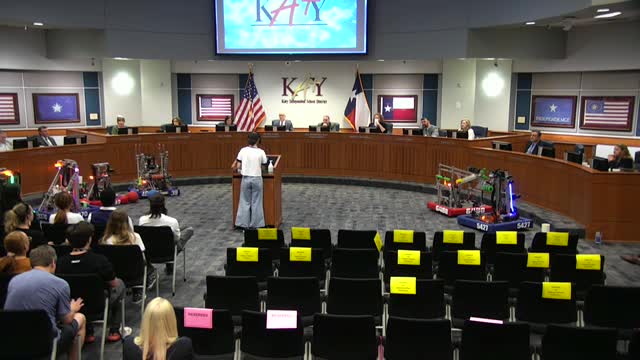
The Katy ISD board received an update on Bluebonnet — a set of state-produced, open‑education instructional materials — from State Board of Education (SBOE) Committee on Instruction chair Audrey Young on Monday, as parents and students filled the meeting room to argue for and against the set of materials under review.
Young said House Bill 1605 directed the state to develop open-education resources (OER) and that Bluebonnet materials are now undergoing Instructional Materials Review and Approval (IMRA) for possible district use in 2025–26. She described the materials as “100% TEKS aligned” and said the materials provide deep teacher guides, integrated knowledge-and-skill strands and a modular, customizable curriculum districts can adapt to local values.
A major focus in public comment was whether Bluebonnet’s lessons that reference religious texts and traditions are appropriate in elementary classrooms. Critics told the board the lessons put Christianity ahead of other faiths and risk violating the separation of church and state. "If parents want this material for their children, they can attend a private school," said David Long. "Public school is for everyone and all religions."
Other speakers, including Young and several parents, said religious-source material accounts for less than 10% of Bluebonnet content and is included for literary and historical value, not to advance any faith. Young said the curriculum explicitly references multiple religions where relevant and provides teachers with context and guidance. "Including content from or about religious source material... is included for the literary and historical value of the content and its connection to creating a strong background of knowledge for students," she said.
Young also described the funding and logistics tied to the state program: House Bill 1605 set aside funds to support high-quality instructional materials — including a printing stipend for districts. The State Board’s IMRA rubrics and public review process are available online, she said, and school districts retain local authority to adopt or exclude specific lessons or chapters to reflect community standards.
Trustees and the public asked about timelines and next steps. Young said math and social-studies TEKS updates are underway; materials tied to those updated standards will follow. For 2025–26 the English-language Bluebonnet materials (K–5 RLA and select math grades) are in the review process and Spanish-language materials are scheduled for the following year.
No board action was taken; trustees received printed sample materials and Young offered to provide additional binder sets to the district for review. Several speakers said they will return to future meetings as the district considers whether to pilot or adopt any Bluebonnet materials.