Get Full Government Meeting Transcripts, Videos, & Alerts Forever!
Get email alerts on the School Discipline topic
No spam. Unsubscribe anytime.
Katy ISD board reviews discipline plan language on fighting, self‑defense amid public outcry
Summary
Trustees heard public comment and a staff presentation on Katy ISD’s Discipline Management Plan section on fighting, physical contact and assault, including how self‑defense is defined and applied; staff said administrators use six statutory factors in discipline decisions and that some policy language was updated several years ago.
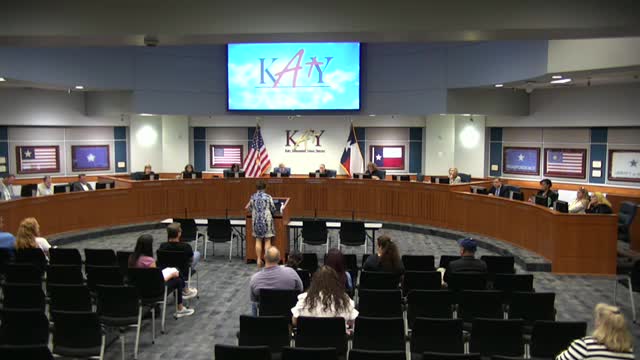
Trustees of the Katy Independent School District on April 14 reviewed the district’s Discipline Management Plan language that governs fighting, physical contact and assault after several parents urged policy changes and staff presented the plan’s current definitions and decision factors.
Board members heard public comments from parents and community members alleging inconsistent application of discipline and urging a clearer self‑defense exception. Justin Graham, the board’s general counsel, introduced the agenda item and Sherry Ashwin, who presented the consolidated language from the board‑approved Discipline Management Plan, walked trustees through the section that appears on page 10 of the plan and related definitions on page 18.
Why it matters: The discussion came after several public speakers said a campus video demonstrated inconsistent classification of an assault and called for policy changes to protect victims and teachers. Board members asked staff for clarifications and for data showing how often fighting and assault disciplinary actions occur and what penalties were assigned.
Ashwin told the board that the district’s written guidance states that “physical contact is not tolerated on school property” and that when “an individual is physically confronted by another student, the individual should avoid striking back” and instead seek an adult. She reiterated language in the plan that “a claim of self defense is not justification to avoid disciplinary action” unless there is documented evidence the student could not flee, and explained that administrators apply six statutorily required factors — including self‑defense and intent — when determining consequences.
Board discussion centered on how self‑defense is evaluated in practice. Trustee Kotel asked who defines “could not flee” and Ashwin said that is part of an administrator’s investigation using student statements, witnesses and available video. Ashwin also noted the district added a three‑part guide for self‑defense (the student must be without fault in provoking the encounter, not be the aggressor, and use only the minimum force necessary to remove themself from immediate danger) about four to six years ago to give administrators clearer guideposts.
Several public speakers pressed for policy changes. Rebecca Trahan, a community member, urged adding an explicit self‑defense clause so that “nobody should be punished for fighting back, especially when that is what is taught in every self‑defense course.” Danny Gianfrancesco, a parent, cited a video and called the plan’s language “ambiguous,” asking how campuses determine participation and whether administrators relabel clear assaults as “mutual.” Gianfrancesco said, “This ambiguity demands attention. Clear, universally applied language must be established to avoid misinterpretations that harm victims instead of protecting them.”
Ashwin told trustees the plan already includes a range of outcomes depending on severity — from “physical contact” to “assault with bodily injury” — and that repeated fights may be recommended for discretionary placement in the district’s DAEP (Disciplinary Alternative Education Program). She said partnership with campus police is common when penal code elements are suspected and that police involvement is determined based on the totality of the evidence.
Trustees asked staff to provide additional materials. Trustee Fox asked for a future presentation with districtwide statistics: frequency of fights across Katy ISD’s campuses, the kinds of discipline assigned and how often more serious placements are recommended. Board staff captured that request for a future report.
The board did not take formal action on policy text at the work study meeting; trustees used the session to question staff and consider whether clarifying language or additional definitions should be proposed for future revision.
Looking ahead: Board members flagged the item for potential revision and asked staff to return with more data and clearer definitions to support administrative consistency and public understanding.