Get Full Government Meeting Transcripts, Videos, & Alerts Forever!
Get email alerts on the Career And Technical Education Film topic
No spam. Unsubscribe anytime.
Parents, students and teachers urge Katy ISD to restore Miller film program after sudden removal
Summary
Dozens of students, alumni and teachers told the Katy ISD board Monday night that the district’s decision to remove the Miller Career & Technology Center film pathway deprived students of career training, and several speakers alleged enrollment numbers were manipulated to justify the cut.
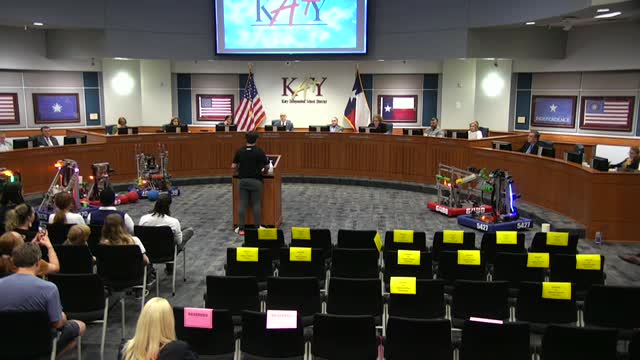
Dozens of students, parents and former Miller film students urged the Katy Independent School District Board of Trustees on March 31 to reverse a principal’s decision to remove the Miller Career & Technology Center film pathway, saying the program provides career-ready skills and hands-on training.
Supporters said the program prepared students for internships and jobs in film and media and that the district did not give the pathway a fair opportunity to enroll students before removing it. “How can a class meet its numbers when students weren't even given the full opportunity to sign up?” said Jay Van Dyke, a Miller student and film practicum participant, describing the course’s removal days before the enrollment portal closed.
The appeals came during the board’s public comment period. The most detailed presentation came from Dr. Stephanie Serone, who identified herself as a Miller advocate and former district educator. Serone presented enrollment and outreach figures she said show the program had been set up to fail: "With a 24 student cap, Film 1 had 24 commitments and Film 2 had 12, representing all eligible juniors... [but] the principal removed the courses from the course planner 4 days before the enrollment deadline, artificially lowering the numbers to justify cutting the program," she said.
Speakers described the Miller film pathway as a source of in-district vocational training, production for school events and an inexpensive provider of audiovisual services. Serone told the board that hiring outside professionals to replace the student film crew for events such as graduations would cost the district about $271,000 compared with $67,000 when the Miller students handled production — a gap she said amounted to a 303% increase in event-production costs.
Former students and alumni gave examples of career outcomes they attribute to Miller’s film instruction. Eduardo Reguelta said Miller staff mentored him into Adobe Premiere certification and jobs at the Houston Livestock Show and Rodeo; he said the program “isn't just about cameras and editing. It's about unlocking futures.” Several speakers described last-minute changes to the course listing and a lack of district communication to students and families as central grievances.
Administrators or board members did not propose or take any formal action on the film program during the meeting. No motion to reinstate the Miller film courses appeared on the agenda; board members later entered a scheduled closed meeting. The board packet included no formal vote on the film pathway itself.
Several parents and students urged the board to reopen the process and restore film offerings or provide equivalent courses at Miller. Speakers asked the board to consider preserving the instructor position and a classroom or to authorize a portable room and additional staffing so current students can complete their pathways. Attendees also asked for clearer communication of course‑planning deadlines and for the district to share the data principals used to cancel the classes.
The board did not announce a timetable for responding to requests about the Miller film pathway. Several speakers said they planned to follow up with trustees and to present petition and attendance data to district staff.