Get Full Government Meeting Transcripts, Videos, & Alerts Forever!
Get email alerts on the K 12 Budget topic
No spam. Unsubscribe anytime.
Katy ISD projects budget gap for 2025–26 as state, federal shifts cut aid and special education remains underfunded
Summary
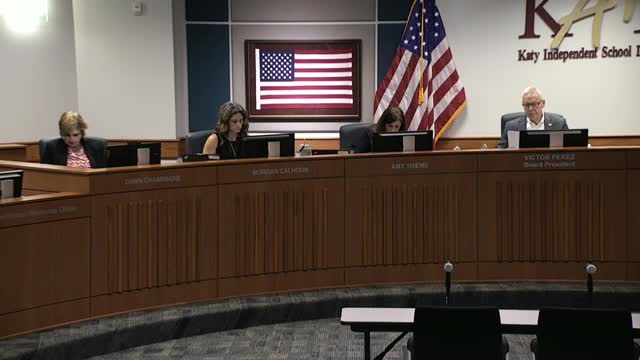
Katy Independent School District Chief Financial Officer Chris Smith told the board during a March 24 work study that the district is projecting a budget deficit for 2025–26 driven by slower enrollment growth, reductions in some federal reimbursements and capped state allotments.
Katy Independent School District Chief Financial Officer Chris Smith told the board during a March 24 work study that the district is projecting a budget deficit for 2025–26 driven by slower enrollment growth, reductions in some federal reimbursements and capped state allotments.
Smith said the district’s present estimate for next year’s enrollment is about 96,655 students and that, under current law, state funding elements such as the basic allotment and the “golden penny” yield add revenue but do not eliminate a projected gap. “We adopted a $27 million deficit,” Smith said, adding that recent budget amendments will improve that by “about $2.5 million.”
The presentation framed several state- and federal-level uncertainties that affect district revenue. Smith said federal reimbursements tied to indirect costs on grants (the district’s “SARS” or similar reimbursement) were reduced by roughly $5 million in December 2023 and by about another $5 million in December 2024, and that the district expects continued pressure on those revenue streams. He also highlighted legislative proposals under consideration in Austin — including potential increases to the school safety allotment, changes to the basic allotment and further property-tax compression — but said those outcomes are not yet certain.
Why it matters: Smith said Katy ISD is operating from a relatively strong starting point — roughly 34% of expenditures in fund balance — but warned the district cannot rely on that cushion indefinitely. “If that percentage stayed at where it was at 34% and stayed that through the rest of my career, I would be very proud,” Smith told trustees, while also saying the district budget must grow proportionally with district size.
Special education and transportation funding shortfalls were particular areas of concern. Smith showed audited figures indicating the district spent about $145 million on special education services while receiving about $115 million in state funding for those students, leaving roughly a $30 million gap that local funds must cover. He said the district is watching proposed increases to the special-education allotment but noted that until those changes cross the district’s current shortfall threshold they will not materially erase the local funding gap.
On transportation, Smith noted Katy ISD’s annual cost to transport students to and from school is about $24 million while related state revenue is roughly $4 million. He said even large one‑time state investments would not close that structural deficit without additional operational changes.
Property-value audit and one-time revenue: Smith and Esperanza Rios, director of finance, told the board a successful property-value audit from 2022 produced a one-time increase in state revenue that is reflected in the proposed March amendments. Rios said the March amendments reduce local tax revenue projections by about $6.35 million because of recent homestead‑exemption legislation, increase state revenue by $16 million tied to the audit, and reduce federal revenue by about $7 million linked to the change in SARS reporting; she said the net effect to the general fund balance is an increase of roughly $2.65 million.
Pension-related accounting: Smith reiterated that the district records a significant non-cash accounting entry for TRS on‑behalf contributions (the Teachers Retirement System), approximately $65 million in the presentation, which appears as both revenue and expense on the ledger.
Board reaction and next steps: Trustees asked for clarification about acceptable fund-balance thresholds and timing: Smith said the district aims for a minimum fund-balance target of 25% and would prefer to maintain the present level near 34%. He noted that underspending trends this year have helped and that property-value audits, timing of legislative action and other one-time events will dictate adjustments to the FY25 and FY26 budgets. The administration will present budget amendments at the regular meeting for board approval and return with updated projections when the legislative session yields clearer outcomes.
Provenance: Excerpts of the CFO presentation and the March budget-amendment briefing were presented to trustees at the March 24 work study meeting.