Get Full Government Meeting Transcripts, Videos, & Alerts Forever!
Get email alerts on the School Budget topic
No spam. Unsubscribe anytime.
Round Rock ISD preliminary budget projects $16.5 million shortfall as state and federal funding remain uncertain
Summary
At a Round Rock Independent School District board meeting, staff presented a preliminary 2025–26 budget showing an estimated $16.5 million deficit under current law. Trustees and staff discussed potential changes in House Bill 2, federal funding risks and possible reductions while stressing efforts to protect classrooms.
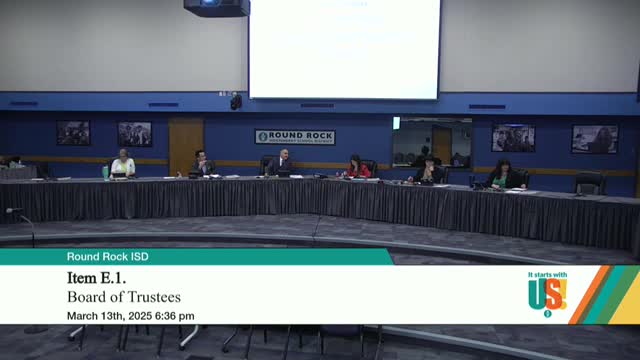
At a meeting of the Round Rock Independent School District Board of Trustees, district staff presented a first look at a preliminary 2025–26 budget that projects a $16,500,000 deficit under current assumptions.
The presentation, delivered to the board and Dr. Azais by staff member Dennis, outlined revenue and expenditure assumptions, potential impacts of pending state legislation (House Bill 2) and possible federal funding changes. Dennis told trustees, “as of today, we are projecting a 16,500,000 deficit.”
The budget assumptions shown to trustees include a 92% blended average daily attendance funding rate (to reflect 4-day pre-K funding rules), a 2% property-value increase, a flat maximum compress rate and no guaranteed increase in the basic allotment. Under those assumptions district staff projected total revenue of roughly $461 million and total expenses of approximately $477.36 million, producing the projected shortfall.
District staff described two competing budget effects tied to House Bill 2 as it was written at the time of the meeting: a potential increase in state funding if the basic allotment and school safety allotments increase, and an offsetting change to the state’s hold-harmless calculation that could reduce district funding. Dennis said the district would receive about $17.4 million under HB2 as written, but warned the bill’s current hold-harmless language could instead produce about a $19 million decrease for the district. Trustees and staff said they were hopeful legislators would alter the bill language to avoid retroactive hold-harmless reductions.
Trustees pressed staff on specifics and contingencies. Trustee Landrum said the three pages of budget detail were “so vital” to communicate publicly, noting that even with an assumed state increase the district faces a sizable gap. Landrum added trustees must plan for the worst-case scenario rather than rely on hoped-for legislative changes.
Trustees and staff also discussed how any new state funds must be used. Dennis reviewed the statutory or legislative constraints referenced in planning and said approximately 40% of certain new dollars would be required to go toward compensation; the remainder could be applied to other needs.
Board members asked about federal funding risks after staff noted recent national reporting of Department of Education personnel cuts. Trustee Weir asked what the district’s federal revenue includes; staff identified roughly a little over $20 million in federal awards overall, including reimbursements for ROTC (about $450,000), Title grants (roughly $6 million), child nutrition (about $8–9 million) and special education funding (IDEA-B). Dennis said the district had received federal planning numbers and that the district’s schedule of expenditures of federal awards (published in the annual comprehensive financial report) is available on the district website.
Staff listed possible internal reductions under consideration to narrow the projected deficit. Dennis said the district had already identified about $2 million in reductions being finalized and that planned reductions include some central-office administrative and school-support positions; other options were being evaluated with a preference for “surgical” trims rather than eliminating whole programs. Dennis said nothing was final and multiple workshops remain before the superintendent’s proposed budget is released and the board adopts a budget by the statutory June 30 deadline.
A single public commenter, Ginny Dezel, a certified teacher and parent, used the meeting’s public comment period to urge the board to reconsider increases to class sizes, saying, “It’s incredibly difficult to imagine being an adult assigned to meet the academic and emotional needs of 27 or more kids,” and asking the district to “reevaluate the decisions made regarding fifth grade class size specifically, but really all class sizes in general.” The board confirmed public comment remarks occur during a separate portion of the meeting and are not open for board discussion under agenda rules.
Votes at a glance D1 (consent agenda item): Approved by consent, motion passed 5–0. Mover: Trustee Markham; second: not specified in the record. Voting: Trustees Weir, Way, Markham, Landrum and Ross voted yes.
What’s next Staff said next steps include continuing cost calculations for proposed reductions, obtaining final property appraisal district (CAD) values, tracking legislative developments, preparing a compensation plan from Human Resources and holding additional budget workshops before the superintendent’s proposed budget and the final adoption.
The board and staff repeatedly stressed the preliminary nature of the figures and emphasized that final budget decisions will await clearer legislative and property-value information.