Wichita Falls ISD reviews feasibility study to convert McNeil to an 800‑student elementary
Loading...
Summary
Consultants presented a feasibility study to the Wichita Falls Independent School District Board of Trustees proposing conversion of McNeil into an approximately 800‑student elementary school, laying out program, possible hardened shelter conversions, cost ranges and a potential schedule to open in 2026–27.
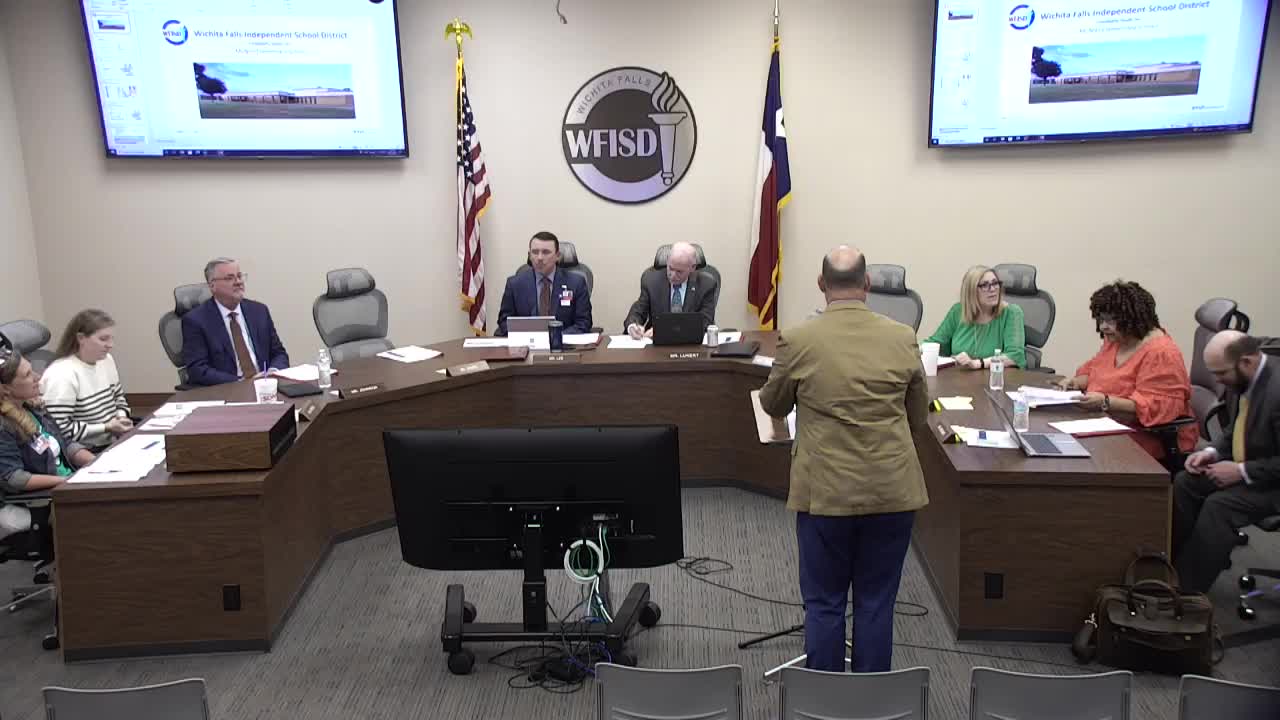
Christine Wood, a consultant on the facilities feasibility study, told the Wichita Falls Independent School District Board of Trustees that consultants believe McNeil can be repurposed into an elementary school sized for about 800 students and that converting the existing building would cost a fraction of building a new elementary.
The study, conducted with district staff and outside engineers, recommends a conceptual program that would accommodate seven sections each of kindergarten through fourth grade, six sections of fifth grade and two pre‑kindergarten rooms, with grade‑level “pods,” dedicated kindergarten/pre‑K outdoor access, and two “specials” suites (art, music, PE, library) to serve a larger student population. Christine Wood said the design team also identified two existing locker‑room areas as candidate hardened spaces that could be retrofitted into storm shelters or dual‑use rooms such as a fifth‑grade science lab.
The study’s authors described ranges of work and cost. Wood summarized the three-tier approach on the project plan and the team’s opinion of probable cost: “major renovations … you could be in that 60 to a 80,” and for other work “minor renovation, 75 to a hundred,” and added that including hardened shelter work affects the total: “the storm shelters … [put] you kind of in that 11 … 11.8 to 13.8.” She contrasted that with the cost of a completely new elementary, saying “you’re starting to stop about $450 a square foot” for new construction. The team presented the conversions as substantially less expensive than new construction because the existing building is about 50,000 square feet and contains areas with relatively recent construction (a wing added under the February 2017 bond initiative) that would need only a refresh.
Board members asked about the level of protection a retrofit could achieve. A board member identified in the discussion as Mr. Johnson asked whether the retrofit could meet FEMA or shelter standards. Wood said the locker rooms already have concrete block walls and restroom facilities, and engineers believe additional structural work (metal deck and concrete lid, reinforcement of existing walls) could bring the spaces “to a level I think that we would all think would be adequate.” She added, “We would love to get obviously, make them post compliant, get all the way there if we can,” and emphasized that level of upgrade depends on how much the board wants to spend.
Consultants presented a tentative schedule that would move the project from schematic design in spring/early summer to a potential contractor award after the end of the current school year, with an 8–10 month construction window if the board elects to proceed so the building could open for the 2026–27 school year. Wood said next steps would include more detailed classroom and support‑space sizing and return to the board with a schematic plan and refined costs.
Several implementation details were discussed: bus and parent pickup can likely be accommodated using McNeil’s existing drives and stadium parking for buses; kindergarten and pre‑K classrooms were shown with direct outdoor access and restroom/storage in the immediate classroom area; and the consultants said hardened spaces could be staged as dual‑use rooms (science lab, flex classroom) if the board chose to defer full shelter upgrades to a later phase.
No formal action was taken. The presentation will be available to district staff as they consider whether to move into the schematic design phase and will be revisited with more detailed cost estimates if the board directs staff to proceed.