Get Full Government Meeting Transcripts, Videos, & Alerts Forever!
Get email alerts on the Urban Forestry topic
No spam. Unsubscribe anytime.
County horticulture staff recommends native, mixed-species planting at Behringer Tully Field; fundraiser planning put on hold
Summary
Galveston County extension staff advised the Santa Fe Parks and Recreation Board to prioritize native and adaptive trees for Behringer Tully Field, recommended planting timelines and maintenance practices, and suggested potential nonprofit partners. Board members agreed to develop a fundraiser but tabled detailed plans pending cost and sourcing.
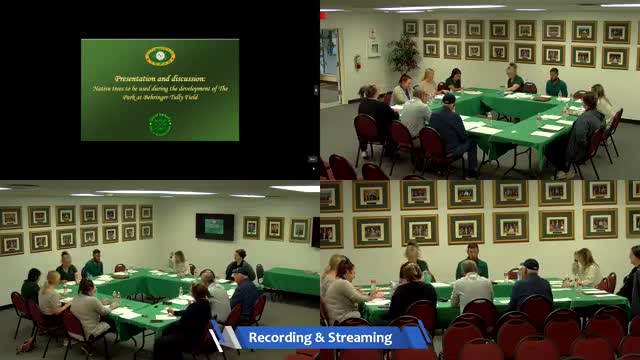
Boone Holiday, a Galveston County extension agent for horticulture, and Ira Gervais, a Galveston County Master Gardener Volunteer, presented recommendations for tree species and planting strategy for the planned park at Behringer Tully Field. The presenters recommended native and adaptive trees to reduce water, fertilizer and pesticide needs and to increase long-term survival.
Holiday told the Parks and Recreation Board that planting smaller, healthy containerized trees (for example 1–2 inch trunk diameter) typically establishes faster and offers better long-term growth than expensive, large-diameter “instant” trees. “A 5-inch diameter tree may take about five years before you see top growth,” he said, and he urged the board to weigh upfront cost against time to canopy development.
The presenters urged the board to plan planting sites methodically, avoid monocultures, mix canopy, evergreen and ornamental species, and anticipate root spread when siting trees near sidewalks or other infrastructure. Holiday recommended pre-treating planting sites with herbicide and mulching to reduce competition from turf and to improve establishment. He advised delaying large-scale planting until the fall (November) to improve survival during the warm season.
The pair reviewed a list of roughly 20 recommended trees for Galveston County conditions, including live oak, pecan, Mexican plum, crepe myrtle, Montezuma cypress, river birch and American elm. Holiday noted tradeoffs for fruiting trees: “Pecans will be our number-one net-producing tree” for low-input fruit production, while citrus and many commercial fruit trees require more protection and inputs and are less suitable for an open park setting.
On fundraising and sourcing, Holiday recommended contacting Trees for Houston, a nonprofit that supplies containerized trees and can direct municipalities to growers. The board agreed that smaller containerized trees (3–5 gallon) are typical of nonprofit and grant-funded plantings and are the preferred start for broad plantings.
Board members did not finalize a fundraiser amount or a sourcing contract. The item on creating a tree fundraiser was discussed but tabled for future meetings pending pricing and a meeting with city staff and the incoming city manager. Board members asked the presenters to return for a follow-up when planning advances and funds are identified.
The board also discussed project timing: there is a preliminary park plan and some funds set aside for a walkway, but staff said a meeting with city council and the city manager replacement is needed before procurement and mass planting proceed.
Ending: The board asked staff to continue planning and to invite Holiday and Gervais back for another presentation as the park design and fundraising plan firm up.