Get Full Government Meeting Transcripts, Videos, & Alerts Forever!
Get email alerts on the Occupancy Tax topic
No spam. Unsubscribe anytime.
Warren County committee approves $450,000 2025 spending plan as treasurer reports short‑term‑rental revenue rise and new state sales‑tax rules
Summary
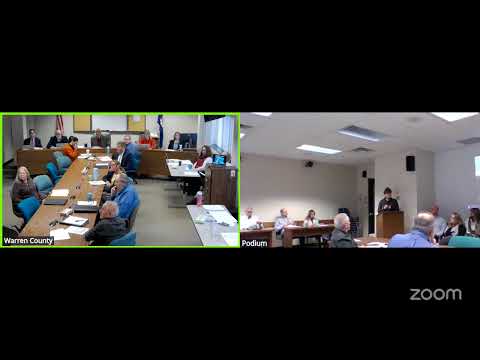
The Warren County Occupancy Tax Coordination Committee on March 24 approved a $450,000 spending plan for 2025 that will be distributed to towns and the city of Glens Falls, and heard a treasurer’s report showing a modest overall increase in occupancy tax collections and new state sales‑tax reporting requirements for short‑term rentals.
The Warren County Occupancy Tax Coordination Committee on March 24 approved a $450,000 spending plan for 2025 that will be distributed to the towns and the city of Glens Falls, and heard a treasurer’s report showing a modest overall increase in occupancy tax collections and new New York State sales‑tax reporting requirements for short‑term rentals.
Committee members approved the spending plan, which the committee staff said is already appropriated in the county budget and will be paid in August 2025 to participating municipalities. The allocation listed in the approved plan is $150,000 for Lake George (town and village combined), $60,000 for Bolton, $60,000 for Queensbury, and $180,000 split among the remaining towns and the city of Glens Falls (about $20,000 each).
Why it matters: Committee members debated whether the county should require a business justification or return‑on‑investment analysis before routing windfall occupancy tax receipts to towns. That debate matters because the county’s short‑term‑rental (STR) receipts have grown substantially and members said they want to ensure the money is producing measurable tourism or economic returns.
Supervisor Ann Wilde, speaking during the public portion of the meeting, said the county has seen “a windfall in our occupancy tax receivables primarily because of short term rentals,” and requested “some type of business justification in terms of why this $450,000 needs to be distributed to the towns instead of staying at the county and exactly what they were used for and what the returns are.”
Supervisor John Stroud countered that local governments are “intimately knowledgeable” about their own needs and pointed to cultural institutions — the Hyde, the Chapman, the World Children’s Museum and others — that he said draw visitors even if they do not directly generate room nights. “Nonprofits are part of the big picture,” Stroud said.
Supervisor Weil framed his remarks as a business question: what is the county’s return on investment from additional distributions to towns, and whether the $450,000 is in excess of what the local economy actually requires. Supervisor Molino urged maintaining the current approach, noting STR revenue has helped keep overall sales and tax collections higher despite hotel and motel declines.
Treasurer’s report and revenue details Christine (Treasurer) told the committee that the county’s combined occupancy tax collections (hotels, motels, resorts plus short‑term rentals) show a modest year‑over‑year increase after recent enforcement efforts. The treasurer reported the county’s collections figures at roughly $7.9 million versus $7.6 million for the comparable prior period, and said enforcement work recovered about $235,000 (including penalties and interest). Separately, a stated $107,000 in penalties and interest was remitted to the county general fund rather than to the occupancy tax fund.
The treasurer’s presentation said hotel, motel and resort collections were down about 1% year over year while short‑term rentals were up about 13%. The committee heard that an enforcement push also produced additional penalties and interest collections compared with the prior year.
Marketing‑vendor performance and vendor review The treasurer reviewed results from a marketing campaign vendor, Granicus, saying the county received $71,000 in revenue attributable to the campaign against an investment of roughly $40,000; that figure was presented as about a 78% return on investment after correcting a previous typo. Committee members said the campaign underperformed expectations compared with other jurisdictions and asked staff to evaluate alternative vendors; staff said demos are scheduled with Tyler Technologies and a commercial vendor called Deckard.
State sales‑tax change and short‑term rentals Committee staff summarized a New York State change that, per the presentation, requires platforms to collect sales tax on short‑term‑rental gross receipts beginning March 1. The treasurer said large booking platforms (Airbnb, VRBO, Expedia, HomeAway and others) have indicated they will collect both occupancy tax and sales tax on gross receipts, which staff said includes fees such as platform commissions, pet fees and extra‑person fees. Independent owners who take direct bookings remain responsible for filing and remitting taxes themselves.
Staff said the county will update its website and is preparing direct communications to STR owners (staff estimated sending roughly 1,500 letters but said that was under consideration because of postage costs). The county maintains a local short‑term‑rental registry, and staff said they will try to coordinate outreach with town boards. Staff also described local and state enforcement penalties reported by the treasurer: a first violation could be $200 per day until registered, a second $500 per day, and repeat violations may result in removal from a registry (a restriction described by staff and attributed to state and local enforcement examples).
Contract and radio‑feature resolution Separately, the committee voted to rescind Resolution 54‑2024 authorizing an extension of an agreement with Loud Media LLC for a weekly Warren County radio feature after staff learned Loud Media had been sold to Styx Media. Staff told the committee that the new owner will maintain existing programming and on‑air support (including the same on‑air host) and that the change requires reissuing the contract in the buyer’s name; staff said there are no substantive changes to program content or pricing. The committee also approved related media contracting items on the agenda.
Votes at a glance - Approval of minutes from the Feb. 27 meeting: motion made by Supervisor Runyon, seconded by Supervisor Thomas; outcome: approved. - Approval of 2025 occupancy tax spending plan ($450,000 distribution to towns/city): resolution made by Supervisor Rudnick, seconded by Supervisor Merlino; outcome: approved. - Rescind Resolution 54‑2024 and reauthorize media contract under new owner name (Loud Media LLC sale to Styx Media): motion discussion led by staff; outcome: approved. - Additional media contract items (agenda items b and c): approved (details: contract award specifics not specified in committee transcript).
What the committee did not decide Staff and several supervisors asked for follow‑up work to provide more detailed business justification and return‑on‑investment analysis for future distributions to towns; the committee did not adopt a formal new policy or require a specific ROI methodology at the March 24 meeting.
Next steps and follow up Staff said county attorneys will reissue or correct contract documents to reflect the media company’s new owner and will prepare the town funding contracts so payments can be made in August 2025. The treasurer said staff will present a month‑end cash‑on‑hand report after March books close and will return with additional forecasting and vendor evaluation results at a future meeting.
Ending Committee members closed the meeting after public comment and routine referrals and adjourned by motion.