Get Full Government Meeting Transcripts, Videos, & Alerts Forever!
Get email alerts on the Staffing And Finance topic
No spam. Unsubscribe anytime.
Davenport civil-rights director says HR and finance delays are stalling investigations, requests meeting with city leaders
Summary
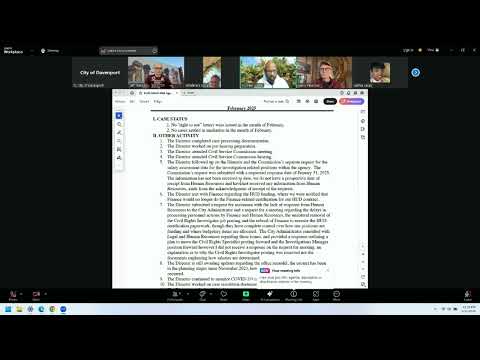
Director Lacey reported at the Davenport Civil Rights Commission’s March 11 meeting that delays and conflicting actions by the city’s human resources and finance staff have left key investigation positions unfilled, hindered the commission’s ability to account for HUD funding and created operational standstills.
Director Lacey reported at the Davenport Civil Rights Commission’s March 11 meeting that delays and conflicting actions by the city’s human resources and finance staff have left key investigation positions unfilled, hindered the commission’s ability to account for HUD funding and created operational standstills.
Lacey said the commission had been authorized two civil‑rights investigator positions for the year but that only one was posted; the posting for the second position was removed without explanation. “It was my understanding that we were using a single posting to fill both positions. However, apparently, the posting was removed without my knowledge,” Director Lacey said. She added the commission received no documentation explaining who removed the posting or why.
The director told commissioners she has twice formally requested a salary‑assessment metric — first in October and again by written request on Dec. 12 — and that neither she nor the commission have received the metric or a timetable for review. “I submitted a request for this data to the HR director on December 12, and then the commission submitted a second one in January. I have not received that data to date,” Lacey said, calling the lack of response “incredibly frustrating.”
Why it matters: Lacey said the missing personnel and salary documentation prevents the commission from recruiting and demonstrating compliance with its federal HUD contract. Under the commission’s HUD contract, she said, 20% of general‑fund money must go to fair‑housing activities; finance has placed several fair‑housing positions in the separate fair‑housing fund, which Lacey says prevents those salaries from being counted toward that 20% contribution.
“The finance staff refuses to remove those positions from the fair housing account. I can’t decide to remove them from the fair housing account. They have to decide to do it,” Lacey said. She told commissioners the finance director also informed the commission staff that finance would no longer prepare the finance‑related certification required by HUD, a task Lacey said traditionally fell to finance.
Lacey described interim staffing adjustments: an attorney moved from the civil‑rights specialist role into an investigations manager role, and the commission proposed converting the third investigator position into a part‑time law‑school internship program to develop a pipeline of trained investigators. She said those changes cannot proceed without updated personnel actions and budget changes that have not been processed.
The director also updated the commission on casework and hearings. She said two public hearings are underway: an initial hearing lasted about three days, the complainant has until the end of April to file a response, the commission’s replies will be due in May and any reply to those replies will be due in June. Lacey reported two new employment cases and one new housing case, and two cases closed in February (one housing, one employment).
Lacey said she has filed a personal lawsuit in connection with a long‑standing vacation‑correction dispute; she described ongoing delays and what she characterized as inconsistent statements by HR and legal about who sets staff salaries.
Commission discussion and next steps: Commissioners said they were concerned about the pattern of delays and the lack of clear responsibility. Chairperson Guster proposed asking the city administrator to meet with the commission; several commissioners recommended including the mayor and the finance director. The commission voted to request a meeting with the city administrator and the mayor to discuss the salary‑assessment metric, position postings, HUD certification responsibilities and other operational barriers (see “Votes at a glance”).
Lacey also asked the commission to consider whether portions of the commission’s upcoming annual report should address the working relationship between the commission and city staff; commissioners suggested reusing material from the 2023 annual report that documented workplace‑related roadblocks.
Ending: The commission agreed to attempt internal escalation first — meeting privately with the city administrator — before pursuing broader public escalations. Director Lacey said the commission will proceed with the HUD performance assessment submission on schedule where possible, but that finance data are missing and may require HUD follow‑up. The commission set a follow‑up joint meeting with city council as an outstanding item for coordination.