Get Full Government Meeting Transcripts, Videos, & Alerts Forever!
Get email alerts on the Education Ai Policy topic
No spam. Unsubscribe anytime.
Highline School District holds AI work session; staff outline draft policies, ambassador training and pilots
Summary
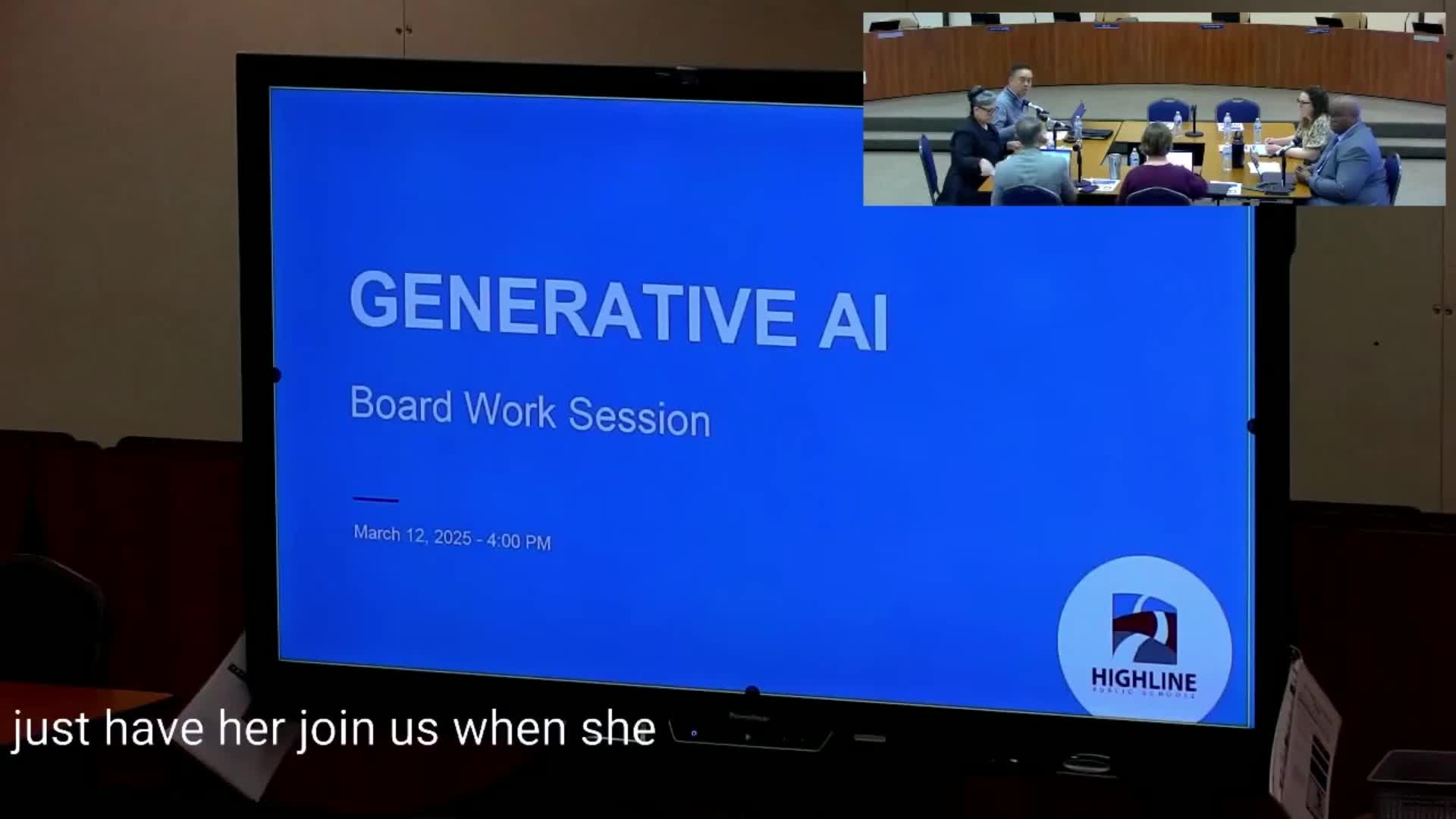
District staff led a work session on generative artificial intelligence, proposing updates to two district policies, launching an AI ambassador program, prioritizing Microsoft Copilot for data protection, and piloting classroom tools with attention to equity, translation and teacher training.
Highline School District officials used a special work session to brief the school board on plans to govern and pilot generative artificial intelligence in classrooms and district operations.
District staff framed the discussion around two existing policies — Policy 2022 (acceptable use) and Policy 2026 (devices and electronic use) — and said both need revision to reflect generative AI tools. Holly Ferguson, chief policy instructor, told the board, “we don’t know what we don’t know,” and recommended keeping policy language flexible as the district experiments with tools.
The presentations emphasized three cross‑cutting goals for AI use: equity, ethics and bias mitigation. Tashawn, a district staff member leading the AI work, repeated a central message from the session: “context is king,” and demonstrated how prompt refinement changes AI outputs during a live Copilot document‑review demo. Staff recommended defaulting to Microsoft Copilot for operational uses because, they said, it keeps district data contained and under the district’s controls.
Megan Terwilliger, director of teaching, digital learning and library, described classroom use cases such as quickly generating contextually relevant texts, producing standards‑aligned rubrics, and improving machine translation for families and multilingual students. “We are not intending to replace teachers,” Terwilliger said. “We are really just looking to increase efficiency so that we can really focus and hone in on our most precious resource, which is time with our students.”
Staff described an AI ambassador program that includes central office and school staff, principals and teachers and that will expand to include students and families. The ambassadors will pilot tools, develop professional learning materials and gather qualitative reports on impact. District staff said they expect ongoing professional development, targeting at least one training every one to two months across instructional and operational areas.
Equity and family engagement were recurring themes. Board members asked how the district will support families whose first language is not English and how to avoid widening existing digital divides. Staff said they are exploring multilingual prompt libraries, working with the district’s family engagement (FACES) team and planning outreach through existing school–family partnerships. The district also noted a small pilot of a kindergarten tool called Magpie.
Staff showed draft guidance documents — a high‑level vision, instructional guidance for classroom staff, and operational guidance for other departments — and said all three are living documents. They also referenced two state bills attached to meeting materials, SB 5263 and SB 5307, which staff urged board members to review with the provided Copilot prompts to summarize and refine the documents.
Board members raised questions about academic integrity, task design, and evaluation. Director Alvaraza asked how teachers would “challenge our kids to use their minds first” before turning to AI. Staff answered that instruction design should prioritize tasks requiring personal reflection or collaboration and that ambassadors will collect stories and qualitative evidence of impact; staff said direct quantitative measures of efficiency will be difficult to standardize across individuals.
The session concluded with staff asking the board for continued support as they finalize policy language and expand training and pilots. President Vann moved to adjourn at the close of the work session; the motion passed with recorded aye responses and no recorded opposition.
Next steps staff outlined include continued ambassador work, iterative policy updates to Policies 2022 and 2026 (moving from “acceptable use” toward “responsible use” language), ongoing district professional learning, stakeholder communication including family outreach, and targeted pilots with protected‑data tools such as Microsoft Copilot.