Get Full Government Meeting Transcripts, Videos, & Alerts Forever!
Get email alerts on the Transportation Reorganization topic
No spam. Unsubscribe anytime.
Franklin outlines bus routing, projected ridership increases and new online registration for 2025
Summary
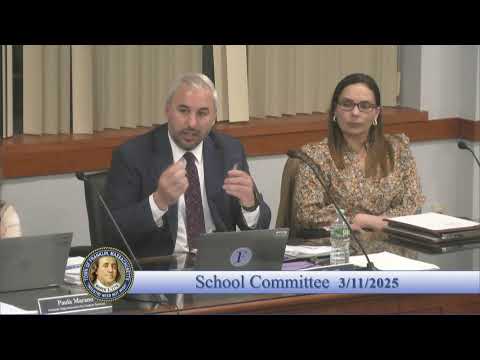
Colin Guavera, Franklin Public Schools' director of operations, reported to the School Committee on March 11 that the district ran route‑modeling exercises for the reorganization and expects higher ridership next year while maintaining similar average ride times.
Colin Guavera, Franklin Public Schools' director of operations, reported to the School Committee on March 11 that the district ran route‑modeling exercises for the reorganization and expects higher ridership next year while maintaining similar average ride times.
Guavera said the district currently transports 2,466 students on 28 buses across 56 routes with 838 morning stops. "For the school year 2024–25 we transport 2,466 students on 28 buses going 56 routes, stopping at 838 bus stops," he said.
Using projected percentages of riders by level (district projections presented as 60% elementary, 69% middle and 38% high school), the operations team ran exercises in its routing software to estimate how consolidation of attendance areas would affect bus counts and ride times. In the scenario Guavera presented, the district could accommodate an increase of about 275 riders while reducing the number of buses in active service by two and keeping average district ride time roughly comparable to the current year. Guavera said modeling could cut some maximum elementary ride times (one current bus had a max ride time of 46 minutes under the existing configuration).
A change in routing assumptions was central to the projected efficiency. Guavera explained that consolidating elementary attendance zones into two larger complexes gives planners more flexibility to route students to a single destination instead of multiple small schools, reducing duplicate local runs. Committee members repeatedly asked whether the modeling assumed every eligible rider was entered into the system; Guavera replied that the scenario used the actual student data and pushed routing "as far out as possible in the town" to test capacity.
Registration and payments: the district will move bus registration and payment to LinkConnect, the same platform used for cafeteria accounts. Guavera said the district has used LinkConnect since 2019 and there is no additional software cost. The portal will enable families to register, view payment history, set reminders and submit required free/reduced lunch sharing forms that determine eligibility. The transportation registration portal will open in April; Guavera said the registration deadline will be the last day of school in June, routes will be developed in July and published in August before school starts.
Caveats and expectations: staff warned of an adjustment period at the start of the year. "Traffic congestion currently exists in all schools during peak arrival and dismissal. This is likely going to continue," Guavera said. He added that start‑of‑school arrival and dismissal typically take longer and families should expect an adjustment period. The administration also said the beta traffic study will recommend future capital improvements that could change circulation on school sites, but no traffic‑related construction will occur in summer 2025.
Community asks and next steps: the administration asked families to register on time to give planners accurate counts; late signups complicate route building. Committee members requested follow‑up on payment plan options and how families would be reached if they miss the deadline; staff said LinkConnect can accommodate payment schedules and that the district will use email, the mobile app and text messages to prompt families.
Ending: district staff committed to post the presentation and to return with finalized routes in July/August once actual registrations are complete. The administration emphasized that the modeling is preliminary and reliant on families registering by the stated deadlines.