
Barnstable school leaders present $93.6 million FY26 budget as public raises alarms over proposed cuts
Get AI-powered insights, summaries, and transcripts
Sign Up Free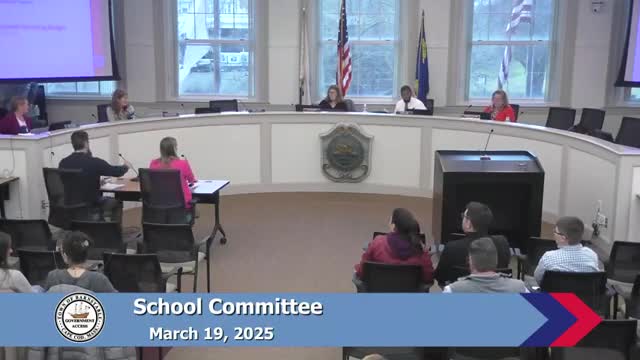
Summary
Superintendent Sara Hearn and Deputy Director Chris Dwelle presented a recommended FY26 operating budget of $93.6 million and a multi-year fiscal forecast. Public commenters and staff urged the school committee to preserve social‑work, nursing support and math intervention positions proposed for reduction.
Superintendent Sara Hearn and Deputy Director Chris Dwelle presented a recommended fiscal year 2026 operating budget of $93,600,000 to the Barnstable Public Schools School Committee at the March 19 public hearing, and warned the committee that district revenues will not support level‑service spending without savings or additional state aid.
The budget hearing was the formal public presentation of the FY26 recommendation and the district’s fiscal forecast for FY27–FY28. Hearn told the committee the district faces a structural gap driven by the expiration of federal pandemic (ESSER) funds, slow state Chapter 70 aid growth, reductions in some federal grant lines and rising inflationary costs. “The bottom line is the current situation is not sustainable,” Hearn said.
Why it matters: The recommended budget preserves core programs but proposes targeted reductions and one‑time purchases funded from savings. Public commenters — including school counselors, psychologists, teachers, nurses and parents — urged the committee to retain positions they said are essential to student safety, mental health and learning, and questioned the use of limited savings for curriculum purchases.
Hearn and Dwelle described the fiscal assumptions and balancing steps. The recommended FY26 package represents a 4.75% year‑over‑year increase and relies on a mix of general‑fund appropriation, revolving accounts, school choice revenue, circuit breaker reimbursement and $908,000 in one‑time savings earmarked to fund certain curriculum and one‑time items. Dwelle noted nearly $4 million of identified savings and other offsets folded into the recommendation.
Key budget choices and proposed reductions: The administration presented additions (special education staffing at West Villages; two classroom teachers at a growing grade in United Elementary School; a half‑time EL teacher for Barnstable High School’s ACE program; technology and phone‑system upgrades) and multiple proposed reductions to reduce recurring cost pressure. Proposed reductions discussed publicly included: reducing a bilingual paraprofessional FTE, eliminating a half‑time LPN at the Early Learning Center (position noted vacant since fall), reducing some interventionist positions (including a proposed reduction of one math interventionist at Barnstable United Elementary from three to two), and reducing a social‑worker position shared between Centerville and another site by 0.5 FTE.
Staff and parents pressed the committee on the human and safety impacts of cuts. Holly Moran, a school counselor at Centerville Elementary School, told the committee the social worker positions at Centerville and Barnstable West are “half of all counseling services to our students and half of all community connections” and warned that cutting the Centerville social worker “could be devastating.” Sarah Haskell, a Centerville school psychologist, and several parents described difficulty accessing community mental‑health services and said school‑based social workers are already the primary support for many families.
Teachers also objected to reductions in math intervention staff. Marybeth Nichols, a teacher at Barnstable United Elementary School, said the school’s fifth‑grade population is growing and that cutting an interventionist would “deny [struggling students] the opportunity to succeed.” Molly Kowalski, a math interventionist at Barnstable United, described daily small‑group work that she said prevents students from “falling through the cracks.”
Nursing and registration staffing drew separate concern. Susan McLaughlin, a school nurse at Barnstable United Elementary, urged the committee to retain a multilingual medical administrative assistant at the Family and Community Engagement Center, saying that person coordinates immunization, registration and clinical follow‑up for families who face language and access barriers.
Budget questions from the committee and next steps: Committee members asked for a clearer multi‑year plan for any one‑time savings the district uses, especially for the larger curriculum review cost (the superintendent identified a $428,000 K–5 math curriculum request and a separate TeachTown purchase for ILCs). Chair Jennifer Collin asked the administration for a five‑year forecast showing how one‑time savings would be used and cautioned against using savings for recurring personnel costs. Deputy Director Chris Dwelle told the committee the district’s savings would be exhausted in roughly four years if recurring costs were funded from that account.
The administration said it would provide a modified view of the budget without specific one‑time line items to show tradeoffs before the school committee votes. The school committee is scheduled to vote on budget adoption at its April 2 meeting; following adoption, the recommendation will go to the town manager and town council appropriation hearings.
Ending: No final budget vote occurred at the hearing. The public hearing was opened, multiple staff and parents spoke during the budget public comment period, and the committee closed the public hearing at the end of those comments. The school committee will consider adoption of the FY26 budget at its April 2 meeting.