Get Full Government Meeting Transcripts, Videos, & Alerts Forever!
Get email alerts on the Emergency Management topic
No spam. Unsubscribe anytime.
Emergency management seeks $116,400 from city; highlights flood response, training and hazard-mitigation work
Summary
Dubuque County Emergency Management Coordinator Tom Berger presented the commission’s FY26 request, emphasized last year’s flood response and hazard-mitigation planning, and asked the city for $116,400 in support of countywide emergency management operations.
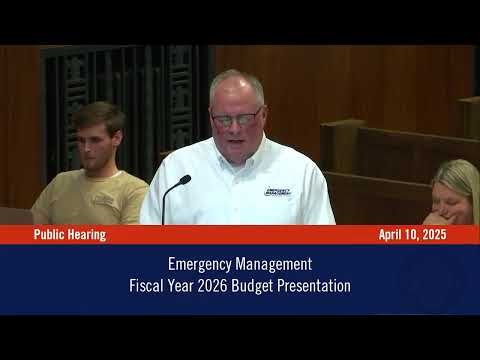
Tom Berger, Dubuque County Emergency Management Coordinator, told the City Council April 10 that the Emergency Management Commission is asking the City of Dubuque for $116,400 in FY26 property-tax support and reviewed last year’s flood and storm responses and ongoing mitigation work.
“We continue to build resiliency for our communities by planning for a responding to mitigating recovering from disasters,” Berger said, identifying the commission’s statutory structure under Iowa Code chapter 29C and saying the commission includes mayors of county cities and county officials.
Berger reviewed 2024 work including Mississippi River flood response that yielded a presidential disaster declaration, a full-county exercise at Epworth Elementary that involved more than 100 responders, rescue task-force and joint training with police, sheriff and fire departments, and approval of a FEMA hazard mitigation plan that will remain valid for five years. He said district mutual-aid relationships (district 6) and county training capacity are critical because the emergency management office is a small, single-person operation.
Berger described continuing priorities: maintaining outdoor warning sirens (the existing sirens are decades old), upgrades to the 9-1-1 communications center, ongoing NIMS/ICS training, hazardous-materials planning with rail and river partners, and completing a grant-funded hazard analysis and risk assessment by June 30. He said the federal Emergency Management Performance Grant (EMPG) pass-through to local offices has been capped for top counties at about $39,000 for many years and that the commission relies on a city/county split for the remainder (city 60% / county 40% by population share) to balance the budget.
Council members asked for details about the EMPG cap and how state decisions determine pass-through amounts; Berger said the state receives roughly $4.5 million and distributes roughly half and that the top 10–11 counties receive a capped amount. He also told the council the commission is pursuing renewing “StormReady” certification from the National Weather Service and seeks to continue cooperation with the 9-1-1 board and local public-safety agencies.
Berger closed by citing performance measures and training requirements and invited questions; no public input was recorded at the hearing.