Get Full Government Meeting Transcripts, Videos, & Alerts Forever!
Get email alerts on the Airport Budget topic
No spam. Unsubscribe anytime.
Dubuque council holds $10,000 airport advertising request for targeted review
Summary
Council members agreed to hold a $10,000 budget request from Dubuque Regional Airport for a separate discussion and asked staff for a targeted marketing plan focused on commercial air service. Airport staff outlined federal grants, capital projects and improvements tied to restoring daily scheduled service.
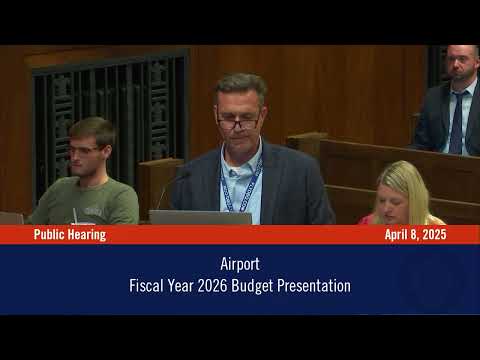
Todd Dalsing, director of Dubuque Regional Airport, presented the airport’s fiscal year 2026 budget and capital plan on April 8, describing federal relief and grant funding, runway and apron projects, and recent progress restoring daily scheduled commercial service.
Dalsing said federal relief awards totaling “just over $3,300,000” have supported debt service and operations and that a Bipartisan Infrastructure Law grant added “just over $1,400,000.” He reviewed a multi‑year master plan adopted by the council in 2021 and described FY26 projects that include continuation of Taxiway Alpha reconstruction, a general aviation apron rehabilitation and terminal security work. He also highlighted enrollment growth at the University of Dubuque aviation program and the airport’s ongoing partnership with Dubuque Air to restore and expand commercial air service.
During the council discussion, councilmembers focused on a recommended FY26 improvement package that included an additional $10,000 for non‑airline advertising. Mayor Brad Cavanagh led the exchange by noting the city’s top priority of restoring and sustaining commercial air service and by asking whether the additional $10,000 could be redirected to commercial advertising. Dalsing and Randy Gale, the city’s public information officer, explained the airport already expects a $60,000 advertising budget for commercial air service comprised of a state air service development grant ($48,000) plus a local match. Gale said the city, DBQ Air and other partners have adjusted advertising weekly since service began in fall 2024, and that combined local and partner spending for FY25 “will have spent nearly a hundred and $60,000 total in marketing for air service this fiscal year.”
Councilmembers asked for clearer detail on how a supplemental $10,000 would be spent and for a plan showing measurable outcomes. Councilmember Ryan Resnick asked the airport to provide options (for example, digital geofencing around competing airports, billboard placement, or ticket incentives) and to include metrics for tracking effectiveness. Jennifer Larson, chief financial officer, cautioned that airport staff had purchased some equipment using FY26 funds already and that any reallocation of savings would require accounting for actual purchase costs.
Following discussion, Mayor Cavanagh proposed holding the $10,000 request for separate consideration and directing staff to return with a proposed spending plan that would prioritize commercial air service advertising and include measurement metrics. Councilmembers expressed support for the hold and the request for a detailed plan; the mayor reported a count of four members in support and the item was set aside for the next meeting so staff and the communications office could prepare that plan.
Dalsing’s presentation also reviewed airport operations and partnerships: the airport’s tenant businesses, recent events and outreach, the airport commission membership, and the DBQ Air coalition’s work to restore daily service with Denver Air Connection (service resumed November 4, 2024). Dalsing said Denver Air initially provided afternoon service into Chicago with interline agreements and was exploring direct Denver flights. He also reviewed FY25 performance measures for fuel sales, based aircraft (92) and operations (just over 80,000 per year), and described planned terminal and airfield projects with federal/state cost shares.
The council did not take a final funding vote on the $10,000 during the session; instead it held the request pending a targeted plan from airport staff and the communications office.