Get Full Government Meeting Transcripts, Videos, & Alerts Forever!
Get email alerts on the Property Tax And Budget topic
No spam. Unsubscribe anytime.
Dubuque City Council approves proposed FY2026 property tax rate after public hearing, 7-0
Summary
At a special March 25 session, the Dubuque City Council approved a maximum proposed FY2026 property tax rate of $10.06 per $1,000 and set the budget calendar; city officials said a state-mandated taxpayer mailing overstates the city-only increase.
The Dubuque City Council approved a proposed maximum property tax rate of $10.06 per $1,000 of assessed value for fiscal year 2026 and received the related budget materials during a special public hearing March 25 in the Historic Federal Building.
City Manager Mike Van Milligen told the council the state-mandated taxpayer statement mailed in March, prepared by the Iowa Department of Management, will show a much larger city-only increase than Dubuque is proposing. “Dubuque property owners will soon receive notifications, which are required and prepared by the state of Iowa, showing a more than 14% increase in the city portion of residential property taxes next year when the proposed increase is actually 3.9%,” Van Milligen said. He said the difference comes from the state formula’s assumption of a 10% valuation increase and other state assessment and rollback calculations outside the city’s control.
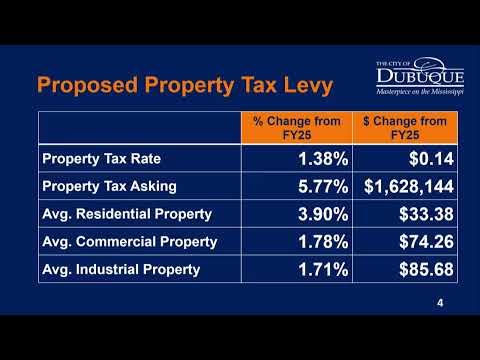
The mailer is required by state legislation passed in 2023 and created by the Iowa Department of Management, Van Milligen said. He summarized the council’s choice at the hearing: the council may approve the proposed rate or reduce it, but cannot set a higher rate than the one noticed. The proposed $10.06 rate would represent a 3.9% increase in city taxes for the average residential property, a 1.9% increase for commercial property and a 1.73% increase for industrial property, Van Milligen said.
Nut graf: The vote establishes the maximum city tax rate and keeps the city on the schedule to adopt a final FY2026 budget after department-level hearings. The city says state assessment rules and recent changes to tax credits and exemptions affect how much the mailed notice appears to show compared with the city’s stated impact on typical homeowners.
City officials outlined factors driving the proposed levy and budget: reductions in state “backfill” payments tied to a two-tier commercial/industrial assessment change; a new homestead exemption paid by the city; a military-related exemption; declines in some local revenues such as DRA lease payments and ambulance fees; and planned wage increases and a $2 million classification-and-compensation implementation. Van Milligen said those items left the city roughly $350,000 below where it otherwise would be at the start of the budget process.
Van Milligen gave dollar figures the council used in setting the rate: the proposed maximum tax dollars are $29,861,901 (a 5.77% increase in dollars over FY2025). The current rate was $9.93 per $1,000; the proposed rate represents a 1.38% change in the rate. Van Milligen also provided estimated average-bill changes: $33.38 more for the average residential property, $74.26 more for the average commercial property and $85.68 more for the average industrial property.
Several council members and the mayor emphasized the multimeeting public process ahead. Mayor Cavanagh and Council Member Jones noted a schedule of department presentations beginning March 31 and continuing through multiple April meetings, with a final public hearing and budget adoption set for April 28. Van Milligen said he will present the full budget recommendation at the March 31 meeting. The council also asked for and was told they would receive a memo outlining the process for adding or removing “improvement packages” by the end of the week.
Resident Clark Slows spoke during public input and urged clarity about mailed notices and the roles of assessments, rollbacks and credits. “If you don't have assessed property, how do you get property tax dollars?” Slows asked, and urged legislators to meet budgeting deadlines. The city clerk reported written input from “David So” and “Leticia McKnight.”
Formal action: Council Member Jones moved to receive, file and approve the proposed property tax rate and dollars; Council Member Farber seconded. The clerk called the roll and the motion passed on a 7-0 vote.
Ending: The council set the budget calendar of departmental hearings and a final public hearing on April 28; it will consider specific budget adjustments during the upcoming sessions before adopting the FY2026 budget. The council adjourned until its next scheduled meeting.