Get Full Government Meeting Transcripts, Videos, & Alerts Forever!
Get email alerts on the Rezoning Cedar Cross topic
No spam. Unsubscribe anytime.
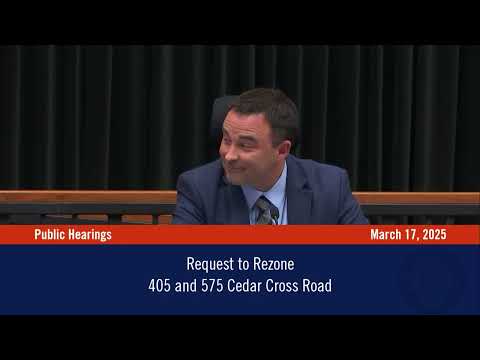
Council approves first reading to rezone 405 and 575 Cedar Cross Road to R4 after debate over traffic and sewer capacity
Summary
After a lengthy public hearing, the Dubuque City Council voted 4-3 on March 17 for a first reading to rezone two properties on Cedar Cross Road from single-family R1 to multifamily R4. Neighbors raised concerns about traffic, stormwater and sewer capacity; city staff said sewer connection could take up to three years.
The Dubuque City Council voted 4-3 on March 17 to give first-reading approval to an ordinance to rezone 405 and 575 Cedar Cross Road from R1 (single-family residential) to R4 (multifamily residential), moving the proposal forward while leaving final passage for a later city council meeting.
The request, filed by Luke and Julie Murfeld of Murfeld Properties LLC, seeks to allow multifamily development on two lots on the city’s south side near Nightingale Lane. Planning staff, neighbors and council members debated traffic, stormwater, and sanitary sewer capacity during a public hearing that drew several residents and prompted detailed questions from council members and city staff.
Planning Services Director Wally Wernmont told the council the request would change the lots’ zoning to R4 and noted that the site is about 2.5 acres and adjoins a mixture of uses including a childcare center, the Arctic Glacier ice plant and commercial properties along Cedar Cross Road. “The request before you tonight is rezone a property on Cedar Cross Road in Nightingale Lane from R1 single family residential to a R4 multifamily residential development,” Wernmont said. He explained the city has water mains on Cedar Cross Road and Nightingale Lane but that sanitary sewer does not yet extend to the site and that sanitary improvements are part of a multi-year capital timeline.
Neighbors urged caution. Mike Reinert, who lives at 401 Cedar Cross Road, told the council rezoning to R4 would “almost surround my property” and warned of traffic, noise and garbage impacts. “R4 allows up to 14 apartments, which again, I don't need 14 apartments to the 1 side of the house,” Reinert said. Kevin Donovan, owner of the nearby ABC Learning childcare property, said his two primary concerns were “traffic and erosion.”
Applicant Luke Merfeld said he and his wife had been marketing the parcels for some time and were seeking to make the land more saleable. “We're just looking to change it from R1 to R4 to maybe get, you know, somebody interested in putting maybe a couple duplexes or something like that there,” Merfeld said.
At the Zoning Advisory Commission the proposal had been recommended for approval by a 4-1 vote; the staff report and commission discussion cited the site’s mixed-use “mosaic” and noted the city’s comprehensive plan encourages infill and a mix of housing types. Wernmont told the council that in an R4 district a single lot could accommodate up to 12 units under the city’s Euclidean zoning rules, though actual unit counts would depend on site plans, setbacks and engineering.
Council members probed infrastructure limits and sequencing. Council Member Sarah Wethal asked about sanitary sewer timing; Wernmont and city staff said a sanitary sewer asset-management study is underway and that, based on current planning and budgeting, a sewer connection to the site could take roughly three years. Staff also said a traffic study would be required if a development proposal exceeds three units and that Callahan’s nearby larger project required a turn lane paid for by that developer. Staff provided trip-generation figures used in reviews: a single-family home is roughly 10 vehicle trips per day and multifamily development averages about 8 vehicle trips per unit per day.
Council debate split along familiar lines. Several members said the city’s development-review process and design review team would vet any formal site plan, traffic mitigation and stormwater controls prior to building permits; others warned that approving a higher zoning classification makes the maximum permitted use more likely to be pursued. After public comment and discussion, a motion to suspend the ordinance-reading requirement initially received four favorable votes and three opposed but was later determined by city staff to fall short of the three-fourths majority required under state law and thus failed. Council then voted 4-3 to approve the ordinance’s first reading; the ordinance will return for future council action for final passage.
What happens next: if the owner or a future developer submits a plan for three or more units the city’s development-review team will require a site plan that addresses parking, fire access, stormwater detention and a traffic analysis. Staff said permits and any public sanitary sewer extension would be subject to state (Iowa DNR) review and city capital funding schedules, which staff estimated could take multiple years to complete.
The public hearing record included written opposition letters from neighborhood residents and several in-person speakers; the city mailed notifications to property owners within 200 feet as required for rezoning requests. The Zoning Advisory Commission chairman is quoted in local coverage saying lot size may limit the realistic density to a few duplexes, but the R4 zoning would allow multifamily options if a developer met site and regulatory requirements.
The council’s first-reading vote moves the rezoning forward but does not change property use yet. Final approval will require a subsequent council vote after the ordinance completes the required readings or a sufficient supermajority vote to suspend those readings in a future meeting.