Get Full Government Meeting Transcripts, Videos, & Alerts Forever!
Get email alerts on the Human Services topic
No spam. Unsubscribe anytime.
Jewish Family & Community Services forms long-term recovery team after hotel sheltering finds dozens of displaced households in Baker County
Summary
Jewish Family & Community Services representatives told the board they found dozens of households living in motels after storms, helped place several families into apartments, provided food and case management, and requested funding to support a local long-term recovery coordinator through June 2026.
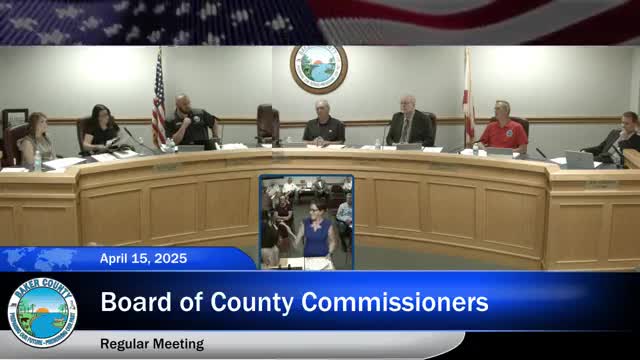
Colleen Rodriguez, CEO of LJD Jewish Family & Community Services (JFCS), told the commission she and partner agencies formed a Baker County long-term recovery committee and have been directly assisting displaced households who were living in motels after storms.
What JFCS found and did - JFCS said it was asked by the sheriff's office to visit hotels in Baker County where residents had been placed through FEMA. In early March teams found 16 households at the Travelodge and three households at the Red Roof Inn; JFCS estimated the total earlier as 18 households and 48 individuals. - By April 10 FEMA hotel assistance had ended for remaining Travelodge residents; JFCS said several households checked out and their whereabouts are unknown. For the 6 households remaining at one visit (22 individuals including two people with disabilities), JFCS arranged moves for two households into new apartments (deposits, rent and moving paid), extended two households' hotel stays under an agreement, moved one household to neighboring Chiefland for work reasons, and worked to place the family with nine children temporarily with relatives while pursuing a stable local placement. - JFCS provided meals, financial assistance and case management. Rodriguez said some residents had not received food for weeks.
Partnerships and funding - Rodriguez said JFCS coordinated with United Way, Red Cross, local churches, and the sheriff's office to help residents, and has applied for more than $350,000 in mental-health and domestic-violence/substance-use funding to serve Baker and surrounding counties. - JFCS said it seeks funding for a one-year local coordinator position (through June 2026) to build local service coordination, stand up a food pantry in donated space, and identify and fill other service gaps; the Red Cross and local recovery groups indicated potential short-term funding for the position.
Why it matters: County staff told commissioners they lacked a single local organization to coordinate long-term recovery for displaced residents; JFCS proposed to fill that role, lead a long-term recovery group and help households transition from temporary FEMA hotel placements to stable housing in Baker County.
Commissioner questions and staff notes Commissioners asked about scope, whether the position would be part of COAD/long-term recovery structure, and how churches and local providers would be integrated. Rodriguez said JFCS will work with United Way and local groups, would not duplicate existing services, and wants to centralize referrals and gap-filling. She said some families were missed by FEMA and had been identified by the hospital and Red Cross.
No formal county funding decision was made; staff said they will coordinate with JFCS and partner agencies and seek short-term funding sources while pursuing longer-term options.