Get Full Government Meeting Transcripts, Videos, & Alerts Forever!
Get email alerts on the Transportation Funding topic
No spam. Unsubscribe anytime.
Baker County holds first hearing on adding local-option fuel tax to fund road work, drainage and pay raises
Summary
Commissioners held a first reading of an ordinance that would allow Baker County to levy an additional local‑option motor fuel tax dedicated to transportation projects. Commissioners and residents debated scope, legal limits and how electric vehicles and impact fees intersect with local funding.
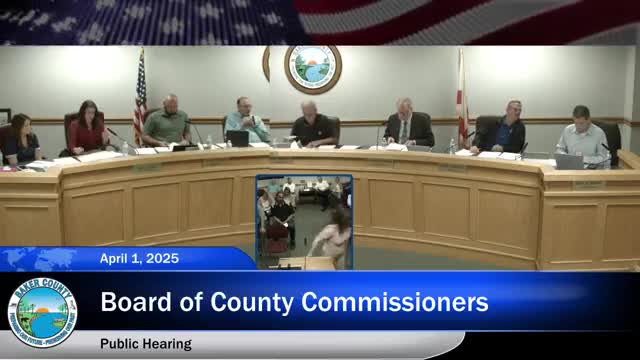
The Baker County Board of County Commissioners held a 6 p.m. public hearing on April 1 for a first reading of an ordinance that would permit the county to collect an additional local‑option motor fuel tax dedicated to transportation improvements.
The proposed ordinance (2025‑05, first reading) would allow the county to add a per‑gallon local option tax beyond the state gas tax; funds would be restricted to transportation uses. County staff and commissioners framed the proposal as a response to rising maintenance and equipment costs for county roads and right‑of‑way upkeep.
Why it matters: Local fuel taxes are a dedicated revenue source for road resurfacing, drainage, rights‑of‑way tree trimming and capital transportation projects — and, depending on statutory language, can sometimes free general fund dollars for other priorities. Commissioners said existing road department staffing and equipment costs have grown and the county’s capital needs outstrip current revenues.
Key discussion points: Commissioner Bennett described the tax as a straightforward, dedicated revenue stream for transportation, drainage improvements and to boost public‑works pay so the county can retain staff. County staff noted the additional local‑option tax is limited by statute to transportation purposes and cannot be diverted to general operations such as fire rescue or parks.
Legal limits and implementation: County attorney Richard Commando (as identified in the hearing) reminded the board the statute prohibits use of the funds for routine road maintenance in some cases and that the county could use the tax for capital projects such as resurfacing or capacity increases. Commissioners discussed using the new tax for capital projects and reallocating existing transportation revenues to support other road needs.
Public comments: Several residents spoke for and against the tax. Residents raised these points: the burden on commuters, the challenge of taxing drivers who work outside the county, the need to account for electric vehicles (EVs) and how EVs will affect road funding, and alternatives such as impact fees. One speaker noted many neighboring counties already collect the tax; another urged caution because it is still a tax on residents.
Next steps: The item is at first reading; commissioners will return to the topic for the second hearing and a possible final vote at a later meeting. County staff also proposed an interlocal agreement (for existing local‑option receipts) and discussed adding language that the additional local‑option revenue remain 100% with the county; commissioners asked staff to extend the length of the interlocal agreement from five years to 10 years and to circulate the revised draft to McClenny and Glen St. Mary for signatures.
Ending: No final decision was made that night — the matter will return for a second public hearing and formal vote. Staff said the Department of Revenue requires interlocal agreements for allocation details before the tax begins to be collected.