Get Full Government Meeting Transcripts, Videos, & Alerts Forever!
Get email alerts on the Counseling Supports topic
No spam. Unsubscribe anytime.
Counseling team unveils centralized supports, Running Start equivalencies and access tools as district shifts to six‑period day
Summary
District counseling specialists described new shared resources — fillable appendices, a Running Start equivalency reference, drop‑in support for counselors and tools to track outside credits — intended to help students navigate the six‑period schedule and graduation pathways.
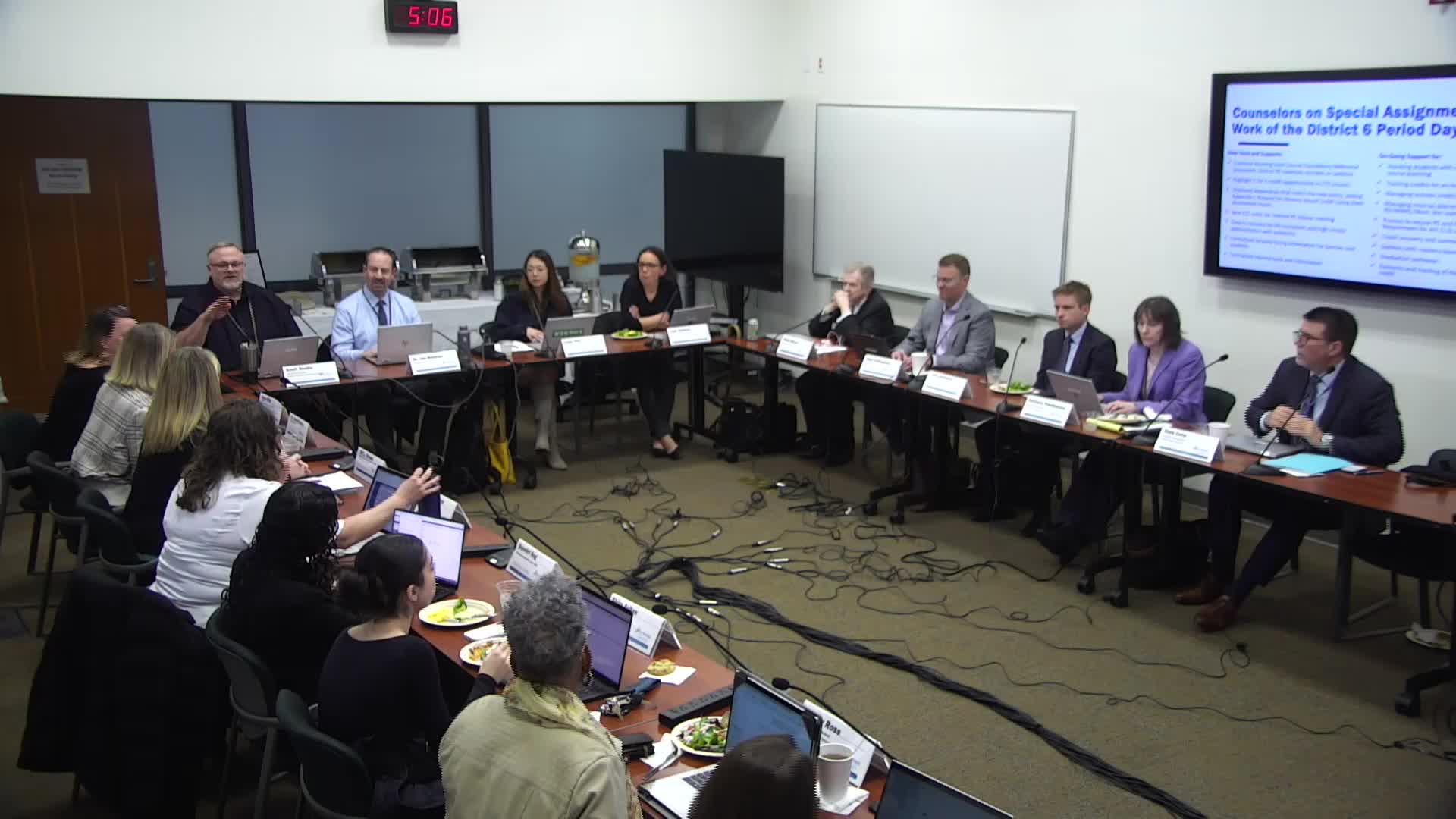
Counseling specialists told the Lake Washington School Board on March 24 that the district has created centralized resources and supports to help counselors, students and families navigate a shift to a six‑period high school day and associated credit changes.
"One of the biggest things we're really proud of is common running start course equivalency reference document," Lise Christiansen said, describing a document meant to remove confusion about which college courses count for district credit.
Presenters said the counseling team built a set of public appendices (A–I) to replace inconsistent building‑level guidance; converted many forms to fillable PDFs; and prepared a video walkthrough for families and students explaining Running Start enrollment, access to funding for books and materials, and other outside‑credit options. Staff said Appendix E specifically addresses excusal or waiver of physical education and that teams have vetted those forms districtwide because community feedback showed variation in how the PE excusal was applied at different schools.
The team also described supports for counselors to manage outside credits and credit recovery: drop‑in help sessions, calibration meetings with partners (including Running Start partners and worksite learning organizations), and a credit‑tracking tool to help counselors reconcile external credits. Presenters said that, so far, the district has identified 112 students who could benefit from mastery‑based credit — credit awarded when students earn qualifying standardized scores (for example a score of 3 or higher on some ELA, math or science measures) that can offset failed coursework.
Staff emphasized that not all outside credits automatically transfer to college degree requirements and advised that students discuss post‑secondary plans with their counselor: "the counselor will have to meet with that individual student to talk about their post high school plan," a presenter said.
Counseling staff told the board they are continuing drop‑in and formal site‑based sessions for counselors and administrators, and that they plan to provide district‑level support in the five most common languages to improve access. They also intend to attach students’ four‑year plans to requests for out‑of‑district credit so that decisions are made in the context of longer‑range plans rather than as one‑off requests.
Board members praised the Running Start equivalency document and asked about access to summer Running Start and how college systems complicate enrollment. Counselors said the statewide form has improved and that staff are working on an FTE calculator and tiered approaches to make Running Start easier for families to use.