Get Full Government Meeting Transcripts, Videos, & Alerts Forever!
Get email alerts on the Schedule Change topic
No spam. Unsubscribe anytime.
Lake Washington leaders outline implementation plan for six‑period high school day starting 2025–26
Summary
District staff described the new six‑period schedule’s weekly pattern, why it was chosen, steps for evaluating its effects and how saved staffing costs will be reinvested. Officials said the schedule adds instructional hours and creates built‑in time for intervention, but acknowledged scheduling tradeoffs for staff and families.
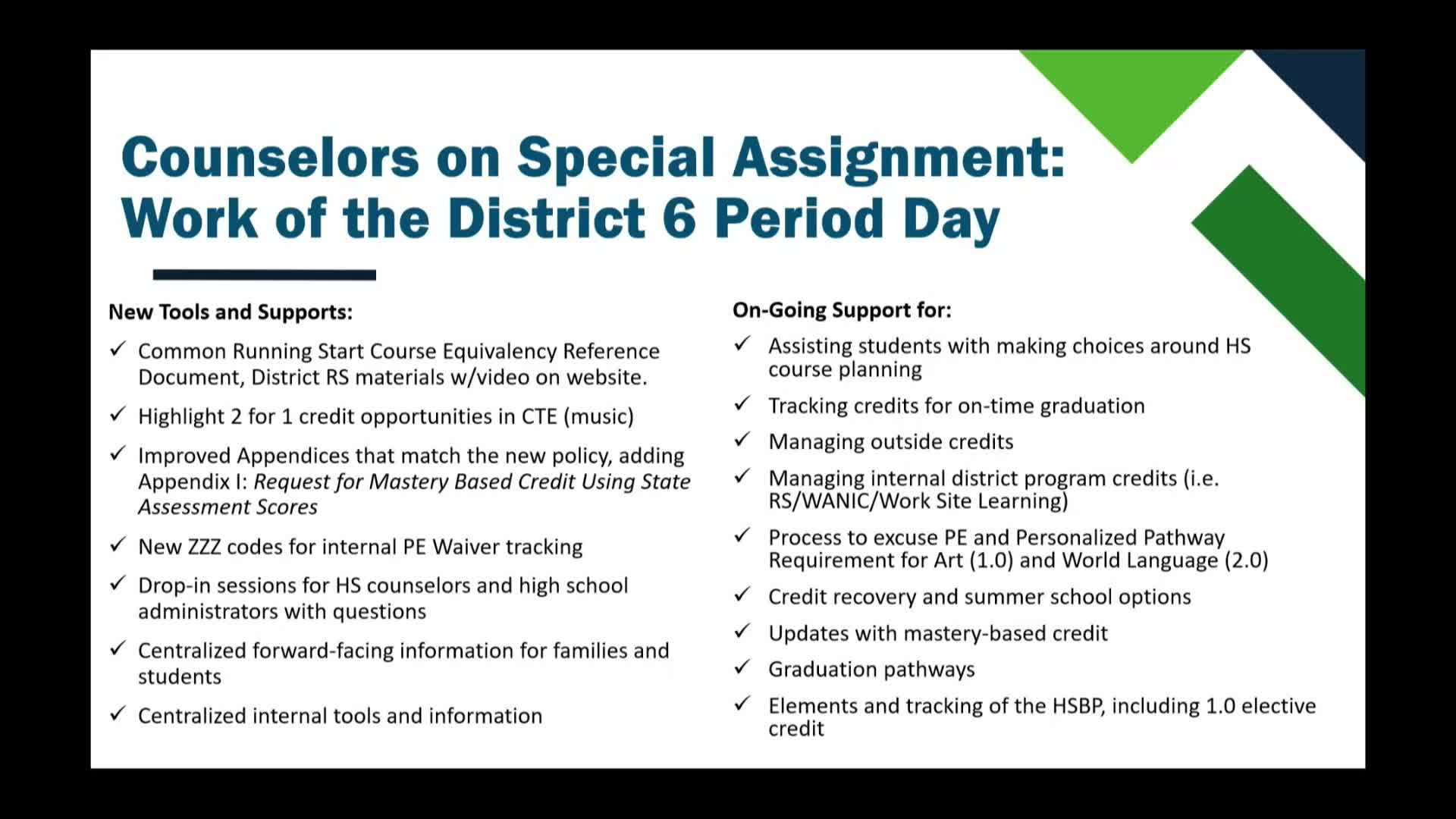
Lake Washington School District staff told the school board at a March 24 study session that the district will move to a six‑period high school day for the 2025–26 school year and described how the new weekly pattern will work, why it was chosen and how the district plans to measure effects.
“The problem really is at the beginning of the year,” Dr. Holman said as staff reviewed calendar and master‑schedule consequences. “This is our schedule. This is what we're moving forward with… Or we can focus on building the new.”
District leaders said the new schedule allocates two longer block periods (about 80 minutes each) and two shorter periods (about 48 minutes), plus one “floating” 45‑minute period that may appear in different places in a class’s weekly sequence. Officials said the design aims to protect block time so classes are not scheduled on consecutive days and to build predictable time during the school day for intervention, reteaching and extended work by teachers and students.
Staff emphasized that the change is not merely a reduction in the number of periods. The district said the new schedule increases average instruction time per course from about 135 hours to about 150 hours — roughly 15 extra hours per class — and is intended to reduce the need for after‑school remediation and to provide teacher teams with more opportunity to design lessons that use longer blocks productively.
Officials acknowledged tradeoffs. The district described early conflicts with external partners that run different schedules — most notably career and college partners whose start or end times differ — and noted the district deliberately kept later high‑school start times rather than prioritize full alignment with external partners’ schedules. Staff also said the placement of the floating period created sequencing concerns for some students and staff; the district adjusted the technical sequence to make periods follow a consistent numeric order after receiving feedback.
District staff described a framework for reinvesting savings from the change. They said the seven‑period day had cost about $9,000,000 in the recent year and required roughly 61 additional FTE; when the district moved away from the seventh period it planned to recoup about half of that cost and reinvest the other half back into schools. Guidance to principals asks them to prioritize reinvestment in three tiers: 1) classes directly tied to graduation or barriers to graduation (for example required world language or arts classes), 2) district priorities driven by data — for instance reducing Algebra or English 9 class sizes — and 3) innovative programs or pilot offerings such as specialized academies.
The district said it will evaluate effects through a representative committee that will collect quantitative data (course‑taking patterns, grades, graduation on‑time indicators) and qualitative feedback from students, staff and families. Dr. Holman told the board the review will likely run through next school year and inform any future adjustments.
Board members asked about teacher workload and professional learning. Staff said they will provide training on teaching in block schedules, cross‑building teacher collaboration, and one‑time supports where schedule changes require redoing existing Individualized Education Program (IEP) service matrices.
The presentation framed the change as a “continuous improvement” effort: staff asked the board to allow time for teachers to adapt lesson design and for the district to track outcomes before considering further changes.
Looking ahead, staff urged principals and building teams to use the district reinvestment guidance to shape master schedules and to involve staff in building decisions so individual educators do not feel they must lobby for positions or programs.