
District leaders report rollout progress on early literacy and math curricula; urge patience and transparency on measures
Get AI-powered insights, summaries, and transcripts
Subscribe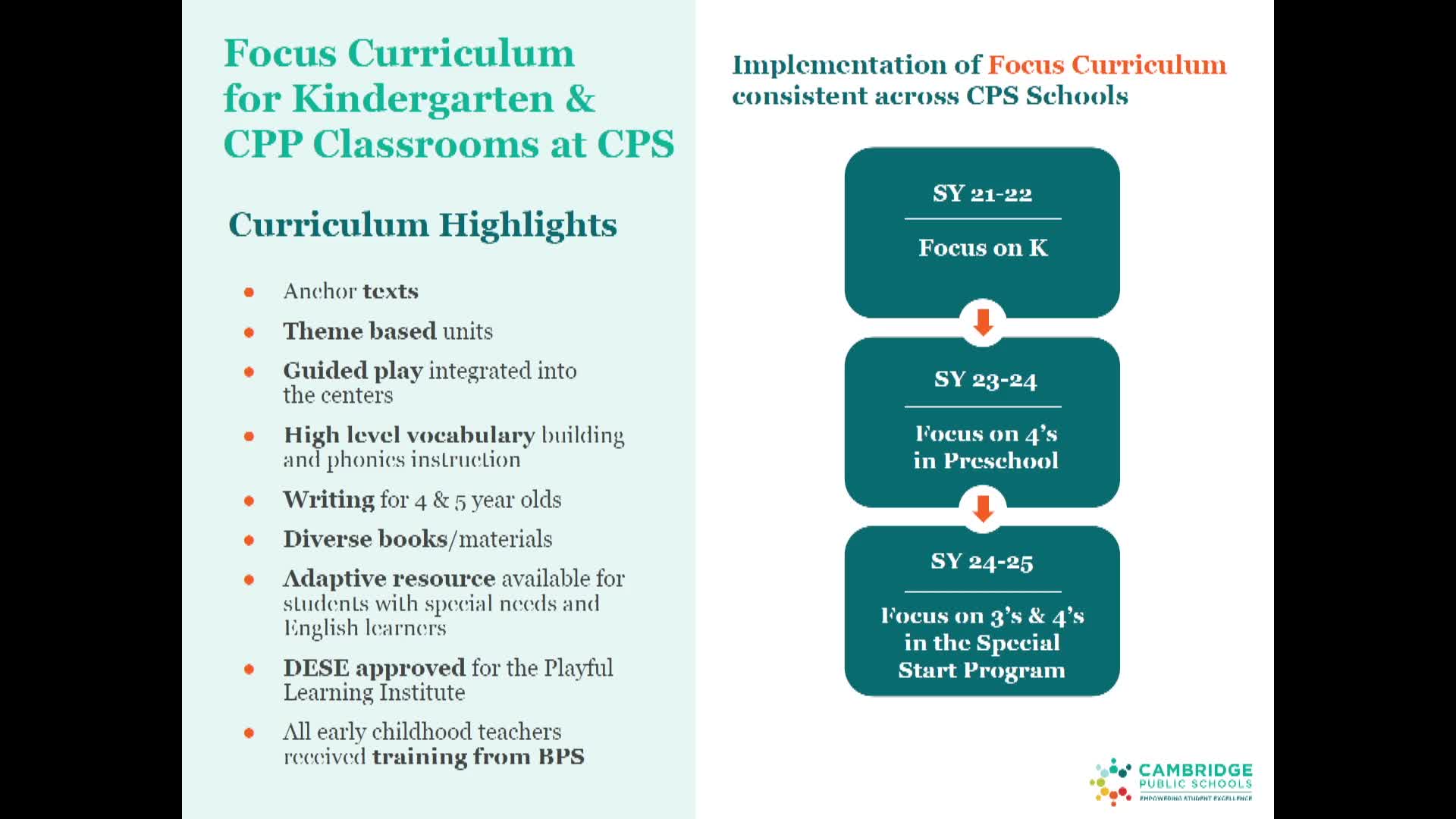
Summary
Cambridge officials described progress implementing Focus on K (pre-K–K), CKLA (grades 1–5) and Illustrative Mathematics, highlighted professional development for teachers, and flagged differences between universal screeners and MCAS results.
District instructional leaders on April 15 updated the School Committee on multi-year rollouts of new curricula and their early results, outlining steps the administration is taking to build teacher capacity and to track student growth.
Assistant Superintendent Michelle Madera and Executive Director Heather Francis briefed the committee on the early-childhood literacy program Focus on K, the K–5 literacy curriculum CKLA, and Illustrative Mathematics. The presenters said the work includes teacher professional learning, school-based coaching, learning labs, and adaptation for multilingual learners and special education settings.
Key takeaways
- Focus on K: Dr. Madera said Focus on K (developed with Boston Public Schools experts) has expanded into preschool and 3-year-old Special Start programs and stresses intentionally structured play, academic vocabulary and diverse anchor texts. She said recent iReady screening data show roughly 73 percent of current third graders reading on grade level on the district screener.
- CKLA (grades 1–5): Dr. Francis said the literacy team is in the first year of districtwide implementation and is collecting student and educator feedback. She said universal screener growth targets are being met across student groups, though not all students are yet on grade level.
- Illustrative Mathematics: The math rollout is in year two in most schools. The department emphasized professional learning via learning labs, coaching, and use of end-of-unit assessments and online tools to monitor growth and target instruction.
On assessments: Several committee members asked why district universal screener results (iReady) outpace MCAS scores. District leaders said the two measures are different types of assessments—iReady is an adaptive periodic screener that measures growth in-year while MCAS is a summative, uniform state assessment—and both data streams matter. Leaders agreed to provide disaggregated data by subgroup.
Why it matters: Committee members and administrators said aligned curricula and consistent professional learning are central to sustaining improvements. The discussion tied curriculum implementation to earlier committee concerns about third-grade reading and long-term accountability.
Next steps: The administration will provide disaggregated screener results to the committee, continue summer planning for year-two implementation, and schedule classroom visits for members who requested them.