Get Full Government Meeting Transcripts, Videos, & Alerts Forever!
Get email alerts on the Graduation Standards topic
No spam. Unsubscribe anytime.
After MCAS requirement ends, Cambridge plans short-term coursework route for grads and will await state council for long-term standards
Summary
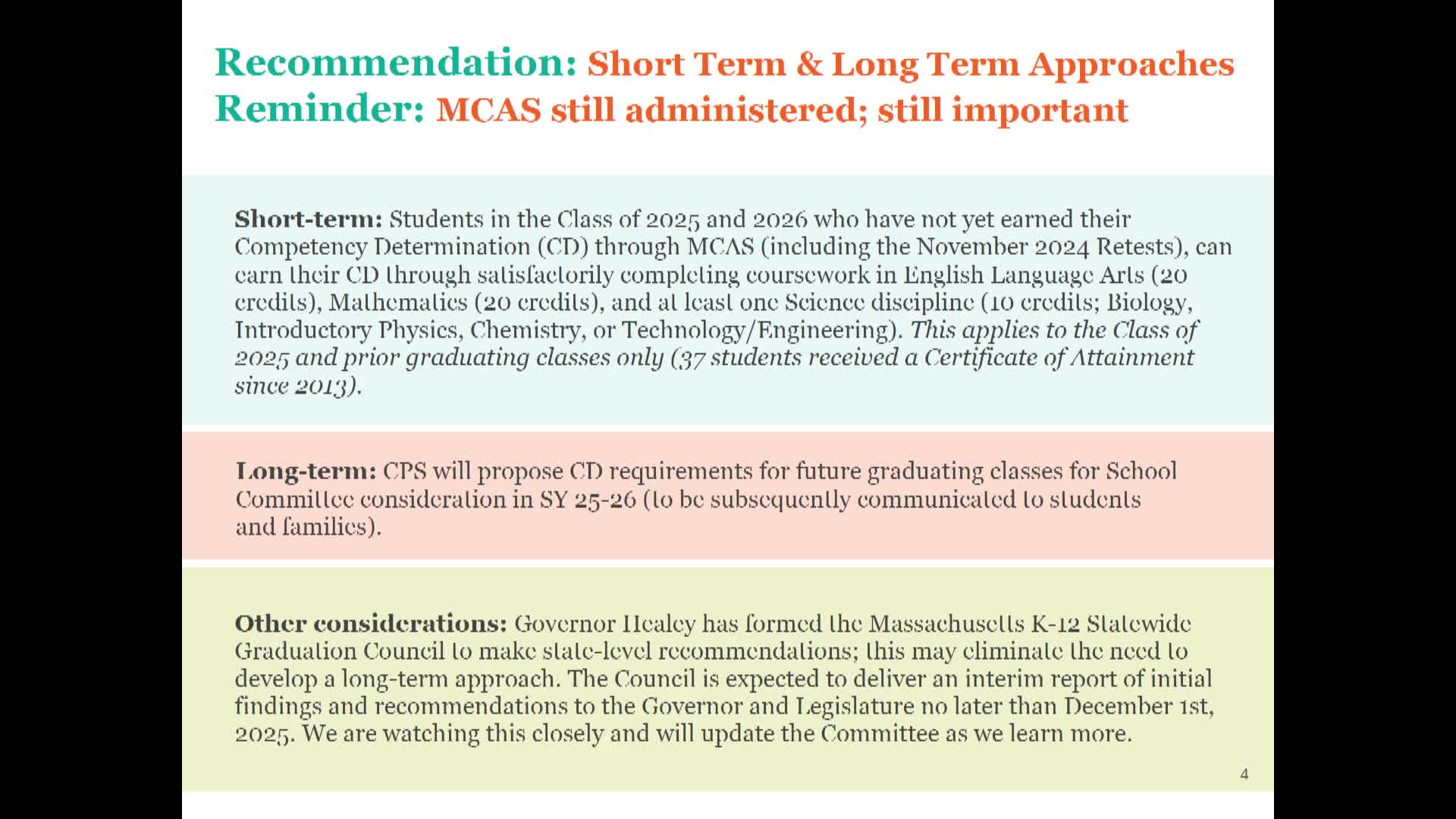
Cambridge officials proposed using satisfactory completion of specified coursework for the classes of 2025–2026 who lack MCAS scores and said the district will monitor the governor's statewide council before finalizing long-term competency standards.
Cambridge Public Schools staff on April 15 outlined a two-part response to the state’s removal of the MCAS graduation requirement: a short-term local path using course completion and a longer-term review that will align with forthcoming state guidance.
Chief Accountability Officer Chad Leith told the School Committee that, for the classes of 2025 and 2026, the district proposes awarding the competency determination to students who have satisfactorily completed specified coursework in English language arts (20 credits), mathematics (20 credits) and at least one science discipline (10 credits).
Leith said the approach mirrors actions taken by other local districts and is intended to provide an immediate path to a diploma for students who previously might have relied on MCAS scores. He added the law is retroactive and the district is reviewing earlier students’ records (going back to 2013) to identify any students eligible for diplomas now.
Why it matters: The state ballot change that eliminated MCAS as a graduation requirement requires school districts to certify competency another way. Cambridge officials said they must balance setting rigorous local standards and following any guidance produced by the governor’s Massachusetts K-12 statewide graduation council.
Short-term proposal and next steps
- For the immediate cohorts (class of 2025 and 2026), the administration proposed relying on satisfactory completion of designated coursework in ELA, math and science—alongside existing credit requirements—to certify competency.
- The superintendent and accountability staff said they will return to the committee with formal language at the next meeting so the district can finalize a local policy before this year’s graduations.
Long-term approach
The district is watching the state-level council the governor convened; that panel is expected to provide recommendations that could shape or replace a locally developed long-term competency determination. Committee members asked that any new standards align with college readiness and postsecondary expectations, and recommended involving students, families and guidance staff in the design.
Documentation and accountability
Dr. Leith and director-level staff said they are compiling data on college matriculation, remediation and completion rates to inform any revised graduation competency framework and pledged to keep the committee updated.
Speakers quoted in this article include staff who presented the competency plan and committee members who asked for timelines and clarity. Direct quotes and attributions were taken from the April 15 public meeting transcript.