Get Full Government Meeting Transcripts, Videos, & Alerts Forever!
Get email alerts on the Downtown Development topic
No spam. Unsubscribe anytime.
Iowa City weighs three development proposals for 21 South Lynn Street; staff recommends two for presentations
Summary
City staff presented three proposals for the city-owned 21 South Lynn Street site and recommended allowing public presentations by two teams. Councilors discussed affordability, tax-increment financing and next steps; they agreed to hear all three teams at a future work session.
City Manager: “I am really excited to be moving this project into the next phase,” said the City Manager as the council opened discussion of development proposals for 21 South Lynn Street in downtown Iowa City.
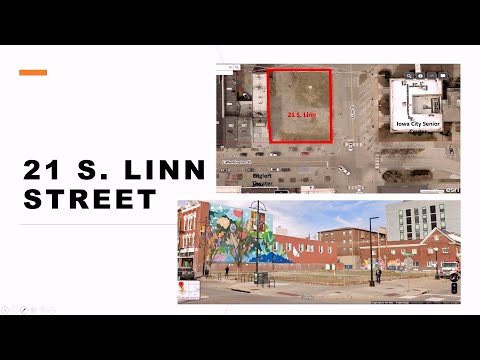
City staff presented a high-level summary of three responses to the city’s September 2024 request for proposals (RFP) for the site the city purchased in August 2023. Staff recommended that two teams — identified in the staff memo as the Grand Rail proposal and the Iceberg proposal — be invited to present publicly next, while noting a third submittal from Salida Partners was “inspiring” but not, in staff’s view, financially viable without substantial subsidy.
The recommendations matter because the city bought the property to steer redevelopment toward uses staff and the council consider beneficial to downtown’s long-term health. The city manager said the city paid about $4.5 million for the site and that the RFP asked for buildings that generate annual property tax revenue, activate the street level with retail or entertainment uses, and include a mix of housing types and construction standards that align with council priorities on climate action.
At a glance, the three proposals differ in height, mix of uses and subsidy requests. Staff’s summary and the proposals in the packet show: - Grand Rail (with partners listed in the packet including Urban Acres and OPM) proposes a mid-rise, six-story building with steel-frame construction targeting LEED Silver; about 6,300 square feet of ground-floor entertainment space (letters of interest from the Englert Theatre and the Stories Project were included), three floors of commercial office, and 20 residential units (16 market-rate, 4 affordable). Staff estimated the project valuation at about $21.5 million; the team offered $3.0 million to purchase the lot and is not requesting TIF at present but signaled that tenant-level subsidies could require TIF assistance. - Iceberg (team includes Hodge Construction Group and others) proposed a taller, 13-story concrete-and-steel building with roughly 3,800 square feet of restaurant/entertainment space, micro-retail on Lynn Street, up to five floors of office and seven floors of residential that would include about 76 affordable senior rental units using Low Income Housing Tax Credits (LIHTC). The Iceberg pro forma is based on the 4% LIHTC; staff said that structure typically carries long affordability periods (30 years) but that a 4% award has backlog and a 9% competitive award (more valuable) likely could not be pursued in time for this project’s schedule. Iceberg proposed a $2.0 million lot purchase and indicated a need for $7–$10 million in tax-increment financing (TIF); staff estimated TIF payback at that valuation could take roughly 8–12 years. - Salida Partners (partners include Shive Hattery; Skydeck Capital appears in the packet) submitted the most detailed street‑level program, including about 6,900 square feet of flexible entertainment and micro‑kitchen space, an art alley, a multi‑story Stories Project footprint and a two‑story performance venue tied to the Englert. Salida’s scheme included a large mix of uses (26 market-rate residential units, 6 affordable units, 14 short‑term stay units, offices and program space) and proposed a $1 land transfer. Staff estimated the total valuation near $37 million but concluded Salida’s pro forma relied on full TIF capture for many years and still left a remaining funding gap (staff cited an estimated additional $1 million in one scenario and up to about $5 million when subsidizing prioritized tenants).
Council members focused discussion on affordability durations tied to LIHTC and to any conditional public subsidy, the city’s goals for ground-floor activation, how long TIF commitments might run, and whether teams should be allowed to present revised concepts. The City Manager said the RFP and subsequent work gave proposers flexibility and that projects will continue to evolve through design and financing; he warned that fundamental changes from what was proposed could require fresh evaluation.
After discussion, Council did not select a preferred developer or approve subsidies. Staff recommended moving ahead with public presentations from Grand Rail and Iceberg. Multiple council members, noting the public nature of the process and the work each team had done, said they would like to hear from all three teams in the same forum to allow side‑by‑side comparison and public review. Council asked staff to schedule presentations at a future work session, with consistent time for each team (staff proposed about 20 minutes to present plus roughly 10 minutes for council questions).
Next steps: staff will reach out to proposers about times and availability for work‑session presentations, and council will hear the teams and then decide whether to identify a preferred concept to move into more detailed negotiation and design. No final agreement, TIF award or land sale was approved at this meeting.