Get Full Government Meeting Transcripts, Videos, & Alerts Forever!
Get email alerts on the K 12 Education topic
No spam. Unsubscribe anytime.
Park County superintendent outlines duties, warns new open‑enrollment rule will increase local tax burdens
Summary
At an April 14 work session, Park County Superintendent of Schools Lisa described her statutory and practical duties, described staffing and finance pressures in rural districts, warned that a new open‑enrollment law will create permissive levies that raise property taxes, and said the STARS Act could help teacher recruitment.
Park County Superintendent of Schools Lisa told the Park County Board of Commissioners Monday that her office carries mandated responsibilities for district finance, transportation, records, licensing and certain personnel actions, and she warned that recent state changes to open‑enrollment rules will shift costs to local taxpayers and complicate levy votes.
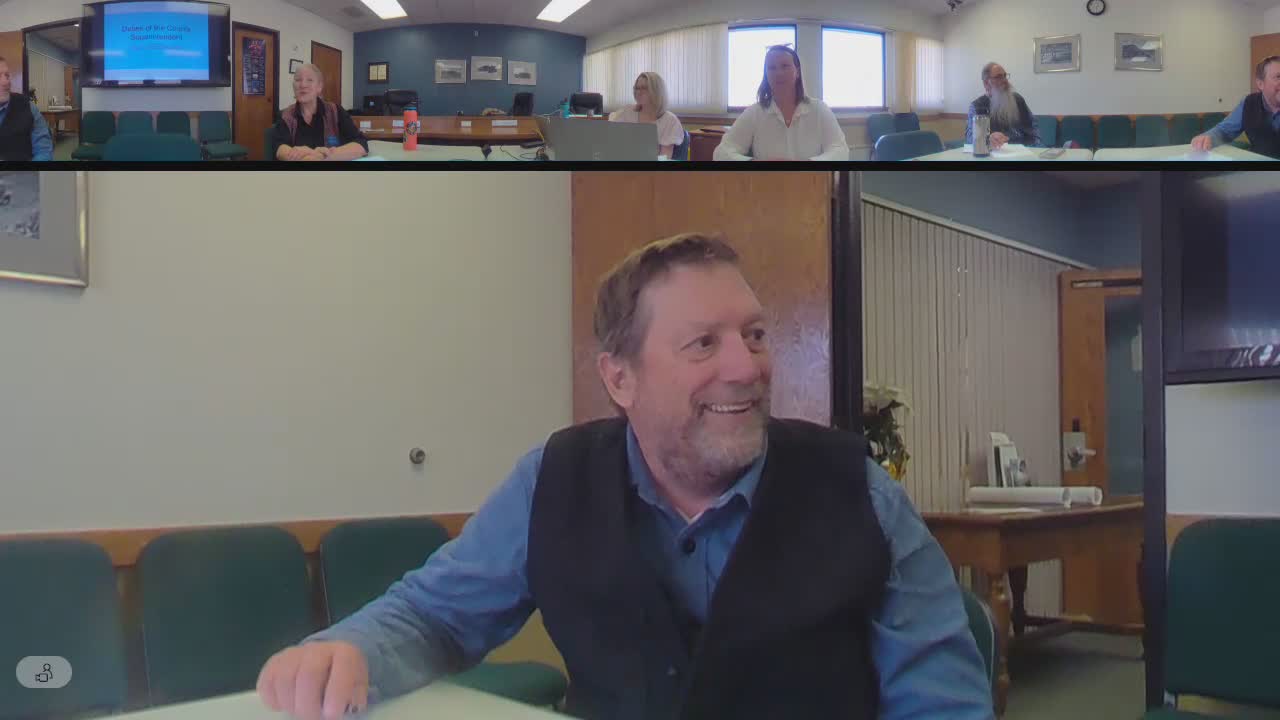
The work session, held April 14, 2025, was intended to orient the three county commissioners to the county superintendent’s scope of work and to explain operational pressures facing small rural schools across the county, including Cooke City, Arrowhead, Shields Valley, Gardner, Pine Creek and Livingston Schools.
Lisa said the county superintendent position in Park County is formally half time but often requires substantially more work. She described routine duties that include certifying district finance reports to the Montana Office of Public Instruction (OPI), producing a monthly apportionment calculation for each district, maintaining records (including long‑term student records for closed schools), certifying TR forms used for student transportation, and administering teacher and trustee oaths of office. “Each district in our county… all their business officers, their clerks, send me those that I check over, go through OPI, make sure everything’s there,” she said.
Nut graf: The superintendent framed these administrative duties against the day‑to‑day realities of rural schools — small class sizes, difficulty recruiting teachers, limited local administrative capacity and the fiscal effects of a new open‑enrollment rule that, she said, will require districts to levy property taxes to cover tuition obligations rather than charging tuition directly.
Lisa said the state’s recent open‑enrollment changes mean districts must invoice sending districts for students who enroll out of district, and that the receiving district’s net loss can be significant. She cited Arrowhead as an example and said the district’s net loss under the new rule is “about $27,000” (noted by Lisa as an estimate). “The more kids you can pack into a school, the less it costs per student,” she said, adding that the new law shifts that tuition burden onto property taxpayers through permissive levies. “It’s just a shame, because taxpayers are going to think, ‘oh, the school’s charging me all this money. Well, thank your legislators,’” Lisa said.
Lisa urged commissioners to be aware of the local impact and to consider school support when communicating with constituents. She identified the STARS Act — a state proposal to raise beginning teacher pay that she said appears likely to pass — as a major potential aid for rural districts’ teacher recruitment. “If the STARS Act passes… it would raise beginning teacher pay,” she said, which would help districts compete for new teachers.
On staffing, Lisa described the frequent use of emergency‑authorized employees in Montana’s rural schools and the superintendent’s role in maintaining their certification paperwork and checklists on OPI’s site. She noted that some emergency‑authorized hires have performed strongly while working toward certification.
Lisa discussed district‑level differences in administration: some small districts employ a principal who also serves as superintendent part time, while others (Cooke City, Arrowhead in recent years) rely on the county superintendent for supervision and evaluations when a certified administrator is not on site. She said Cooke City’s long‑term student records and some records from closed districts (e.g., Springdale) are kept in the county superintendent’s locked file cabinets.
The superintendent described countywide responsibilities that reach beyond direct school oversight, including running a countywide spelling bee, serving as the county’s authorized representative for certain OPI grants and federal grants for small districts, maintaining the county education web pages and coordinating the annual transportation meeting with GIS and district transportation directors.
Lisa also addressed homeschooling and nonpublic schools. She said Park County maintains records of intent to homeschool and annual attendance reports; the county currently lists about 450 students designated as nonpublic (a figure Lisa said is high compared with years before the COVID pandemic). She noted that private and religious schools in the county report enrollment and that tracking across multiple providers can complicate county‑level counts.
On teacher housing and recruitment, Lisa said local efforts vary by district. Shields Valley and Gardner already offer some teacher housing units; Arrowhead has discussed using a double‑wide unit and exploring a partnership with the Human Resource Development Council (HRDC) to create housing for teachers that could be rented to other qualified tenants if local need declines. She said such housing plans, if they require county approval, would eventually be brought to the Board of County Commissioners.
Commissioners asked about graduation class sizes and population trends; Lisa said graduating classes in smaller districts were often under 50 students and that K‑8 enrollments have declined in some areas while other districts have seen modest rebounds. She cautioned that overall county population growth has not consistently resulted in larger K‑12 enrollments.
Several statutory and program references were raised in the session: Montana statute 20‑3‑207 (discussed in the context of duties when a district lacks a certified principal or superintendent), the Office of Public Instruction (OPI) reporting and certification requirements, the McKinney‑Vento homeless liaison duties, federal ESSER reporting obligations, and state proposals including the STARS Act. Lisa also referenced the Montana Small Schools Alliance as a source of training and support for rural districts.
Ending: Lisa said she will notify the commissioners when the districts need specific assistance and that she will pursue teacher‑housing conversations with HRDC and local districts. Commissioners thanked her for the overview and for answering questions on finance, staffing and county support.