Get Full Government Meeting Transcripts, Videos, & Alerts Forever!
Get email alerts on the Transportation Infrastructure topic
No spam. Unsubscribe anytime.
MDOT outlines road project planning, low-bid contracting, warranties and new tech in presentation to appropriations subcommittee
Summary
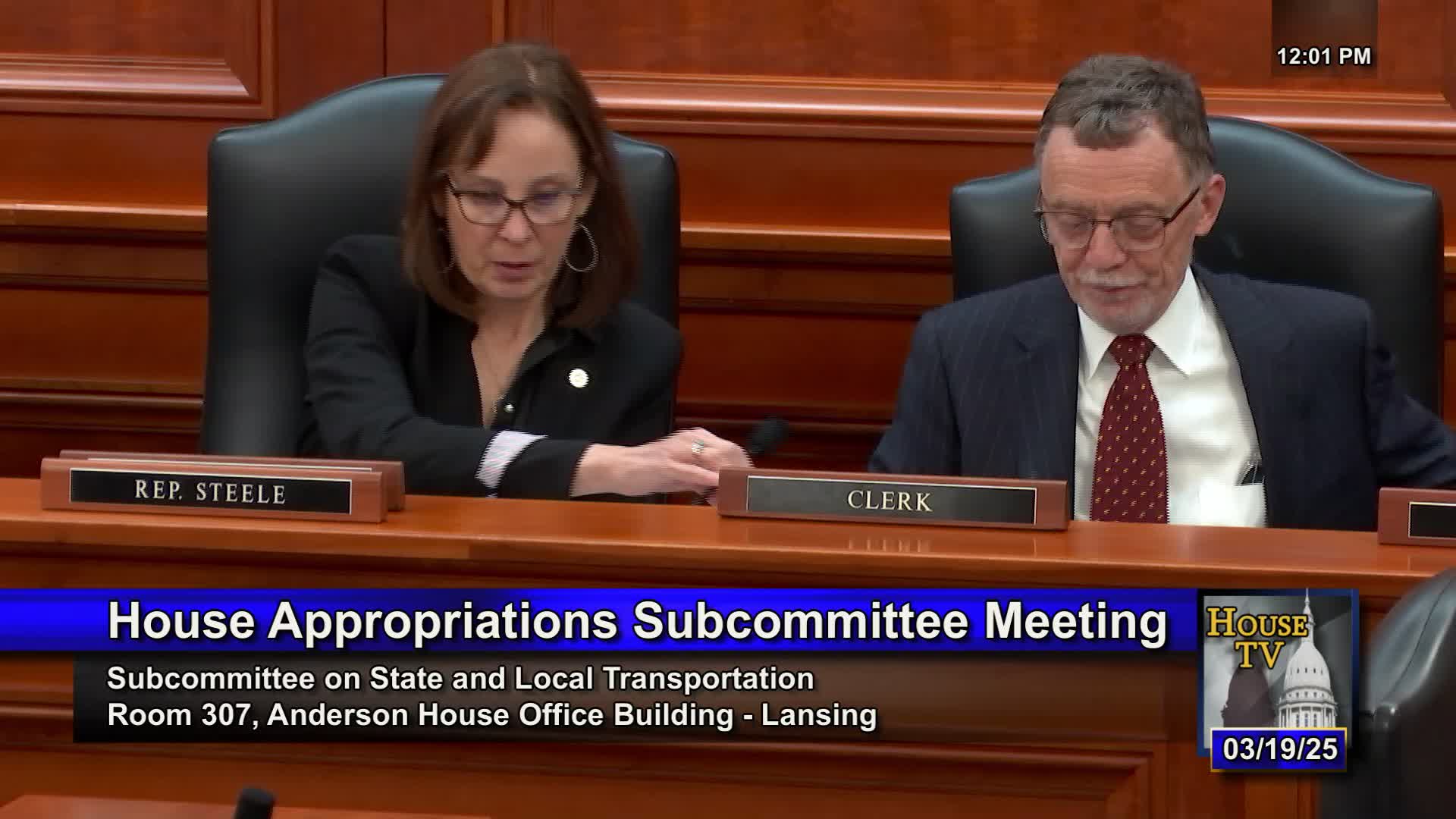
The Appropriations Subcommittee on State and Local Transportation heard a roughly 45-minute briefing from the Michigan Department of Transportation on MDOT’s project lifecycle, contracting practices, funding sources, maintenance model and technology pilots.
The Appropriations Subcommittee on State and Local Transportation heard a roughly 45-minute briefing from the Michigan Department of Transportation on MDOT’s project lifecycle, contracting practices, funding sources, maintenance model and technology pilots.
Greg Bruner, MDOT’s chief operations officer and chief engineer, told the panel that MDOT’s work spans about 10,000 miles of state routes and roughly 4,800 bridges and that the department manages planning, design, construction oversight and post-construction warranty and maintenance work. “I’m Greg Bruner, MDOT’s chief operations officer,” he said as he opened the presentation and review of MDOT’s procedures.
Why it matters: MDOT manages a large portion of the state’s commercial and passenger traffic and administers plans and contracts for projects funded by the Michigan Transportation Fund and federal aid. The subcommittee sought the briefing to understand how projects are scoped, procured and overseen and how the department coordinates with local governments.
What MDOT described: Bruner said MDOT is organized into five bureaus (finance, planning, field services, bridges and structures, and development) and seven regions with 23 transportation service centers. He described the department’s five-step project lifecycle—scoping, design, advertisement, award and construction oversight—and said MDOT advertises most projects for 3–6 weeks and awards by low bid, with bids broken into pay items (for example, dollars per ton of asphalt or per unit of curb) so the department can compare like items across bidders.
On low-bid contracting: Bruner said low-bid contracting is the standard for about 95% of MDOT work because federal rules require a low-bid process for most construction contracts. He described safeguards MDOT uses to protect quality under low-bid procurement: detailed pay-item specifications, contractor prequalification, unbalanced-bid reviews that compare bid pay-item rates to engineer estimates, and in‑field inspection and testing during construction. “We set what those specifications are,” Bruner said, “and if they don’t meet the specifications, we’ll have them rip it out and kind of rebuild it there.” He added that MDOT uses quality-based selection for certain “innovative” or design‑build projects.
Funding and scale: Bruner said the Michigan Transportation Fund (MTF) provides about $3.8 billion a year in state road-user revenues (primarily vehicle registration and fuel taxes, with some recent additions such as portions of income and marijuana tax revenues), supplemented by federal aid. He said roughly 55% of MTF funds go to local and county roads and the remainder to MDOT-owned routes; by law, about 75% of federal aid goes to MDOT while 25% goes to local roads, he said.
Pavement choices and asset management: MDOT uses a life-cycle cost analysis for major pavement decisions on projects with pavement costs exceeding $1.5 million; where alternatives are within 10% of each other, the agency seeks alternate bids for asphalt and concrete. Bruner described MDOT’s capital preventive maintenance (CPM) approach—targeted, earlier fixes such as thin overlays and crack sealing intended to extend pavement life rather than a “worst-first” reconstruction approach.
Warranties and performance: Bruner said Public Act 175 of 2015 governs MDOT’s warranty practices (the law updated MDOT warranty rules) and that the department has placed about 5,000 warranties to date, with roughly 600 active and approximately 12% of warranties requiring corrective action. He described two common warranty types: materials-and-workmanship warranties (typically used on reconstruction projects and often 3–5 years) and shorter performance warranties (commonly 2–3 years) used for preventive maintenance or bridge painting.
Permitting and environmental coordination: Bruner identified the State Historic Preservation Office (SHPO) and the Department of Environment, Great Lakes, and Energy (EGLE) as primary permitting partners for cultural‑resource and environmental reviews. He said MDOT engages with those agencies early in design to set construction schedules around constraints such as fish spawning or bird nesting seasons; he characterized substantial scheduling stoppages for those reasons as uncommon but possible in specific projects.
Maintenance delivery and local partners: MDOT described a hybrid maintenance model in which counties perform maintenance on many state routes under contract and MDOT maintains some corridors directly from its garages. Bruner said about one-third of state routes are maintained from MDOT garages and the remainder are handled under county contracts or mixed arrangements, and he urged early coordination so local utilities can plan for utility replacements to avoid repeated cuts in newly reconstructed pavements.
Innovation and technology pilots: Bruner described MDOT’s e‑Construction initiative (electronic plans and paperless processes), intelligent-transportation-system pilots and smart work-zone technologies. He cited pilots for in-vehicle alerts from construction, a three-mile pilot for managed lanes and a wrong‑way driver alert pilot in Metro Detroit. He also referenced work with industry groups such as the Michigan Infrastructure and Transportation Association and national ITS organizations.
Questions from members focused on how low-bid contracting preserves quality, how often SHPO/EGLE require schedule changes, whether local agencies are adequately compensated for maintenance, the Mound Road pilot’s technology and how MDOT selects asset-management priorities. Bruner said MDOT sets region-level targets informed by a central asset-management function and aims to coordinate early with local governments to reduce redundant work.
Votes at a glance: Representative Robinson moved to adopt the minutes of the committee’s March 5 meeting; the motion prevailed by unanimous consent (no recorded roll-call vote), and the minutes were adopted.
What the presentation did not decide: The committee received information and asked questions; there were no committee directives, budget decisions or bill votes recorded in the transcript beyond adopting the minutes.
For further reading: Bruner said MDOT publishes an annual five-year program of projects and a yearly legislative report on pavement demonstration projects; the subcommittee requested MDOT return for additional briefings on specific topics.