Get Full Government Meeting Transcripts, Videos, & Alerts Forever!
Get email alerts on the Local Road Funding topic
No spam. Unsubscribe anytime.
Subcommittee hears counties, cities say local road and bridge funding falls short as federal mandate raises costs
Summary
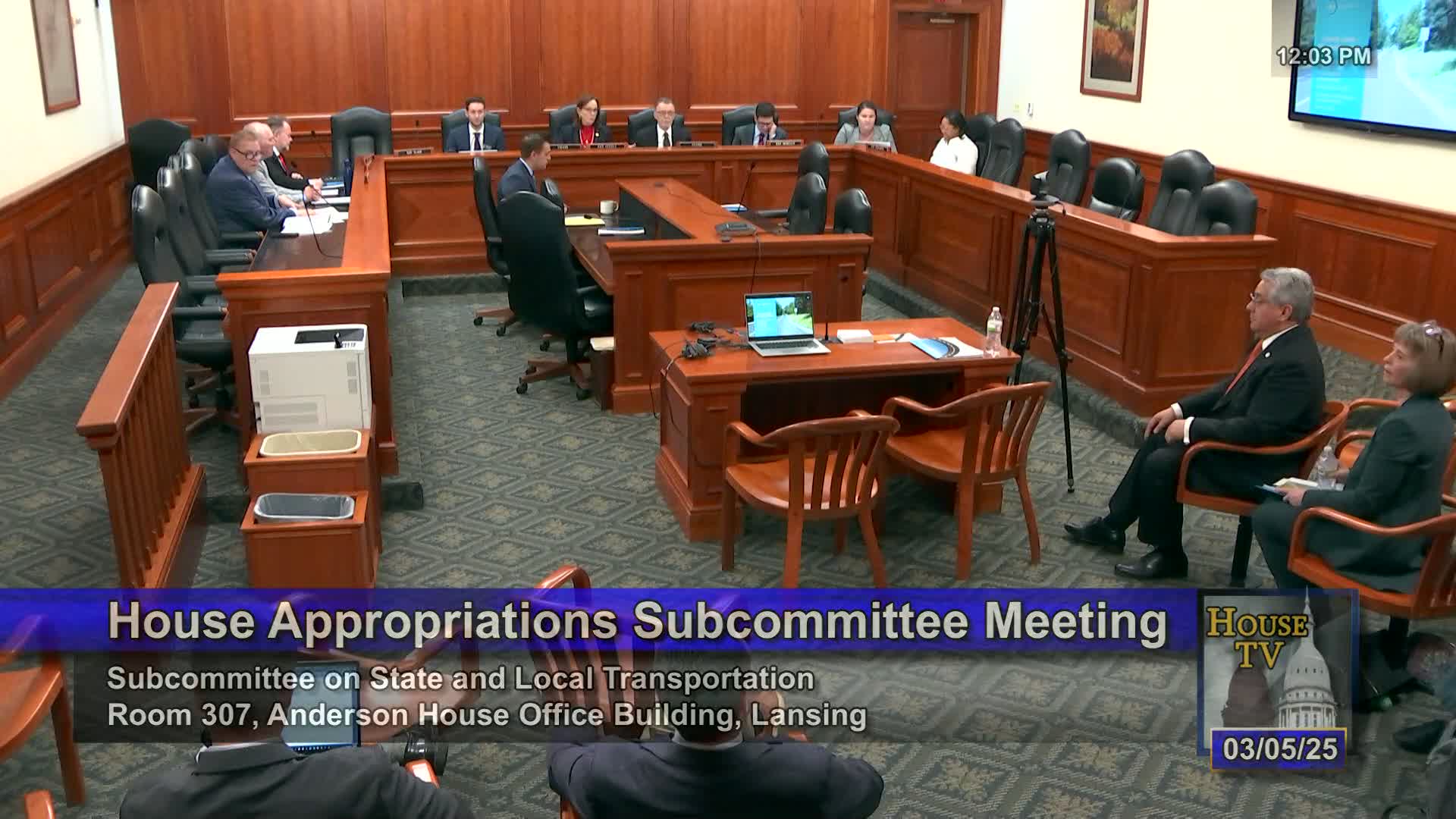
At a meeting of the Appropriations - Transportation subcommittee on state and local transportation, representatives from the County Road Association and the Michigan Municipal League told lawmakers that local roads and bridges face growing maintenance backlogs and new federally driven data and engineering requirements that will increase costs for counties and municipalities.
At a meeting of the Appropriations - Transportation subcommittee on state and local transportation, representatives from the County Road Association and the Michigan Municipal League told lawmakers that local roads and bridges face growing maintenance backlogs and new federally driven data and engineering requirements that will increase costs for counties and municipalities.
The testimony outlined the size of the local system, the main funding streams that support it, and a multi-year shortfall to meet both maintenance and federal reporting mandates — with presenters asking the Legislature to consider targeted state funding to help local governments meet the new workload.
Ed Noyola, representing the County Road Association, said counties are responsible for about 90,000 miles of road while municipalities have roughly 22,000 miles and the Michigan Department of Transportation (MDOT) about 10,000 miles, a split the presenters summarized as about 75 percent county, 17 percent municipal and 8 percent state. Noyola said counties oversee 5,868 county bridges — roughly 52 percent of all state bridges — and cited MDOT Bureau of Bridges and Structures data that show about $1 billion in closed, critical, serious or weight-restricted bridges statewide.
Denise Donahue, chief executive officer of the County Road Association, told the committee that typical bridge useful life is assumed to be 50 years and that recent project assumptions increase replacement deck area by about 20 percent to meet modern standards. She also described a recent bridge funding call in which 401 applications requested about $515 million in work while only $80 million was available, and noted that counties have application limits (three per county in the most recent call) and must show match when applying.
Donahue and Noyola also described two new federal requirements that will raise local costs: 54 additional National Bridge Inventory data fields counties must collect by 2027, and a bridge load analysis requirement the presenters said will require custom engineering assessments for each local bridge and entry into AASHTOware rating software. Noyola said MDOT’s Bridges and Structures Bureau has estimated a five-year cost to complete the required work on local bridges at about $22.5 million in the initial year and roughly $21 million in subsequent years; he said a portion of that would be eligible for federal aid but that a state/local match would still be required.
"We need 22 and a half million," Noyola said, describing the immediate funding gap he and the department have estimated.
Presenters laid out other budget figures and trends: a 2024 Michigan Transportation Fund (MTF) revenue picture that includes fuel taxes, registration fees, ad valorem vehicle taxes and transfers; a county-local funding mix that includes countywide and township millages, special assessment districts and occasional bond proceeds; and a County Road Investment Plan finding that local (non-federal-aid) roads show substantially worse condition than federal-aid-eligible primary roads. Donahue said the local, non-federal-aid roads rated about 44 percent "good" in available data with an objective goal of 60 percent, while federal-aid-eligible primary roads rated about 65 percent good with an objective of 90 percent.
The County Road Association described the local system need as about $2 billion for the non-federal-aid network, with a $487 million increase in that need from 2021 to 2023 (a roughly 34 percent rise). Presenters said current improvement capacity covers about 6,800 miles per year versus an objective of improving just over 13,000 miles annually across roughly 90,000 miles of county-owned roads.
John LaMacchia of the Michigan Municipal League said cities and villages face many of the same pressures but also have broader municipal responsibilities — parks, elections and other services — that affect how local governments can direct funds to roads. LaMacchia proposed a neighborhood-roads fund targeted at residential and neighborhood streets and described a possible revenue mechanism: a 50-cent retail delivery fee he estimated could generate about $275 million per year, to be distributed through a targeted formula for non-federal-aid eligible roads. He framed the proposal as an example of a funding source and said the distribution formula could apply to other new revenue choices as well.
Committee members pressed presenters on specifics. Representative Morgan asked whether federal aid projects were at risk because of developments in Washington; Noyola said his recent conversation with Michigan’s Federal Highway director, Ted Birch, indicated federally aided projects are generally moving forward, though projects with unusual environmental or special conditions still need approval from Washington. Representative Robinson asked for a sense of "what ballpark number" would be needed to address the bridge backlog; presenters declined to offer a single lump sum, saying that costs depend on how many years the work is spread over and on contractor capacity, but they cited existing bridge account balances and the approximate annual federal share for the program.
Votes at a glance: the committee adopted the minutes of the Feb. 26 meeting by unanimous consent after Representative Borton moved to adopt them; no other formal funding actions were taken at the hearing.
The presentations and member questions left the committee with several follow-up items: confirm available federal aid for the MDOT-identified bridge assessments; reconcile MDOT and county estimates for the five-year bridge data and load-analysis mandate; and consider targeted state funding or changes to MTF distributions to help counties and municipalities satisfy the new federal requirements and to reduce the growing backlog on local roads.
The subcommittee then moved on to later agenda items and adjourned without taking further funding votes.