Get Full Government Meeting Transcripts, Videos, & Alerts Forever!
Get email alerts on the Shared Time Growth Cap topic
No spam. Unsubscribe anytime.
Educators urge lawmakers to remove Michiganshared-time growth cap, citing wait lists and penalties
Summary
Educators told the House appropriations subcommittee that the 5% shared-time growth cap in the State School Aid Act limits part-time enrollment from nonpublic and homeschool students, creates operational burdens, and can trigger financial penalties when districts exceed the cap.
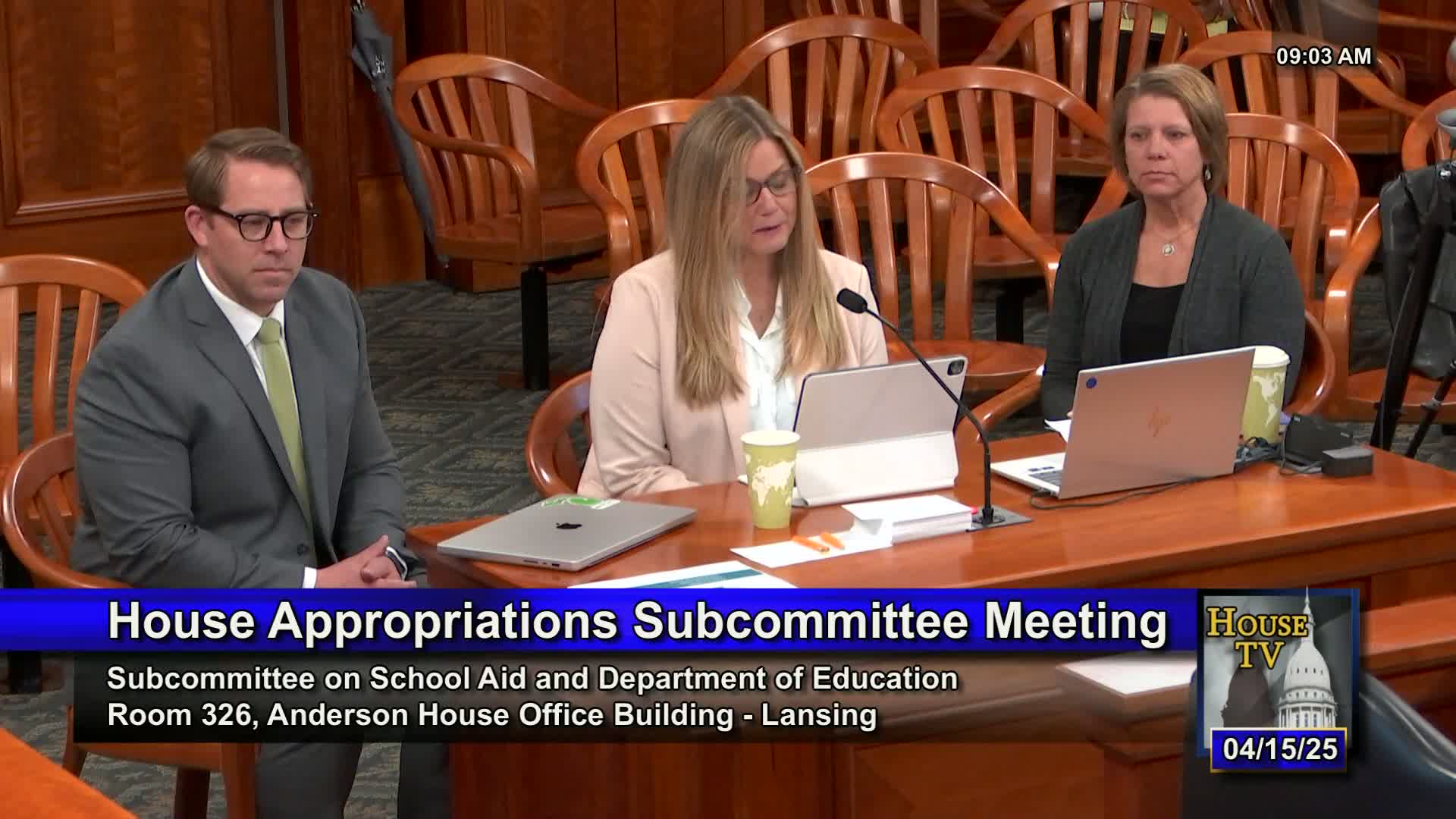
LANSING Dr. Rebecca Redmer, executive director of innovative programming at Jenison Public Schools, told the House Appropriations Subcommittee on School Aid that Michigan's 5% shared-time growth cap is preventing districts from enrolling nonpublic and homeschool students in part-time courses and is producing wait lists and financial penalties.
"This is an antiquated policy that was, that's creating problems for us today," Dr. Rebecca Redmer said, arguing the cap was adopted before the rise of digital learning and the post-COVID enrollment decline.
The issue: funding for "shared time" students (nonpublic and homeschool students who take courses from public districts) is calculated as a fraction of full-time equivalent (FTE) based on courses taken. Redmer explained that in a six-period day, one public-taught elective equals 0.17 FTE. Current statute limits the amount of shared-time FTE a district may claim to 5% of its total FTE; districts that exceed the cap pay a penalty and then face a constrained growth allowance in subsequent years.
Why it matters: Redmer said the cap forces districts to keep wait lists even when families want part‑time enrollment, complicates teacher assignments and scheduling, and risks large financial hits. Using an example Redmer offered, a district of 2,500 students could claim 125 shared-time FTE under the 5% cap but might generate 165 FTE based on part‑time course enrollment, which she said could produce a roughly $400,000 penalty for the district.
Committee members asked how the cap interacts with the Pupil Accounting Manual and other guidance. Redmer said the manual interprets the statute and would be adjusted if the Legislature removed the statutory cap. She suggested the cap no longer reflects the diversity of modern digital, hybrid, and career-technical pathways.
Representative Jim Jenkins Arno pressed on athletic eligibility, asking whether part-time enrollment can be used to bolster school sports rosters. Redmer said athletic eligibility is governed locally and by MHSAA rules; her district imposes a three-class limit for shared-time students and relies on the rule that students enrolled over 66% are eligible for athletics.
Representative Beeson asked whether the per-course funding is adequate to cover dual-enrollment costs. Redmer said a single anchored course at 0.17 FTE amounts to a bit more than $800 per semester in the example she gave and argued that permitting shared-time enrollment enables families to use state funds for college-level courses and can ultimately reengage students into full-time enrollment.
The presenters asked the committee to consider removing the shared-time growth cap from the State School Aid Act to allow districts greater flexibility to enroll part‑time students, reduce administrative burden, and stabilize shared-time participation even when a district's full-time enrollment declines.
Ending: The subcommittee heard the testimony as part of a broader panel on personalized learning, and members indicated interest in examining pupil-accounting rules alongside any statutory change. No formal committee action on the shared-time cap was taken at the meeting; the minutes were approved at the start of the session by unanimous consent.