Get Full Government Meeting Transcripts, Videos, & Alerts Forever!
Get email alerts on the Land Management Fees topic
No spam. Unsubscribe anytime.
Lane County to phase in permit-fee increases after public hearing; fourth readings set for April 29
Summary
Lane County's Board of County Commissioners on April 8 directed staff to return revised ordinances that would phase in higher permit fees for the county's Land Management Division, citing a multi‑year shortfall in the division's fee revenue.
Lane County's Board of County Commissioners on April 8 directed staff to return revised ordinances that would phase in higher permit fees for the county's Land Management Division, citing a multi‑year shortfall in the division's fee revenue. Commissioners set fourth-reading deliberations for April 29, 2025, at 1:30 p.m. in Harris Hall.
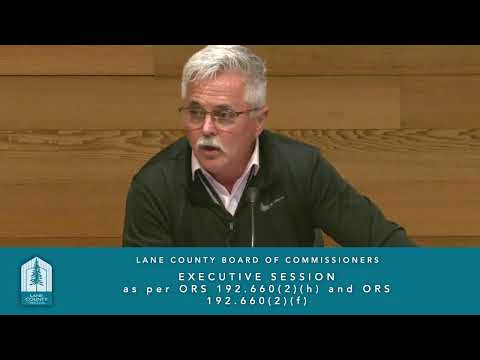
The hearing focused on proposed changes to the Land Management Division (LMD) fee schedules for building permits and a companion order adjusting planning, stormwater, on‑site sanitation and code enforcement fees. Keir Miller, Land Management Division department head, told the board the division has a “structurally imbalanced budget to the tune of about $1,200,000.” He said LMD “only recoup[s] about 35% of our total costs through permit fees,” meaning the division has been subsidized by other county funds for many years.
Why it matters: LMD's current shortfall, Miller said, risks longer permit processing times and cuts to services such as public information, long‑range planning, code enforcement and the Florence satellite office if the gap is not closed. The fee changes are designed to reduce pressure on Lane County's general fund — which supports public safety and other services — by shifting more of LMD's costs to permit revenue.
Board action and timeline
The board considered two phasing options Miller presented: a two‑year option with 10.5% increases in year one and year two, and a three‑year option with roughly 7% increases each year. Both options incorporate the routine CPI adjustments the division normally seeks and were modeled to move the division toward a structurally balanced budget. Miller said the most recent proposal reduced the previous flat 22.5% proposal to a 21% overall increase for building fees (the companion adjustment for planning, stormwater, sanitation and code enforcement was presented as a 21.5% package).
Commissioners also discussed the impact on the division's reserves. Miller said the division currently holds about 11 months of operating reserves. Under the two‑year option reserves would fall to about 9.9 months; under the three‑year option reserves would fall to about 9.5 months. The division's stated reserve policy target is 18 months.
The board voted to direct staff to modify Ordinance 2504 implementing the building program fee schedule using option 2 (the three‑year, ~7% phased increase), and to set a time certain for a fourth reading on April 29 at 1:30 p.m. The motion to close the public hearing and direct staff was moved by Commissioner Farr and seconded by Commissioner Buck; the board recorded the motion as passing 4‑0, with Commissioner Senegate absent. The board made an identical direction on the companion staff order (Order 25031108) to apply the same phasing and exemptions to planning, stormwater, on‑site sanitation and code enforcement fees; that action also passed 4‑0 with Commissioner Senegate absent.
Exemptions and affordability measures
Miller told the board he and staff recommend targeted exemptions to reduce impacts on lower‑cost housing types. The exemptions the board folded into its direction cover three permit categories: permits for manufactured dwellings/mobile home parks; accessory dwelling units (ADUs); and emergency RV placements. Miller said these permit types were identified because they are most commonly associated with lower‑cost housing.
Miller also presented analysis of how fee increases would affect a typical home under the proposed schedule. He said the packet analysis showed the overall added cost to develop a 2,500‑square‑foot house would be “less than 1% of the total cost to develop that home,” amounting to slightly under $2,000 in total permit increases under the new proposal.
Service impacts if fees are not increased
Miller outlined service areas that could be trimmed if the county chose not to raise fees, including longer permit processing timelines (some planning permits already have statutory deadlines), reduced public information and customer service, reduced code enforcement capacity (LMD currently has 2.5 FTE for countywide code enforcement), diminished long‑range planning work and possible closure of the Florence satellite office. He said the division has made recent investments — including an electronic permit application and submittal system (EPAS) — that have reduced permit timelines, and staff want to avoid reversing those gains.
Public and commissioner comments
Miller summarized public input from earlier hearings and written comments, including submissions from builders and the Eugene Realtors. Commissioners debated whether to choose a faster phase to preserve reserves or a slower phase to reduce immediate cost pressure on builders and prospective homeowners. Several commissioners said they preferred the three‑year phase to reduce immediate impacts while still moving LMD toward structural balance; others favored the two‑year option to preserve reserves more quickly. Commissioner Farr moved the ordinance motion and later moved the companion order; both motions passed on voice vote recorded as 4‑0 with one commissioner absent.
Next steps
Staff will return a revised ordinance and order reflecting the board's direction for a fourth reading at 1:30 p.m. on April 29, 2025. If adopted following the required minimum intervening period the adjustments would take effect July 1, 2025. Miller told the board that final adoption requires subsequent board action after the fourth reading and the completion of the statutorily required waiting period.