Get Full Government Meeting Transcripts, Videos, & Alerts Forever!
Get email alerts on the Land Banking Housing Supply topic
No spam. Unsubscribe anytime.
Lane County staff outline land‑banking program to speed housing supply in smaller cities
Summary
County policy staff proposed creating a revolving land‑banking program to acquire and prepare parcels for higher‑density housing across Lane County, with a focus on smaller cities. Commissioners broadly supported the idea and asked staff to return with a detailed program design and implementation options.
Lane County policy staff on Tuesday laid out a proposal to create a county land‑banking program intended to acquire, upzone and ready parcels to accelerate housing production, particularly in smaller cities outside the Eugene–Springfield metro area.
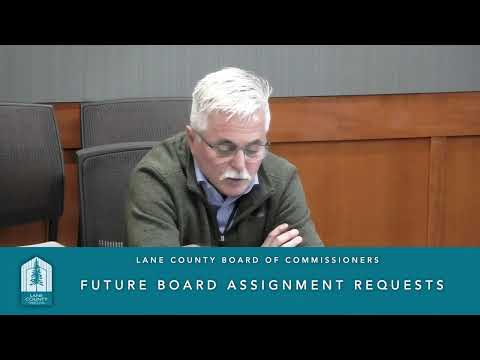
The presentation, led by Eric Mongan, a policy team member working on housing, recommended a revolving acquisition fund that the county would seed, use to acquire parcels and then replenish by selling parcels at cost to developers who would deliver higher‑density housing. "The effort would be to find larger tracts, work with the communities... and look at either up‑zoning them, partitioning them," Mongan said. He described the approach as a way to lower development costs without ongoing subsidy to the end developer.
The proposal referenced Cottage Grove as an example: the city purchased 61 acres zoned R‑2 (a medium‑density residential zone with a stated minimum of eight units per acre in the discussion) and partitioned and readied the land to attract both regulated affordable housing providers and market‑rate developers. Mongan said the city sold some parcels at about $1 per square foot so regulated affordable developers could acquire land at low or no cost and market developers could pay the county’s acquisition price to proceed. He told commissioners the county had identified "at least a half dozen parcels" outside the metro area that could be candidates.
Why it matters
County staff framed the land bank as an "upstream" tool to reduce the cost of producing housing by lowering land costs and increasing certainty about allowable uses and densities. Commissioners emphasized that the program could help produce more units across the housing ladder — from market rentals to regulated affordable units — and could be paired with other local incentives or partnership arrangements.
Key details and constraints
- Seed fund: staff and commissioners discussed seeding a revolving fund; Mongan and commissioners referenced a previously discussed figure of $2,000,000 as a possible initial size for the fund.
- Candidate parcels: Mongan said there are "at least a half dozen parcels" countywide outside Eugene and Springfield that could be pursued, naming Cottage Grove, Florence, Bonita and Coburg as places with opportunities.
- Turnover timeline: staff estimated that each parcel cycle (acquire/prepare/sell) could take roughly two to three years, so a small fund would move slowly if used on multiple parcels.
- Density objective: the county would seek to support development that maximizes units per acre where appropriate within local codes and urban growth boundaries.
- Regulatory obstacles: staff and commissioners warned of external constraints that could reduce development potential or delay projects, including floodplain changes, DEQ or infrastructure limits, ODOT "trip limit" conditions on state roads and market downturns. Mongan explained the trip‑generation concept used by ODOT and traffic engineering (for example, a single‑family dwelling is treated as roughly one trip, multifamily as roughly 0.67 trips per unit in the staff explanation).
Partnerships and pilots
Commissioners and staff discussed building partnerships with cities, school districts and other public or nonprofit owners to identify land that could be used for teacher housing, workforce housing or small community pilots. Commissioners suggested working with school districts on community land trust models — for example, parcels reserved or sold at reduced prices and prioritized for school staff — and cited examples from other Oregon communities where school districts conveyed land for affordable housing. Staff flagged opportunities to collaborate with Homes for Good, Square 1 Villages, the University of Oregon policy lab and municipal partners.
Optics and public engagement
Several commissioners cautioned about optics — residents could view public acquisition and resale of land priced below market as favoritism toward developers. Commissioners said the county should accompany any program with public education about the anticipated community benefits (for example, units targeted to residents at or below an identified AMI range). Mongan said staff would emphasize maximizing "doors" (housing units) rather than developer profit.
Next steps and board direction
Commissioners asked staff to return with a full program design and implementation options. Mongan said he would prepare a detailed land‑banking program for board consideration and noted that specific real‑property negotiations would likely be handled, when appropriate, in executive session. The board did not take a formal vote on the proposal at the work session; the direction was to develop a program plan and bring it back for deliberation.
Quotes
"I could ramble on about housing stuff for hours and hours, so don't let me do that," Eric Mongan said as he began the presentation.
"This is a time to seize an opportunity," Commissioner Farr said in support of moving quickly to capture available parcels.
Ending
Staff left the matter open for further direction; commissioners broadly supported pursuing a land‑banking pilot and asked Mongan to return with a final program design, funding options and recommended next steps.
Votes at a glance: no formal votes were taken on this item at the work session.