Get Full Government Meeting Transcripts, Videos, & Alerts Forever!
Get email alerts on the Justice Reinvestment topic
No spam. Unsubscribe anytime.
Lane County board approves pursuit of Justice Reinvestment grants, delegates application authority to PSCC staff
Summary
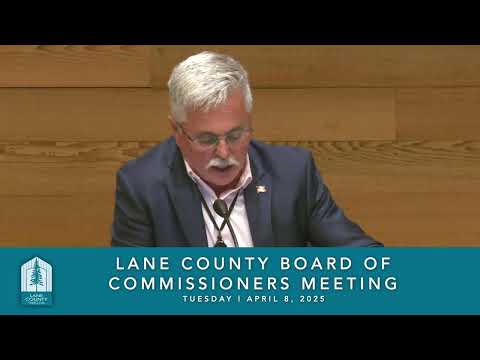
The Lane County Board of Commissioners on April 8 authorized staff to apply for 2025–27 Justice Reinvestment Program grants and delegated application authority to local Public Safety Coordinating Council staff and the county administrator.
The Lane County Board of Commissioners on April 8 approved an order allowing local staff and the county administrator to apply for and execute documents related to 2025–27 Justice Reinvestment Program (JRP) grant funds.
The board voted 4–0, with Commissioner Ryan Seneca absent, to approve Order 25040806. The motion, moved by Commissioner Heather Treager and seconded by Commissioner Buck, delegated authority to the local Public Safety Coordinating Council (PSCC) staff to submit online grant applications and to the county administrator to execute additional grant documents.
PSCC presentation and program goals: Erin Reynolds, chair of the PSCC, and Denise Walters, PSCC staff, described the funding and how Lane County plans to use it. Walters said the program’s two main goals are to “decrease prison utilization for these types of charges and convictions and to reduce recidivism for folks with those charges and convictions.” She emphasized that eligible services focus on people charged or convicted of property crimes, drug offenses and driving‑related charges.
Funding details and constraints: Walters explained the JRP funds come in multiple pots: a formula allocation tied to a county’s supervision population and a competitive pool. Lane County’s formula share is estimated in the staff materials at roughly 9.17% for the 2025–27 biennium; staff estimated the county’s total available funding could be about $4.3 million, with competitive funds possibly adding up to $750,000. Per program rules noted in the presentation, a minimum of 10% of awards must be allocated to victim‑service providers and counties may use up to 3% for program evaluation.
Eligibility and program requirements: Walters said counties must accept short‑term transitional leave from Department of Corrections facilities (typically 120 days) and that funded programming must help people enroll in the Oregon Health Plan and work to embed equity across criminal justice services. She described examples of locally funded efforts, including parole and probation support, reentry services, cognitive behavioral therapy, pretrial electronic monitoring subsidies and a downward‑departure program (the local “4–16” program name used by staff for a wraparound support model).
Targeted use and a local recommendation: The PSCC presented a local recommendation to allocate about $30,000 of expected funds to support transitional housing at Sponsors, which operates 40 transitional beds frequently used by parole and probation clients, but staff said the board could repurpose that allocation if other needs emerge.
Patrol funding clarification: Commissioner Pat Farr asked whether JRP funds could be used for patrol or sheriff response. Chair Reynolds and staff clarified that Justice Reinvestment funds are not eligible to fund patrol operations; the program targets services for people already charged or convicted of qualifying offenses.
Vote and next steps: The board approved the order to pursue the JRP funds and delegated authority to PSCC staff to submit the application and to the county administrator to sign required documents. Staff will submit program descriptions as part of an initial application and will return later with a line‑item budget once the legislature finalizes dollar amounts.