Get Full Government Meeting Transcripts, Videos, & Alerts Forever!
Get email alerts on the Land Use Legal Lots topic
No spam. Unsubscribe anytime.
Lane County planners review history, case law and process changes for legal-lot verifications and property-line adjustments
Summary
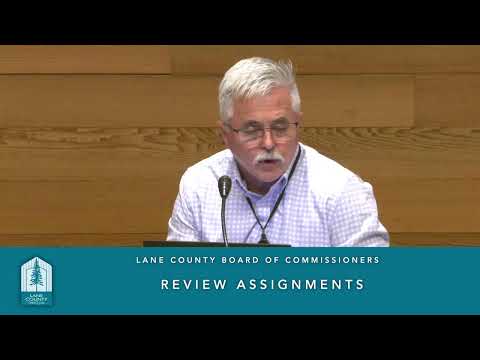
Lane County planning staff on March 18 gave the Board of County Commissioners a detailed briefing on legal-lot verifications and property-line adjustments, tracing the evolution of state and local regulations, summarizing key court decisions and describing current type 1/type 2 application procedures.
Lane County planning staff on March 18 gave the Board of County Commissioners a detailed briefing on “legal lot” verifications and property-line adjustments, tracing the evolution of state and local regulations, summarizing key court decisions and describing how the county now processes applications.
The presentation, led by senior planner Kevin Gilbride and Planning Director Amber Bell, framed a legal lot as a lawfully established unit of land either created by a county-approved land division or verified through the county’s legal-lot verification process (Lane Code chapter 13). Staff explained that property-line adjustments are allowed moves of shared property lines between abutting parcels that do not create a new lot and are regulated by both Lane Code and Oregon Revised Statutes (ORS) on land divisions and property-line adjustments.
Why it matters: the definition and verification of a “legal lot” determine whether a parcel can receive permits for new dwellings, certain commercial or industrial uses, and other land-use approvals. Court rulings and evolving case law can alter whether past administrative determinations remain valid, and that legal uncertainty affects applicants and buyers.
Key points from staff
- Modern procedures: Lane County now uses type 1 (clear-and-objective, ministerial) and type 2 (discretionary, noticed) application tracks for both legal-lot verifications and property-line adjustments. Type 1 legal-lot verifications are limited to properties created prior to 04/07/1949 that have not changed configuration since that date. Type 2 applications include notice to surrounding property owners and require a discretionary historical analysis when the parcel’s status is unclear.
- Case law drivers: staff summarized several influential decisions that shaped practice. - REDCO (Weyerhaeuser Real Estate Dev. Co. v. Polk County): LUBA and the Court of Appeals held that a later approved partition plat can extinguish preexisting platted lots beneath it unless the later plat preserves them. That ruling limits the ability to “resurrect” older platted lots beneath later partitions. - Walcott v. Lane County: reaffirmed that preliminary administrative legal-lot determinations are not final unless they are noticed; final determination can occur at time of first permit, prompting re-reviews of past preliminary verifications. - Bowerman v. Lane County: narrowed ministerial over-the-counter adjustments, requiring serial/recorded conveyances for sequential adjustments; court clarification now allows a single application that shows serial adjustments recorded in order. - Christian Futures v. Lane County: clarified when a road or easement constitutes intervening ownership; ownership in fee (not mere easement) can create separate lawful parcels.
- Program pressures and improvements: staff said a single former FTE handled a high volume of complicated applications (more than 80–108 complex cases in some years). The division reclassified an existing position to add an engineering analyst and restored a second FTE to reduce processing delays. Other improvements include posting historic land-division ordinances online, adding applicant certification requirements to deter forged deeds, enhancing staff reports with graphics and more explicit findings, and regular coordination with County Counsel and an experienced land-use attorney to vet legal questions.
- Housing context: staff reviewed building-permit and assessor data and reported 13 new dwellings over the recent three-year period tied to legal-lot approvals (9 stick-built, 4 manufactured), underscoring that legal-lot work can enable homes but has produced a modest number of units in that window.
Board discussion and direction
Commissioners repeatedly asked staff to simplify the customer-facing explanation of the process, noting that property owners interact with it only rarely while staff and attorneys handle it daily. Commissioners raised concerns that preliminary verifications issued earlier in the county’s history have created buyer confusion when a later re-review changes an earlier preliminary finding. Commissioners also asked about potential limits to public participation in legal-lot verifications and whether the county could narrow who receives notice or can appeal. County Counsel advised that the public-notice requirements stem from state and local law and any change would require analysis of what state law allows.
After questions, the board asked staff to return for further engagement: commissioners requested a work session focused on Lane Code chapters 13 and 14, the board’s historical role in land-use decisionmaking, and outstanding items from previous procedural reviews (including Howlett/Mann recommendations). Staff agreed to scope follow-up material and to coordinate stakeholder outreach for code-review conversations.
What staff did not decide
Staff recommended process improvements and described staffing changes but did not propose or adopt any new code amendments at the meeting. No formal motions or votes were recorded on code changes during the session.
Ending
Commissioners thanked staff for the research and asked that the presentation and staff training be shared internally so Planner-on-Duty staff can give clearer guidance to applicants. Staff said they will return with a follow-up work session and bring stakeholder feedback as part of any future code-amendment planning.