Get Full Government Meeting Transcripts, Videos, & Alerts Forever!
Get email alerts on the Education Budget topic
No spam. Unsubscribe anytime.
Michigan education officials cite gains, outline budget requests tied to 'Top 10' strategic plan
Summary
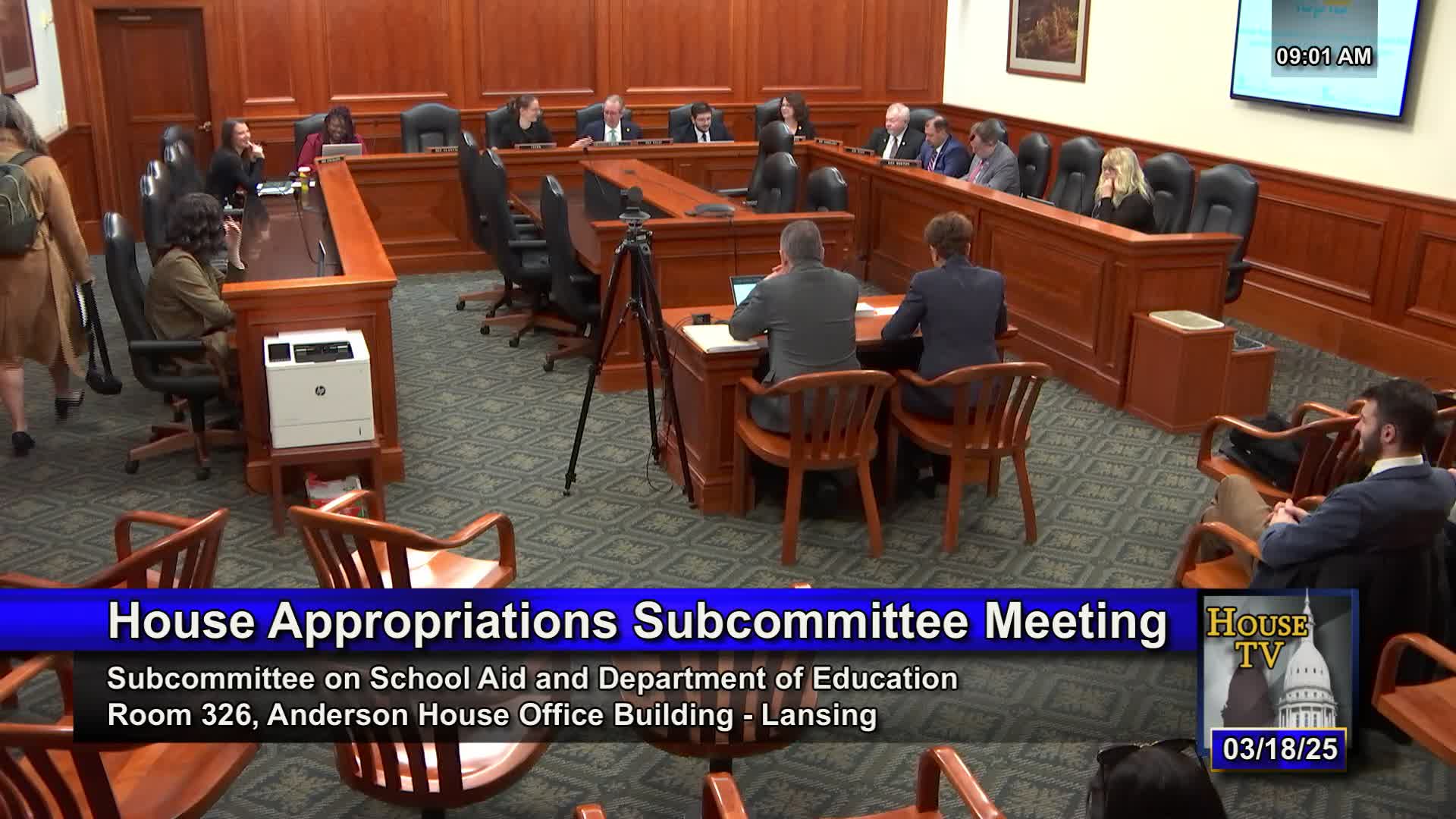
State Superintendent Dr. Michael Rice told the House Appropriations Subcommittee on School Aid and Department of Education that Michigan has made measurable gains on several goals in the state’s “Top 10” strategic education plan, and asked the subcommittee to support multiple budget requests to sustain and expand that progress.
LANSING — State Superintendent Dr. Michael Rice told the House Appropriations Subcommittee on School Aid and Department of Education that Michigan has made measurable gains on several goals in the state’s “Top 10” strategic education plan, and asked the subcommittee to support multiple budget requests to sustain and expand that progress.
Rice, joined by Sue Carnell, chief deputy superintendent of the Michigan Department of Education (MDE), presented the department’s review of the Top 10 strategic education plan and highlighted gains and outstanding gaps across early childhood, literacy, career and technical education (CTE), teacher supply and school funding.
Rice told lawmakers the state’s four‑year graduation rate reached a historic high — 82.8 percent (reported as about 83 percent) compared with 80.6 percent when Rep. Kelly last served in the Legislature — and that the governor’s 60-by-30 postsecondary credential goal is at a high watermark of 51.8 percent. He credited expanded CTE, personal curricula, early warning intervention systems and other supports for some of the improvements. “CTE completers are at the highest level in our state’s history, 52,625, up 19% in the last 3 years,” Rice said. He added that participation and test‑score outcomes in Advanced Placement programs have risen in the last two years as well.
Why it matters: Rice emphasized that several of the plan’s goals are “interlocked,” and that resource goals — notably addressing the teacher shortage and providing adequate and equitable school funding — are upstream priorities that affect many downstream outcomes, including early literacy and graduation. The department asked the subcommittee for targeted investments to address persistent shortfalls in areas such as special education and rural CTE access.
Key budget requests and program details
- Career and Technical Education: Rice said the executive budget recommends $20 million for CTE equipment upgrades (section 61c) and MDE is requesting broader support of $125 million over five years to close “CTE deserts” and opportunity gaps across the state. He told the subcommittee CTE participation has grown and that CTE completers graduate at high rates; “We have got to do a better job in this area.”
- Early literacy and dyslexia implementation: Rice reviewed recently enacted literacy laws (listed as PA 146 and PA 147 of 2024) that require districts to select approved dyslexia screeners and high‑quality early literacy instructional materials, require interventions for students who screen positive, and strengthen pre‑service and in‑service training. He noted MDE has supported LETRS professional development, saying, “3600 of our educators have gone through this very rigorous training ... another 6,400 are working toward completing this.” Rice urged the Legislature to consider making funded early literacy initiatives mandatory statewide and recommended doubling a one‑time $87 million appropriation for high‑quality early literacy materials in fiscal year 2026.
- Michigan School Meals Program and nutrition: Rice reported year‑over‑year increases in school meals — breakfasts up 26 percent, lunches up 20 percent — and urged codification and recurring funding for the Michigan School Meals Program. He also asked the subcommittee to make recurring a $125 million supplemental appropriation included in the fiscal year 2025 budget that the department described as nonrecurring.
- Teacher shortage and workforce supports: Rice summarized multi‑year state investments to address the shortage: $575 million in fiscal year 2023, $448 million in fiscal year 2024 and $140 million in fiscal year 2025. He said the FY23 funds included about $305 million for fellowships/scholarships and $175 million for grow‑your‑own programs and student‑teacher stipends. Rice reported a 71 percent increase over six years in the number of people enrolled in teacher preparation programs and said roughly 5,200 people benefited from recent fellowships and a similar number from student‑teacher stipends.
- Special education funding gap: Rice showed MDE’s revenue/expenditure data for special education in 2022–23: roughly $3.4 billion in revenue and $4.0 billion in expenditures, a gap the presentation framed as about $600 million underfunded for that year.
Other topics and data cited
- Early childhood: Rice said enrollment in the Great Start Readiness Program (GSRP) has doubled since 2010, with a 52 percent increase in the last three years and that the governor has announced about 47,000 children in GSRP.
- Assessment outcomes: Rice said state test proficiency improved on 13 of 20 tests in spring 2024 and that math, science and social studies have trended upward across the last two years; he noted declines in some early grade English language arts results and said third grade M‑STEP proficiency was about 40 percent.
- Instructional time and class size: Rice recommended reconsidering exceptions to the 180‑day school year and urged a return to more in‑person instructional time. He also urged reconsideration of a small class size grant to reduce K‑3 class sizes in high‑poverty classrooms, citing classroom visits where teachers reported 27–33 students in third grade.
- Dual enrollment and foundation allowance: Representative Steckloff and others asked whether dual enrollment costs should be funded outside the K‑12 foundation allowance. Rice said MDE does not collect district‑level cost data on dual enrollment and expressed uncertainty whether moving dual enrollment funding out of the foundation would benefit local districts without additional revenue sources.
Fiscal context presented by House Fiscal Agency
Noel Benson, fiscal analyst with the House Fiscal Agency, provided an overview of the MDE administrative budget. He said the department’s budget is approximately $164.98 million (the figure cited in the presentation), with about half federal funds (roughly $82.6 million), $63.9 million in state general funds, $10.1 million in state restricted revenue and other relatively small sources. Benson said the budget dropped from larger COVID‑era totals because early childhood and related childcare scholarship funding moved out of MDE to a different agency. He also provided detail on library funding, noting the state reached a goal of roughly 50¢ per capita funding for libraries in fiscal 2022 and that total public library operating revenue remains mostly local millage revenue.
How the subcommittee responded
Members asked for clarifications on the CTE equipment funding and whether it includes recurring costs or software subscriptions; Rice said he believed the $20 million equipment line did not include subscription renewals but that he would confirm the exact language. Members also asked for detail on dual enrollment costs, CTE partnerships with community colleges, absenteeism trends and the scale of mental‑health staffing increases. Rice and staff cited data showing increases in helping professionals (about 1,700 additional nurses, counselors, social workers and psychologists over five years) and said chronic absenteeism has declined in the last two years but remains higher than desired.
Ending: Rice and MDE staff said they were available to return with additional breakdowns and asked for legislative support for the executive budget recommendations on the items summarized above. The subcommittee then heard a fiscal overview from the House Fiscal Agency and adjourned.