Get Full Government Meeting Transcripts, Videos, & Alerts Forever!
Get email alerts on the Appropriations School Aid And Education topic
No spam. Unsubscribe anytime.
Research council warns Medicaid "unwinding" is creating an at‑risk funding cliff for Michigan schools
Summary
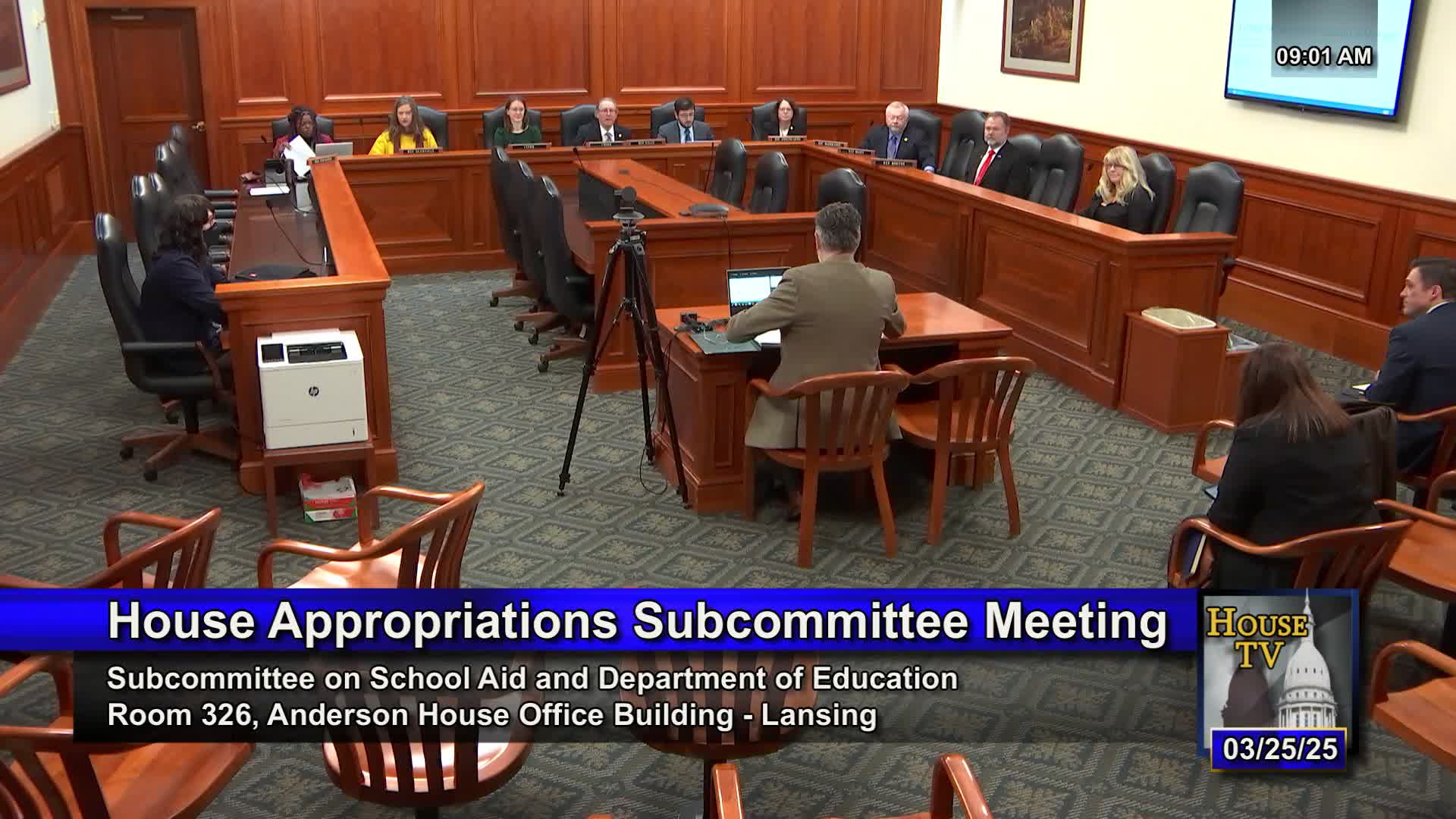
Craig Theel, research director at the Citizens Research Council, told the House Appropriations Subcommittee on School Aid and the Department of Education that a 7.5% fall 2024 drop in students counted as economically disadvantaged, combined with an uneven federal Title I formula, is creating an "at‑risk funding cliff" for some Michigan school districts.
Craig Theel, research director at the Citizens Research Council, told the House Appropriations Subcommittee on School Aid and the Department of Education that two federal funding dynamics — unequal Title I allocations and changes in Medicaid eligibility counts — are combining to create an "at‑risk funding cliff" for Michigan school districts.
Theel said Michigan receives about $500,000,000 annually in federal Title I funds but that the federal hold‑harmless provisions and the Title I formula produce inequitable distributions across districts. He urged the subcommittee to use state Section 31A at‑risk dollars to help correct those federal inequities: "Congress has failed to address the inequities of title 1, so Michigan lawmakers should step in," Theel said, and he left his full analysis with the clerk for the committee record.
Why this matters: Theel showed that the state adopted weighted funding goals described in the 2018 School Finance Research Collaborative (SFRC) report — a 35% weight on the foundation allowance for students from low‑income backgrounds and a higher weight for the highest‑poverty districts — but that federal Title I dollars do not align with those goals. Separately, he said fall 2024 student counts showed a 7.5% statewide drop in the number of students identified as economically disadvantaged after the pandemic‑era Medicaid continuous enrollment requirements ended in June 2024. Those two facts together mean some districts will see sharp declines in total at‑risk revenue even though the governor’s budget increases per‑pupil at‑risk payments.
Most important facts: Theel told the subcommittee that Michigan’s at‑risk funding target in law (Section 31A) aims at a 35% weight relative to the foundation allowance (the foundation allowance he presented near $9,800). At that target, an additional at‑risk student would represent roughly $3,363 of funding before proration; the appropriation has been prorated down in practice. Theel showed district examples: Livonia Public Schools lost roughly 800 students counted as economically disadvantaged (from about 4,600 to about 3,800), which he estimated would produce about a $1.5 million net reduction in its at‑risk funding after the state per‑pupil increases are applied — roughly the equivalent of 10 full teacher compensation packages under his math. He said smaller high‑poverty districts such as Westwood Heights (Genesee County) could lose in the hundreds of thousands of dollars and several teaching positions.
Federal and state drivers: Theel traced the enrollment change to the end of pandemic Medicaid protections. Because Michigan used direct certification via Health and Human Services data to identify free and reduced‑price lunch (and thus economically disadvantaged status), families who were automatically enrolled during the pandemic no longer qualified when the federal policy ended; Theel said, "these students are still enrolled in your districts. They're just not being identified as economic economically disadvantaged, which means they're not generating the funding for your districts." He emphasized the subcommittee controls Section 31A distribution rules even though it cannot alter the federal Title I formula.
Options discussed: Theel suggested the subcommittee consider policy changes to soften the cliff, including blending counts across multiple years instead of a single‑year lookback for eligibility, or using some of the recent increases in state at‑risk appropriations to equalize districts that Title I underserves. He did not offer a specific bill; rather he provided his report as analysis and a set of policy options for the committee to consider.
Questions and context: Members asked how Michigan compares to other states and whether alternative measures such as ALICE household thresholds could be used. Theel said Michigan historically reimbursed low‑income students at a relatively low rate compared with states like Massachusetts, and he described how identification flows through direct certification and CEPI data. He told the committee that his CEPI‑based analysis discovered the 7.5% decline and that the decline’s impacts are uneven — some districts will see large cuts while others will see increases depending on local enrollment shifts.
Ending: Theel left the committee with two published reports and a call to action for lawmakers: consider using state at‑risk dollars to offset federal allocation inequities and examine the state’s counting method to avoid abrupt year‑to‑year funding shocks for districts.