Get Full Government Meeting Transcripts, Videos, & Alerts Forever!
Get email alerts on the School Funding topic
No spam. Unsubscribe anytime.
Charter and cyber school leaders tell appropriations subcommittee funding shortfalls hurt high‑need students
Summary
Leaders from charter and cyber public schools testified before the House Appropriations Subcommittee on School Aid and the Department of Education that the governor’s proposed budget would leave cyber students and many high‑need pupils funded at lower levels than district schools.
LANSING — Leaders from charter and cyber public schools told the House Appropriations Committee’s Subcommittee on School Aid and the Department of Education that the state’s proposed education budget would leave cyber charter students and many high‑need pupils funded at lower levels than their district counterparts.
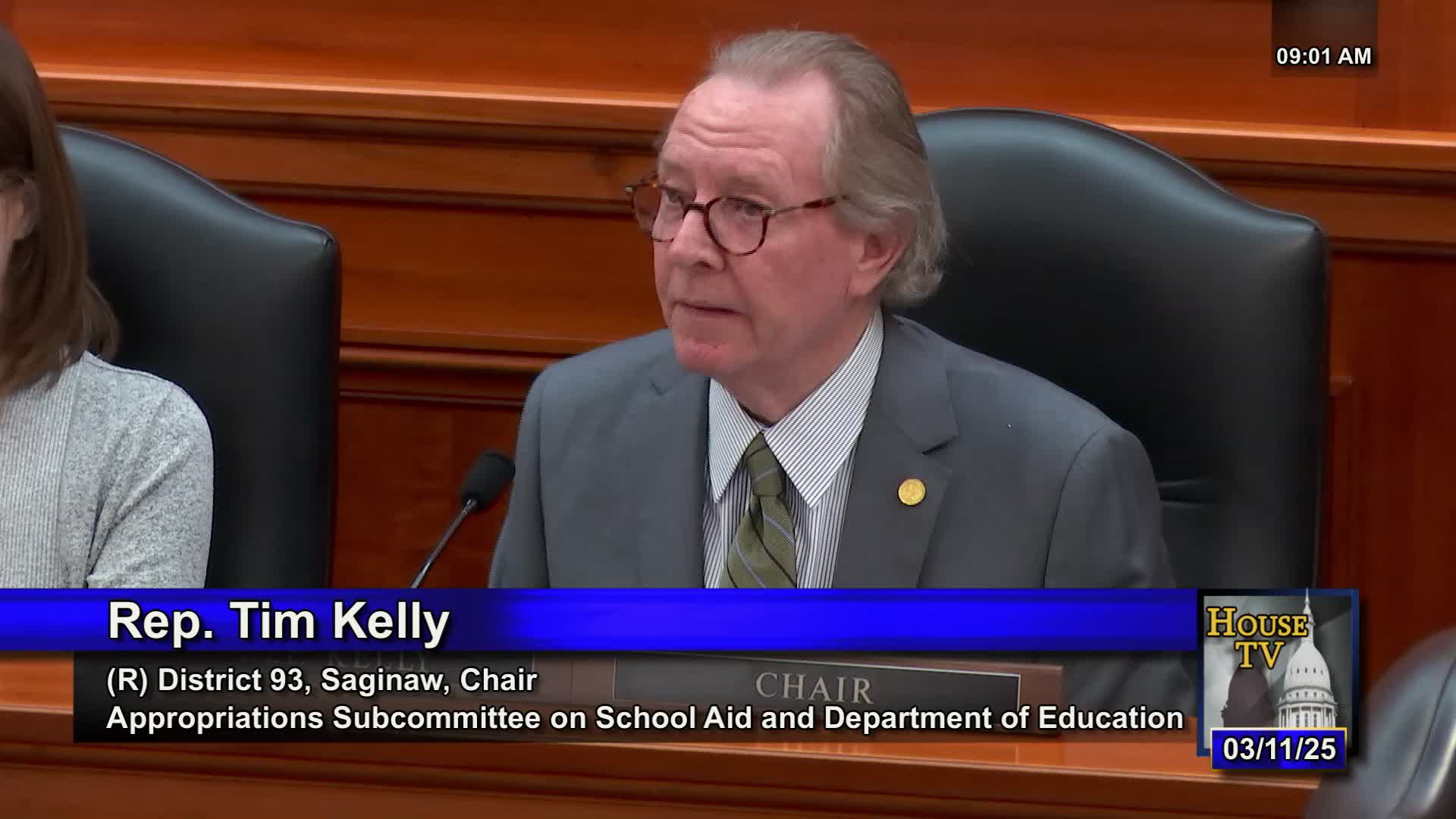
The testimony came March 2025 as the subcommittee heard presentations from the Michigan Association of Public School Academies (MAPSA), Uplift Michigan Online School, Success Virtual Learning Centers and Copper Island Academy. Chair Representative Kelly said it is his intent “to restore that promise made 30 years ago for equitable funding, regardless of where a student chooses to go.”
Why it matters: witnesses said charter and cyber schools disproportionately serve students at high risk of academic failure — including students living in poverty, students with disabilities and students experiencing housing instability — and that reduced funding will directly limit schools’ ability to provide wraparound services they say are necessary for success.
Dan Quisenberry, president of the Michigan Association of Public School Academies, told the committee that charter public schools are funded out of the state’s per‑pupil foundation grant and receive no local millage or property tax revenue for facilities. “The state of Michigan, the legislature every year would provide equitable, consistent, and student centered funding for all public schools and public school students, including charter public schools and cyber public schools, through that per pupil foundation grant,” Quisenberry said.
Quisenberry and other presenters outlined several data points they said show the populations served by charters: Michigan has about 286 charter public schools serving approximately 150,000 students; charter students are disproportionately minority (about 67% of charter students versus 34% statewide) and economically disadvantaged (presenters said roughly 75% of charter students live below the poverty line). He also said cyber charter enrollment rose about 2.7% from 2022‑23 to 2023‑24 and that 96% of traditional school districts have students attending cyber charter schools.
Quisenberry criticized the governor’s proposed budget for not restoring funding provided last year through “Section 22e,” which the presenters said had been used to offset retirement or other district costs and that the governor’s proposal effectively zeroes out for certain charter and cyber students. “If you’re attending a cyber charter school, you’re only getting $8,000,” Quisenberry said, and he contrasted that with the governor’s stated $10,000 investment per child and with roughly $800 per‑student differences between some school types in the fiscal year projections presented to the committee.
Uplift Michigan Online School officials described the specific needs of their student body and the additional costs of serving them. Superintendent Tanya Lowery said the school serves students with a high prevalence of special education needs and housing instability and that the school must provide related services such as occupational therapy, speech and language supports and social‑work interventions. “That is discrimination in every possible way. It’s not okay,” Lowery said, describing the difference in funding levels compared with other public schools.
Tim Wood, a former principal and charter superintendent who spoke for Uplift, said roughly 90% of Uplift students qualify for at‑risk (31a) funding and that about 32% of their students are in special education — figures he said are well above statewide averages. He told the committee Uplift routinely serves students up to age 22, students who have dropped out of other programs, and students with severe cognitive impairments who, in other districts, would be moved to ISD‑level programs.
Erica Bushey, Uplift’s at‑risk specialist, gave multiple case examples of students who graduated after extensive wraparound supports: a young man who lost several family members but will enter an apprenticeship program after graduation; a student who graduated at age 20 despite severe social anxiety; and a student who is pregnant and also caring for young children and who needed schedule flexibility and supports that the cyber model provided.
Miranda Coburn, executive director of Success Virtual Learning Centers, described a blended model with 11 physical centers across the state, extended staff hours, center‑based social workers and on‑site snack and meal supports. Coburn said Success offers sequential, one‑class‑at‑a‑time pacing and weekend and evening teacher support to accommodate students who work or care for family.
Representatives on the subcommittee pressed presenters on staffing, student‑teacher ratios and root causes. Uplift staff described ratios around 22–24:1 in some programs, 15–20:1 in elementary programs, and multiple social workers and counselors on staff; they said student needs drive staffing decisions and that the schools are expensive to operate because they provide frequent home visits, one‑on‑one instruction and intensive family engagement.
Copper Island Academy, a newer charter in the Upper Peninsula, presented a contrasting model focused on hands‑on, outdoor and Finnish‑inspired practices and reported steady enrollment growth to about 385 students and high state index scores.
No formal votes were taken at the meeting. Chair Kelly closed by repeating his intent to pursue restoration of equitable funding across public school types as the committee develops budget recommendations.
Sources and context: presenters repeatedly cited the per‑pupil foundation grant as the state’s primary funding vehicle for public schools and referred to the Michigan Public School Employees Retirement System (MPSERS) liabilities as a major driver of recent budget choices. Witnesses said the legislature previously used Section 22e in last year’s budget process to offset certain costs and that the governor’s proposed budget for the coming fiscal year does not continue that offset for some charter and cyber students.
Looking ahead: the subcommittee will consider budget recommendations during the legislative process; presenters urged lawmakers to close the funding gap and to allow schools flexibility in the foundation allowance so local operators can direct resources to the wraparound services their students require.