Get Full Government Meeting Transcripts, Videos, & Alerts Forever!
Get email alerts on the School Aid And Education topic
No spam. Unsubscribe anytime.
House subcommittee hears overview of Michigan school aid budget and key pressures
Summary
House Appropriations Subcommittee on School Aid and Department of Education received a fiscal briefing showing a $20.8 billion school aid budget, declining K‑12 enrollment, rising retirement and special‑education costs, and federal funding that makes up about 11% of the budget.
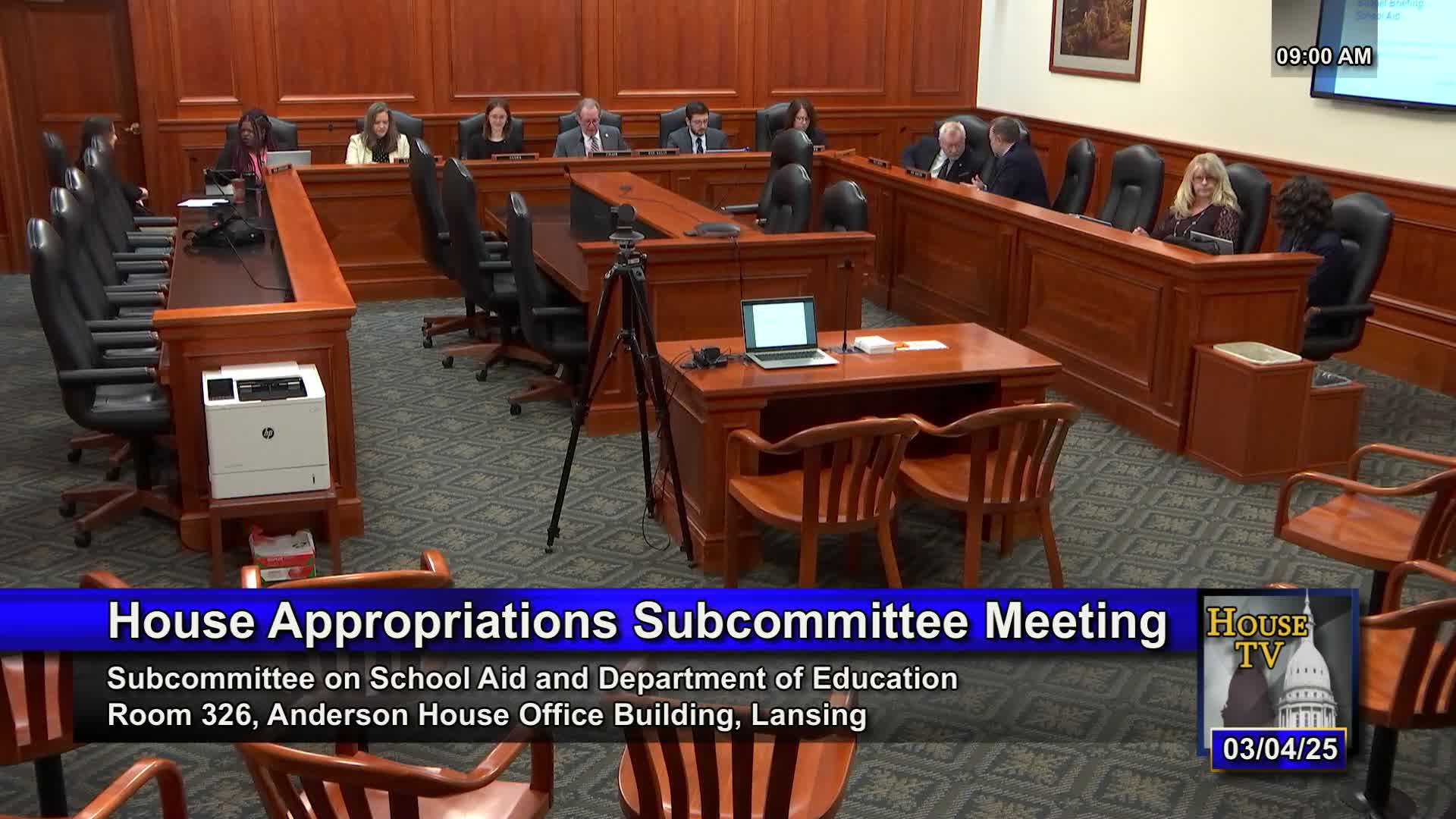
House Appropriations Subcommittee on School Aid and Department of Education Chair Representative Kelly convened the committee for a briefing on the state’s school aid budget, where analysts outlined the budget’s size, revenue mix and budget pressures, including retirement liabilities and special‑education costs.
The briefing, delivered by Jacqueline Mullins, senior fiscal analyst for House Fiscal, and Noel Benson, fiscal analyst for House Fiscal, said the school aid budget is about $20.8 billion and represents roughly 26% of statewide appropriations (excluding most federal funding). Mullins told the subcommittee that 89% of the school aid budget is funded with state‑restricted revenue (primarily the School Aid Fund), roughly 11% comes from federal grants, and a small rounded share is general fund dollars used for items not eligible for School Aid Fund spending.
Why this matters: the school aid budget is the state’s largest education appropriation and funds day‑to‑day operations for K‑12 districts, charters, intermediate school districts and several education agencies. Committee members pressed staff for inflation‑adjusted comparisons, data on special‑education head counts versus FTEs, and clarification on charter and cyber‑school funding after the presentation.
Analysts’ overview: Mullins said the budget pays operations for 537 local school districts, 286 public school academies and 56 intermediate districts. Analysts showed projected enrollment declines — about 1,380,000 pupils in FY 2025 with further small declines projected in FY 2026 and FY 2027 — and a composition of spending that places roughly 49% of appropriations toward foundation allowances (about $10.2 billion). Key categorical appropriations called out in the briefing included the Public School Employees Retirement System (MPSERS), special education and at‑risk funding.
Mullins described several headline numbers: special education appropriations total about $2.6 billion (approximately $2.1 billion state and $533 million federal in the current fiscal year), and uncompensated special‑education costs reported for FY 2023 were about $601.5 million. She said MPSERS appropriations were about $2.8 billion in the current fiscal year and that recent one‑time payments have been used to reduce unfunded liabilities; staff projected the remaining unfunded liabilities will be paid off in 2038 under current projection assumptions.
On funding mechanics, analysts explained the foundation allowance framework: a single target foundation allowance of $9,608 per pupil for most districts, with cyber schools currently funded at $9,150. Mullins also described exceptions, including out‑of‑formula districts (examples cited in the briefing: Big Bay and Baldwin) that receive higher per‑pupil funding from local millages and hold‑harmless districts that maintain higher historical foundation allowances.
Program and revenue details: staff presented a fiscal ‘‘baseline’’ showing a structural gap in ongoing revenues against projected ongoing expenditures, offset in the near term by an existing beginning balance (approximately $1 billion) and one‑time funds. For FY 2026, the baseline as shown in the briefing left roughly $2.0 billion to allocate, about half ongoing and half one‑time, according to Mullins. Federal funding for education programs was shown at just under $2.3 billion overall, with major line items including school lunch programs and Title I.
Questions from members and staff follow‑up requests: Committee members asked for additional data. Vice Chair Danville asked staff to provide inflation‑adjusted foundation allowance figures over time and to clarify special‑education head counts versus FTEs; Mullins agreed to provide those data. Representative Jenkins Arno asked about charter and cyber‑school funding; staff said most charter schools now receive the same target foundation allowance as traditional districts except fully cyber charter schools, which remain at a lower cyber foundation amount and that a one‑time per‑pupil payment for charters was included in FY 2025 appropriations. Representative Stekeloff and others pressed on the importance of passing the school aid budget on time to prevent uncertainty for districts that must set staffing and program plans before the school fiscal year starts.
Statements from the bench: Representative Kelly summarized concerns raised during the briefing about ‘‘more money, fewer students’’ and declining student achievement despite increased spending. Representative Beeson and others urged accountability and asked staff to track how categorical funding and program changes have shifted costs onto districts. Noel Benson described expansions in the Great Start Readiness Program (the state’s four‑year‑old preschool program), noting that recent eligibility changes have expanded participation and appropriations for that program.
Next steps: staff offered to provide the committee with requested supplementary data — including inflation‑adjusted foundation allowance history, special‑education head counts, and a full list of federal grant line items — for later meetings. Chair Kelly said the committee will return to more detailed budget work in subsequent hearings. The meeting adjourned after questions concluded.