Get Full Government Meeting Transcripts, Videos, & Alerts Forever!
Get email alerts on the Contaminated Sites Cleanup topic
No spam. Unsubscribe anytime.
EGLE outlines scope of contaminated sites, urges steady funding for long-term cleanups
Summary
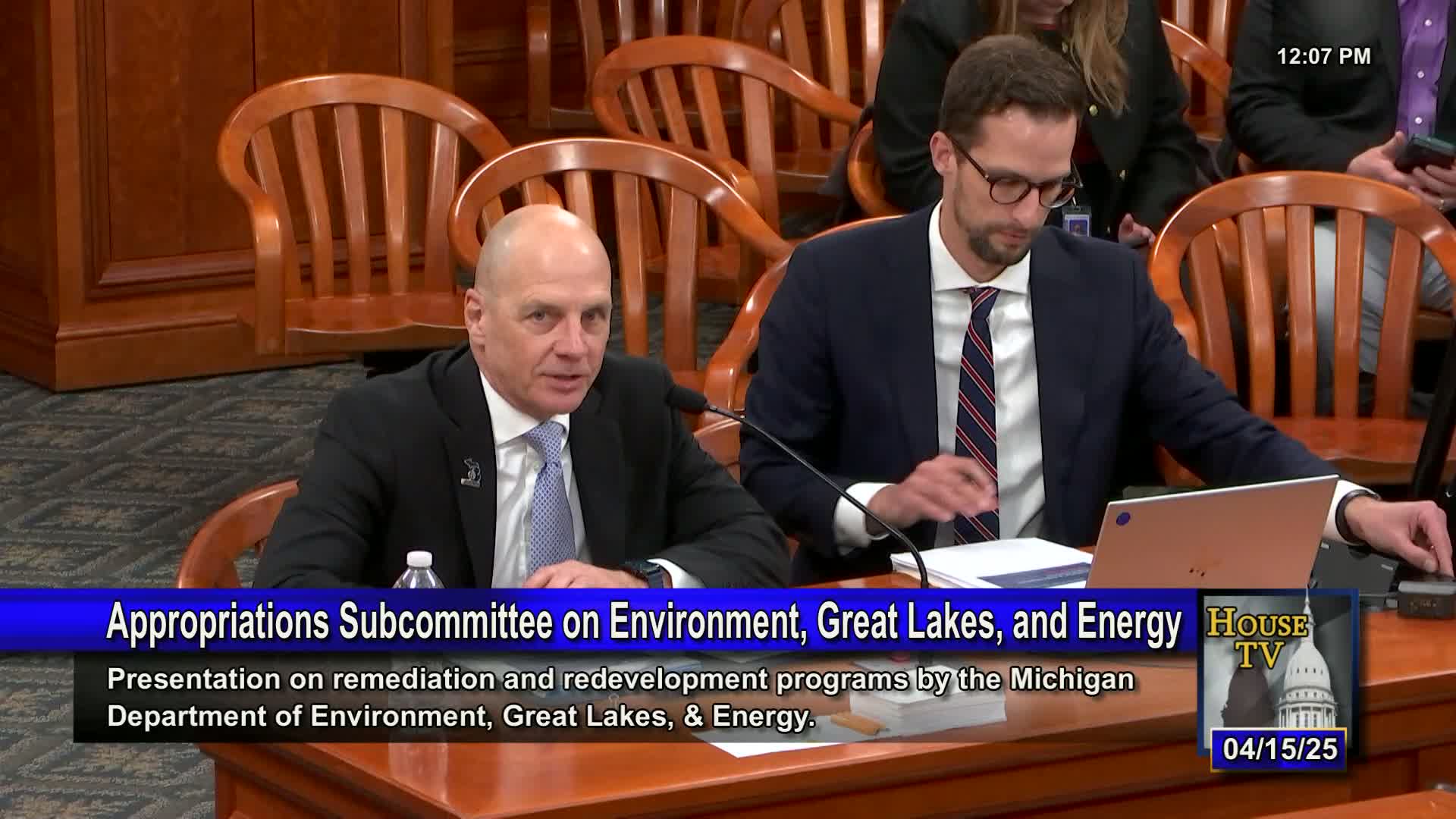
The Michigan House Appropriations Committee on Environmental, Great Lakes and Energy heard a briefing from the Department of Environment, Great Lakes and Energy (EGLE) on the scale of contaminated sites in the state, progress in closures, funding mechanisms and emerging PFAS dredging guidance from the U.S. Army Corps of Engineers.
LANSING — The House Appropriations Committee on Environmental, Great Lakes and Energy heard detailed briefings Tuesday from officials at the Michigan Department of Environment, Great Lakes and Energy on the state’s contaminated-site programs, the scale of known contamination and the need for consistent funding to avoid costly project delays.
Mike Neller, division director for the Remediation and Redevelopment Division at EGLE, told the committee his division manages multiple state-mandated cleanup programs, the Brownfield Redevelopment Program and the state’s role in federal Superfund (CERCLA) sites, and that the work depends on steady appropriations.
Neller emphasized the public-health stakes and long timeframes for many cleanups: “The average time a site is on the NPL is 40 years,” he said, describing National Priorities List Superfund sites as “the worst of the worst.” He also warned that stopping and restarting work raises costs and can allow plumes in groundwater to spread.
State and program context
Neller described four program areas his division manages, including enforcement and oversight under Part 201 of the Natural Resources and Environmental Protection Act (NREPA) for releases to soil and Part 213 for leaking underground storage tanks (LUSTs). He said roughly 18,000 sites appear in the division’s inventory when discussing Part 201, and later showed a map he described as depicting “about 27,000 known sites of contamination that exceed the criteria.”
On those leaking underground storage tanks, Neller said, “We have about, just under 8,000 open releases currently in our inventory,” and noted many date back decades and are orphan sites where the liable party no longer exists. Of the larger inventory, he said about 1,700 sites are currently being actively worked on and roughly 1,100 are classified as “risk present and immediate.”
Funding and performance figures
Neller told the committee the state has allocated more than $300 million to address 787 sites (amounts are multi-year allocations for work that can span several years). When asked for the typical annual spending level for remediation work, he said, “The $60,000,000 a year is basically, on average, what we’ve been spending to work on sites.”
He outlined other funding mechanisms that support cleanup work: the state pays a roughly 10% cost share on CERCLA Superfund responses (which he said averages about $8 million a year), the Michigan Underground Storage Tank Authority (MUSTA, sometimes shortened in discussion) receives about $20 million a year from a refined petroleum fee to act as a financial-assurance/insurance mechanism for many tank owners, and the Renewing Michigan’s Environment program provides roughly $69 million annually for state-funded cleanups, brownfield grants and other water and materials-management work.
Neller said a closure goal set several years ago — 404 LUST closures per year — has been exceeded recently: the division closed 428 sites in 2024 and is on track to close about 550 this year.
Program priorities and process
Neller described the division’s action-plan process for prioritizing sites: officials sort sites by risk category, compare available funding and select projects that address the greatest present risk. He said that approach means some work is containment rather than full remediation when budgets are constrained.
Travis Boscol, deputy director at EGLE, and other staff emphasized the operational distinction between sites with responsible parties and orphan sites. Boscol said at responsible-party sites “the department may not have much insight about exactly what they’re doing on an ongoing basis” because the law allows owners to manage much of their cleanup while providing progress information to the agency; at orphan sites the department must take a more active role.
PFAS and dredging guidance
Sydney Hart, EGLE legislative liaison, said the department has worked with the U.S. Army Corps of Engineers since October 2024 to develop guidance for PFAS-related sediment sampling and dredging decisions. Hart said the Detroit District received the guidance and that the Corps must seek headquarters approval before sampling and dredging proceed. She said the Corps has identified 69 potential dredging sites nationwide and EGLE identified about 17 of those in the Detroit District as proximate to PFAS concerns. “Due to the proximity, there’s an elevated risk for PFAS,” Hart said, and EGLE’s guidance aims to match disposal methods to contamination risk so dredged material is handled in a way that limits exposure.
Public access, records digitization and FOIA impacts
Neller described the division’s multi-year digitization of site records as a major efficiency and transparency effort. He said the division now houses about 1.3 million documents in a public-facing database and that digitization has reduced FOIA demand on staff by about 20 percent, while speeding consultant access to files needed for baseline environmental assessments.
Questions from committee members
Committee members asked for more local detail and for briefing support. Representative Borton (R) asked how to get status details for LUST sites in his district; Neller offered to set up a briefing to show which releases are active and what work is proposed. Representative Markkanen asked whether wells along a geological feature were all counted as sites; EGLE staff said contamination and confirmed releases — not merely the presence of a well — are what make a location a Part 201 site, and EGLE offered to provide follow-up detail.
Representative Steckloff asked about the state’s 10% Superfund cost share and the consequences to public health if funding shrank. Neller said the division prioritizes “risk present and immediate” sites and that if work on those sites stopped or slowed it would increase the risk of exposure, but he declined to quantify a precise public-health toll beyond describing that higher-risk sites require prompt containment or remediation.
What the committee was told this means
EGLE officials told lawmakers that consistent, predictable funding allows long-term project planning and avoids the inefficiency of starting and stopping large cleanups. They gave examples where recent state funding enabled municipal water hookups to protect residents near Camp Grayling and allowed the agency to apply newer remediation technologies at a long-running chemical site in Mason.
Ending
Committee leaders thanked EGLE staff and indicated follow-up briefings and materials would be arranged. No formal committee votes or bill actions occurred during the session.