Get Full Government Meeting Transcripts, Videos, & Alerts Forever!
Get email alerts on the Energy Infrastructure topic
No spam. Unsubscribe anytime.
Katy amends heavy‑industrial rules, moves battery storage into special‑use permit process; council directs staff to return within three months
Summary
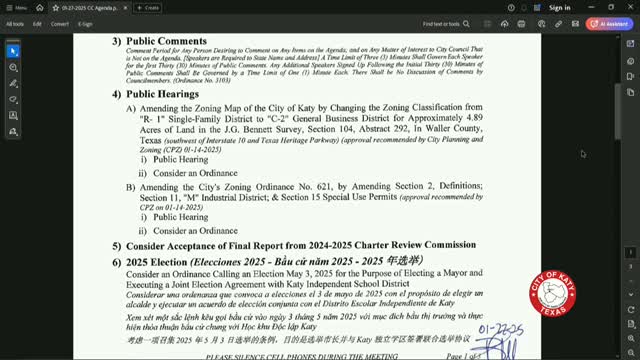
Council adopted an amendment to city zoning ordinance No. 6‑21 to require special‑use permits for heavy industrial uses and to explicitly list battery energy storage systems (BESS) in the special‑use section; council also directed staff to return with additional information on BESS projects and formation of an advisory group within three months.
The City of Katy on Jan. 27 approved an amendment to zoning ordinance No. 6‑21 that moves heavy industrial uses to a special‑use‑permit (SUP) requirement in the MS industrial district and expressly identifies battery energy storage systems (BESS) as a use subject to SUP review.
City planner Rachel Lazo said staff brought the item after a contentious rezoning last fall revealed that several industrial‑use definitions and permitted uses had become antiquated. Under the approved changes, uses defined as “heavy industrial” (notably processing and distribution of raw materials) will require a special‑use permit, giving council discretion over siting and design for such operations in or near core city areas. Lazo also said BESS will now be a expressly listed use in the special‑use permit section so the approval process and standards are clear.
Council members praised the update as a necessary cleanup of older code, but several said the change is an initial step and urged more detailed standards for BESS projects — for example, environmental and plume studies and other engineering analyses — before any specific project is approved. In the meeting several council members said they are not technical experts and recommended forming a group of external experts to review standards and options.
The ordinance was moved by Mayor Pro Tem Chris Harris and seconded by Council member Gina Hicks and was adopted following a public hearing and council discussion. Separately, Council member Dan Smith moved that staff return to council with more information regarding BESS projects and the possible creation of an advisory board; that motion (initially proposed as six months) was amended on the floor to a three‑month timeline and adopted. The transcript records the motions and that the amended timeline passed, but it does not list a roll‑call vote tally by name.
During discussion staff offered to prepare draft standards and suggested a public workshop or draft ordinance that council could review; council members said they also could draw on model ordinances from neighboring cities but preferred a locally tailored approach. Several council members asked for an advisory group with representation from residents and technical experts to present both pro and con perspectives before standards are finalized.
The ordinance includes standard severability and penalty language and authorizes publication of the caption only as provided in the ordinance text. Council directed staff to return within three months (from Jan. 27) with options for next steps on BESS and for consideration of forming an advisory committee.