Get Full Government Meeting Transcripts, Videos, & Alerts Forever!
Get email alerts on the Teacher Preparation topic
No spam. Unsubscribe anytime.
LSU College of Education presents pipeline, early-childhood and rural initiatives to BESE committee
Summary
LSU faculty briefed the BESE Educator Effectiveness Committee on programs aimed at expanding the teacher pipeline, early-childhood credentials and rural access, highlighted a PBS-backed early-career TV program for young children and described research on student homelessness.
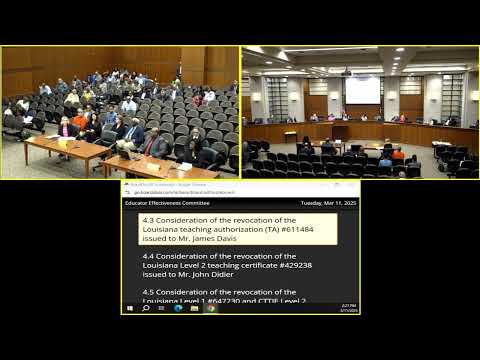
The State Board of Elementary and Secondary Education Educator Effectiveness Committee heard a presentation from Louisiana State University College of Education on efforts to strengthen the teacher pipeline, expand early-childhood credentials and reach rural classrooms.
The presentation, led by Eugene Kennedy, interim director of the Lutrelle and Pearl Payne School of Education at LSU, framed several university initiatives aimed at increasing the supply of qualified teachers and preparing children earlier for career and learning skills. Kennedy introduced a series of speakers who described programs ranging from an early-career transmedia series for children to university-led certificate pathways and rural outreach.
Why it matters: Committee members said the state faces teacher shortages in critical secondary subjects such as math, chemistry and physics and that higher education must increase both the volume and readiness of graduates. Committee member Michael Morris told LSU officials the state needs more graduates who can “step in a classroom ready to teach” on day one, specifically citing alignment to the science of reading and foundational math skills.
LSU outlined three main focus areas. Dr. Jane Curry described Skillsville, a transmedia career-education program developed with TPT (a PBS affiliate) and funded by a U.S. Department of Education grant. Curry said the program, aimed at roughly 4- to 7-year-olds, launched March 3 on PBS and includes 80 short television episodes, online and paper games, virtual field trips and hands-on lesson plans. ‘‘Young children love to learn about careers,’’ Curry said, adding the program combines executive-function skills, self-regulation and career exploration across 16 career clusters. She said researchers currently are conducting randomized and quasi-experimental trials and reported an ongoing pre/post study sample of 485 children.
Dr. Cindy DeCarlo, who leads LSU’s Early Childhood Education Program and Institute, summarized the university’s birth-to-kindergarten certification, a PK–3 teacher certification that begins student clinical placements in freshman year, and a birth-to-kinder alternative certification launched in 2021 to address shortages. DeCarlo said LSU received Board of Regents chartering for an early childhood institute, was the first university to offer birth-to-kindergarten certification, and became a BESE-approved early childhood ancillary certificate provider. She described a 2022 online certificate in childcare administration, and a transformational $5,000,000 gift to the institute to support birth-to-4 research and student supports.
DeCarlo noted workforce barriers: BESE-approved early childhood ancillary cohorts typically enroll only 20 students per cohort, completion rates vary (LSU reported a 74% post-high-school completion rate and a 93% completion rate in a pilot high-school cohort), and childcare wages remain substantially lower than public-school pay, producing turnover she said can reach about 40 percent.
Dr. Willie LaViere (Brumley in transcript), who is leading LSU’s rural education initiative, described strategies to recruit, train and retain rural educators through online certification pipelines, local partnerships, technology access points in parishes and targeted professional-development ‘‘Ed Camps.’’ LaViere said the initiative is engaging tribal nations, including Tunica-Biloxi and Houma, and aims to create pathways for local residents to become certified without long commutes to campus.
Carrie Tobin, an LSU researcher who studies student homelessness, briefed the committee on prevalence and classroom impacts. ‘‘This is a dramatically under-researched area,’’ Tobin said, noting national Department of Education counts put student homelessness at roughly 1.4 million and emphasizing attendance as the strongest mediator of academic outcomes for this population. Tobin described classroom-embedded teaching, workshops for administrators and a service-learning collaboration that raised funds for local group homes.
Committee response and next steps: Members pressed LSU for data on how many graduates the university produces in high-need secondary fields; LSU acknowledged secondary math and chemistry teacher graduations are low (‘‘less than a dozen’’ secondary-level math graduates in the last year, according to the university representative) and agreed to follow up with more detailed program-level and enrollment data. Kennedy and other LSU speakers encouraged continued dialogue with BESE and state education leaders on aligning preparation with employer and regional demand.
The presentation materials and contact information were provided to the committee; LSU representatives said follow-up answers to board questions would be sent by email.