Get Full Government Meeting Transcripts, Videos, & Alerts Forever!
Get email alerts on the Planning Code Amendments topic
No spam. Unsubscribe anytime.
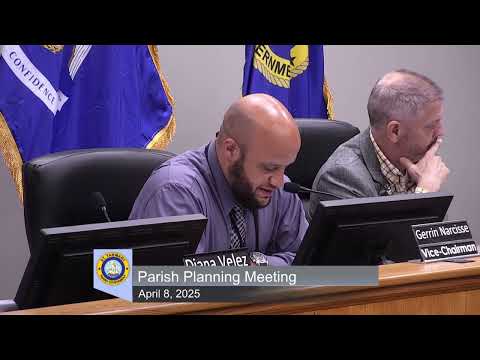
Commission forwards Unified Development Code amendments to council after debate over communications and tree incentives
Summary
The commission voted to forward an amendment to Part 2 of the Code of Ordinances (Unified Development Code, chapters 100–900) to the Parish Council after discussion about commissioner communication with interested parties and changes to tree-preservation incentive math and major-subdivision incentives.
The St. Tammany Parish Planning and Zoning Commission voted to forward a package of text amendments to the Unified Development Code (Code of Ordinances, Part 2, chapters 100–900) to the Parish Council for final consideration after discussion and public comment on several provisions, including rules about commissioner communications and changes to tree-preservation incentives.
Planning staff presented amendment 11 as a multi-part change: restoring limited pre-meeting communication language for commissioners, clarifying tree-survey requirements to match existing development standards (including live oaks, cypress and trees 8 inches or greater in required buffers), adding indoor entertainment as a permitted use in the Planned Business Campus District, and revising incentives linked to major subdivisions. Staff said prior amendments (amendments 6–8) were combined and adopted earlier and that amendments 9 and 10 were introduced at a previous meeting; amendment 11 moves through final consideration next.
Public comment and commissioner discussion focused on two points: whether commissioners should be allowed to communicate with “other interested parties” outside public meetings, and how to calculate the heritage-tree incentive that reduces minimum lot width or area. A member of the public, Mr. Jimenez, urged retaining restrictions that prevent commissioners from meeting privately with “interested parties” and cautioned against loosening rules designed to avoid undue influence. Planning staff and several commissioners argued that limited communication with proponents, opponents or other parties familiar with a plan can be useful for historical context and technical clarification.
On tree incentives, staff described the proposed change to the heritage-tree calculation. The current code tied a 5% reduction in minimum lot width or area to preservation of heritage trees based on a 25-caliper-inch increment; staff said the math did not align with how trees are measured in the field. The proposed rewrite sets thresholds based on retaining multiple heritage trees (each at least 18 inches caliper) and adjusts the numeric calculation to 108 total inches in the sample metric used in the amendment. Staff and commissioners said the change is intended to reflect realistic field measurements and to encourage preservation of significant trees across subdivisions. Planning staff also described expanding the major-subdivision incentives so that developments with six to 24 lots can opt into the incentives previously limited to 25 lots or greater; the proposed incentives include reductions in lot area or width in exchange for preserved natural areas or additional planting.
Commissioners requested clarity about enforcement and maintenance. Planning staff said code enforcement and the planning department would follow up on required mitigation if planted areas die, and that certain landscape dedications would be in perpetuity unless otherwise specified. The commission debated whether reducing the numeric threshold (from the prior math to the proposed 108 inches) would lower protection; one commissioner suggested a modest increase in the figure and staff responded the revision was based on a real project used as a test case.
After discussion and public comment, a commissioner moved to approve and forward the amendment package to the Parish Council; the motion carried by the commission’s vote.
Ending
The commission approved forwarding the Unified Development Code amendments to the council, noting that council action will be required for final adoption and that staff will continue to refine language on enforcement and measurement methodology as the measure proceeds.