Get Full Government Meeting Transcripts, Videos, & Alerts Forever!
Get email alerts on the State Budget Hb96 topic
No spam. Unsubscribe anytime.
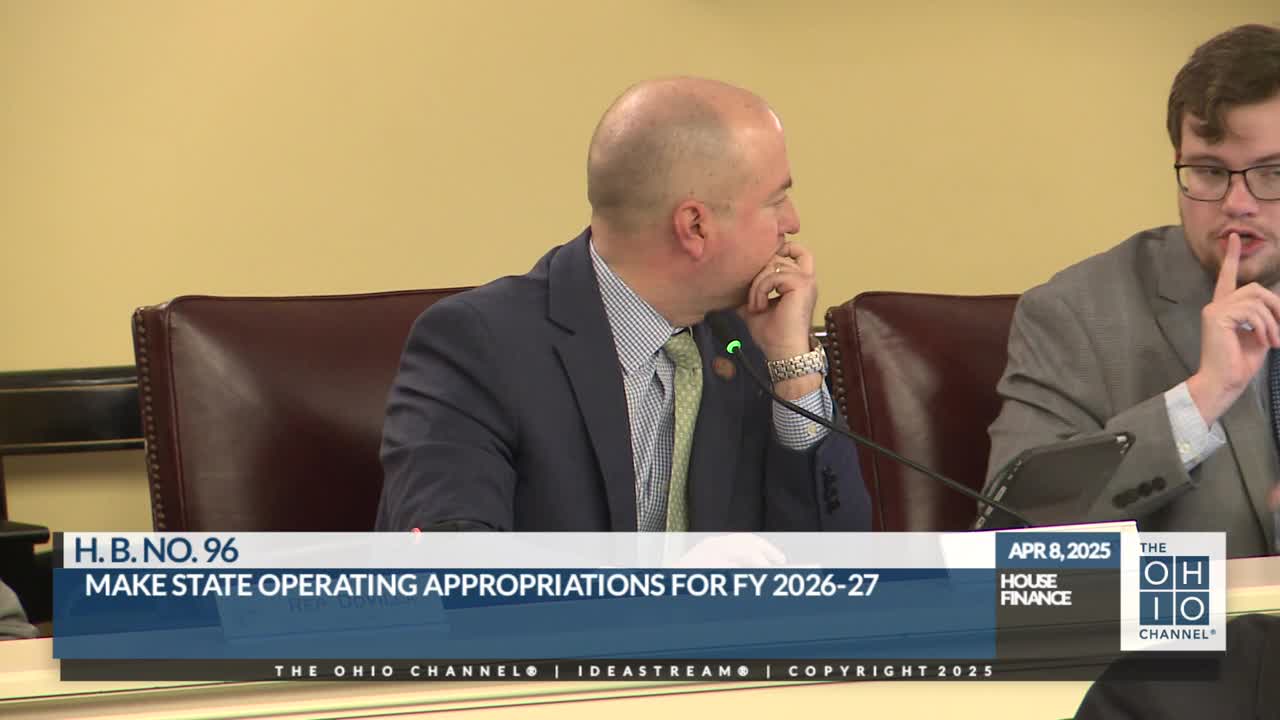
House Finance Committee advances amended substitute HB 96 after hearings on school funding and foster-student aid
Summary
The Ohio House Finance Committee voted 19-10 to favorably report an amended substitute of House Bill 96 after a morning of testimony on K‑12 funding and an appeal to include a Foster-to-College scholarship in the state operating budget.
The Ohio House Finance Committee on April 8 adopted an omnibus amendment to the state operating budget and voted 19-10 to favorably report amended substitute House Bill 96 to the Rules and Reference Committee after a day of testimony on school funding and a separate appeal to restore a Foster‑to‑College scholarship.
Committee members heard from Angie Hamburg, superintendent of the Westerville City School District, who warned that an amendment under consideration — which would direct the auditor to suspend property tax collections for any district with an unreserved cash balance above 25% — would force districts to make deep cuts and seek levies more frequently.
Hamburg said Westerville serves nearly 15,000 students across Franklin and Delaware counties, employs nearly 2,000 people and includes 16% special education students, 23% gifted students and nearly 11% English learners. She told the committee her district uses cash reserves as a planned stopgap while shifting positions off federal ESSER funding back to the general fund and is projecting to remain solvent through 2029 only because of those reserves and prior budget actions.
"Only looking at a year of the forecast — no business can function by reducing revenue while increasing services," Hamburg said. "The only band aid we have right now is our cash balance, and like many districts, losing it abruptly would be catastrophic for us." She said the district is deficit‑spending by more than $20 million over its forecast and lost about $4 million in state aid this school year, while seeing a net decline overall despite modest property tax increases tied to reappraisals.
Hamburg described operational scale and cash flow constraints: the district spends about $638,000 per day, salary and benefits comprise roughly 82% of the budget, and the district had banked $25 million in credit through an expedited local partnership with the Ohio Facilities Commission. She said the district had placed a levy on the ballot to fund facilities work; when that levy failed, leaders moved some reserved funds back to operations to keep the five‑year forecast balanced.
Committee members pressed Hamburg on specifics. Rep. Young asked about the district's budget and reserves; Hamburg replied the district's budget is roughly $233 million and that its carryover was about $161 million (roughly 68% of the annual budget), and said those reserves are part of a multiyear plan. Rep. Hoops and others questioned whether the 25% threshold in the amendment would be appropriate; Hamburg said cash balances reflect differing local circumstances and that some districts' higher balances result from one‑time federal funds or timing of tax receipts rather than structural surplus.
Separately, Julia Marino, a postdoctoral scholar at The Ohio State University and a member of the Junior League of Columbus, urged the committee to restore the Foster‑to‑College Scholarship Act to the budget. Marino invoked testimony from a child witness, identified in testimony as Priya, and recounted stories of foster youth who left college when support ended. Marino said the scholarship — described in testimony as "last dollar" tuition support after federal grants — has bipartisan backing and that 35 states already provide similar aid.
"If money is the obstacle, it shouldn't be because these kids have been through so much already," Marino said, urging lawmakers to include the measure or otherwise advance the bill outside the budget process.
On procedure, Vice Chair Davila moved to amend substitute House Bill 96 with amendment 2698‑1; the committee accepted the omnibus amendment by voice after the vice chair described the changes and noted the public could view details on the committee website. Later, the committee voted on a motion to favorably report the amended substitute and recommend passage. The roll call produced 19 affirmative votes and 10 negative votes; the committee granted LSC harmonizing authority for the committee report and forwarded the bill to Rules and Reference for floor consideration.
The committee recessed for caucus during the day and said it intends to continue floor debate on the bill the following day. No floor action occurred in the committee; the committee's recommendation now moves the amended substitute to the full House schedule.
Votes at a glance
- Amended substitute House Bill 96 (with amendment 2698‑1) — Committee motion to favorably report and recommend passage: Passed 19‑10. Committee recorded roll call and granted LSC harmonizing authority.