Get Full Government Meeting Transcripts, Videos, & Alerts Forever!
Get email alerts on the Historic Preservation Policy topic
No spam. Unsubscribe anytime.
Staff outlines demolition‑by‑neglect procedures, liability coverage and enforcement options
Summary
At the April meeting staff presented a one‑page demolition‑by‑neglect procedure, explained board liability protections, and discussed enforcement tools including municipal court, administrative warrants for property access, and potential funding approaches for stabilization work.
City staff updated the Historic Review Board on demolition‑by‑neglect procedures, liability protections for board members and enforcement options at the April 8 meeting.
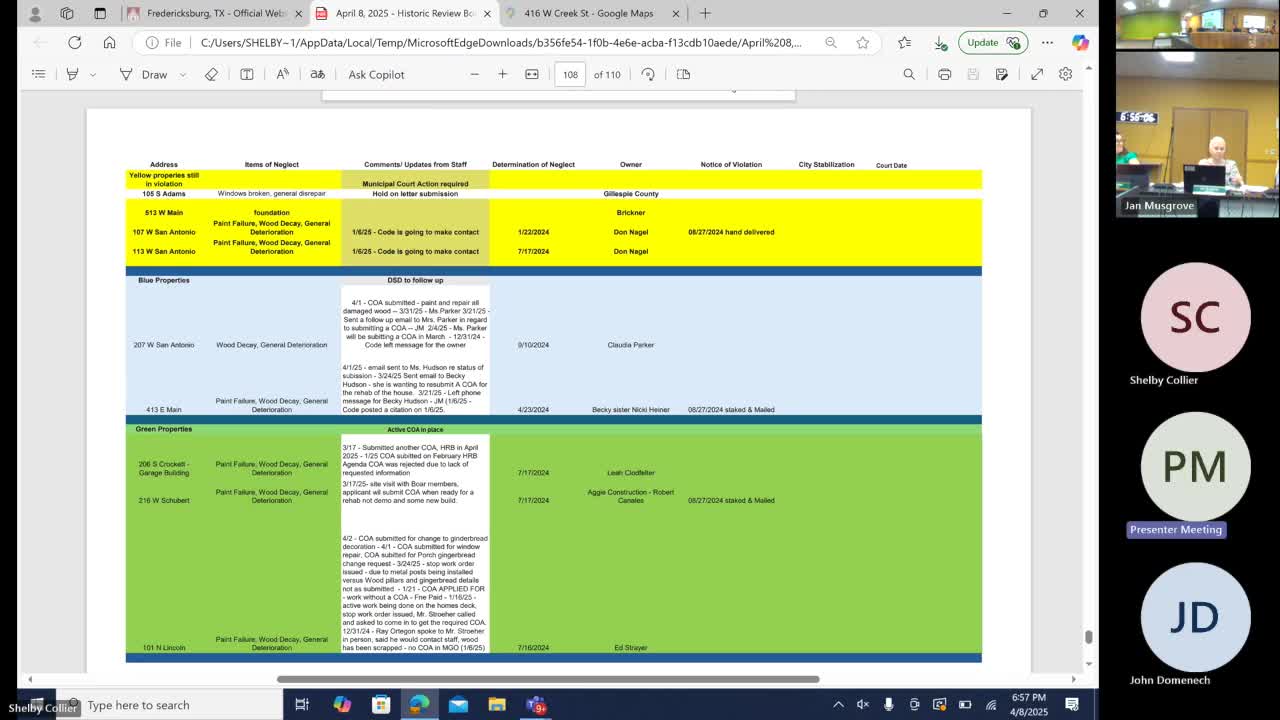
Historic preservation staff described a new one‑page demolition‑by‑neglect handout that summarizes steps, timelines and interdepartmental responsibilities. Shelby said the procedure clarifies that applicants or violators generally have 120 days before more aggressive enforcement steps, and staff will maintain a spreadsheet tracking active cases and properties with issues.
Planning staff explained board members and volunteers are covered under the city’s liability framework when acting within their official duties; staff said the city attorney confirmed individual members receive qualified/official immunity while performing discretionary official acts and that no additional signatures or waivers are required once members are sworn in.
On enforcement, staff said code enforcement will pursue municipal court citations when education and voluntary compliance fail. For property access to obtain condition estimates, staff said the city could use an administrative warrant or a court order to inspect and obtain an estimate; whether the city can perform repairs under such orders depends on legal counsel and would be done through court authorization. Staff noted that some repeat contractor noncompliance has limited available enforcement tools under current licensing rules and that stronger measures would require ordinance changes.
Staff discussed funding options to stabilize hazardous historic properties, including using hotel occupancy taxes to seed a stabilization program; staff said they are preparing example estimates and a proposal to present to city leadership and, if supported, to city council for the next budget cycle. The board asked staff to include estimated stabilization costs for specific properties on the demolition‑by‑neglect list when they circulate the updated spreadsheet.
Ending: Staff will continue to update the board monthly on the demolition‑by‑neglect spreadsheet, refine the one‑page procedure to include step indicators, and prepare cost estimates and a council proposal for a possible stabilization funding source.