Get Full Government Meeting Transcripts, Videos, & Alerts Forever!
Get email alerts on the Special Education Policy topic
No spam. Unsubscribe anytime.
Panel endorses revisions to Bulletin 15‑08 to speed special‑education evaluations
Summary
The Louisiana Special Education Advisory Panel endorsed revisions to Bulletin 15‑08 (the pupil appraisal handbook) aimed at clarifying evaluation rules, expanding who may serve as qualified examiners, aligning dyslexia screening with Bulletin 19‑03 and discouraging use of RTI as the sole reason to delay evaluations.
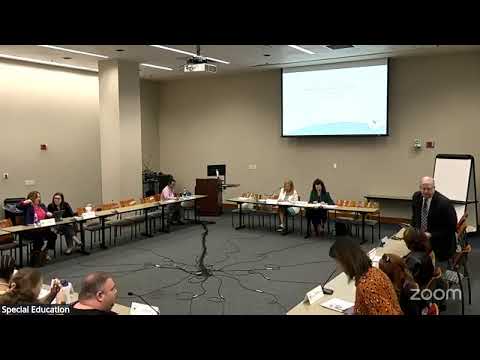
BATON ROUGE, La. — The Louisiana Special Education Advisory Panel on March 26 endorsed proposed revisions to Bulletin 15‑08, the state pupil appraisal handbook, that the Department of Education said are intended to make special‑education evaluations timelier and clearer for families and school teams.
Meredith Geord, a member of the Department of Education’s special education staff, led the presentation and described a set of “high‑leverage” changes developed with clinicians and practitioners across the state. “We wanted current child‑find policies and evaluation procedures that ensure students suspected of having a disability are identified early and receive services and supports,” Geord said.
Panelists and Department staff told members the revisions would: add licensed specialists in school psychology and speech‑pathology assistants as allowable qualified examiners on pupil appraisal teams; state explicitly that evaluations should not be delayed or denied solely because a student is in a tiered intervention system (RTI); align dyslexia screening and evaluation language with Bulletin 19‑03; require teams to review current data before exiting a student from related services; discourage reevaluations that go two consecutive three‑year cycles without current data unless a parent refuses additional assessment; and accept physician notes from any U.S. state, rather than only nearby states.
Geord said the work reflected at least six months of stakeholder engagement with school psychologists, speech‑language pathologists, occupational and physical therapists, school nurses, social workers and other related‑service personnel. She also said the revisions clarify the department’s expectation that students with disabilities access the general education curriculum and that response‑to‑intervention practice should mean “high quality” instruction and interventions that can close gaps efficiently.
Panel member Ashley McReynolds moved to endorse the revisions; a second was recorded and the motion carried with no opposition. The panel also previously approved minutes from the November meeting by motion of McReynolds and second by Julie Tanner.
During discussion, panelists praised clearer language on dyslexia and SLD identification and urged the department to maintain consistency in terminology (for example, replacing “low achievement” with “weakness” across the SLD section). Geord said references to parental consent were retained elsewhere in the bulletin (section 1‑09) and that the department would provide resources such as functional‑vision assessments or checklists outside the formal policy document rather than as appendices.
The revisions also include technical edits — for example replacing references to “certified school nurses” with “registered nurse” to reflect current certification language — and remove references to attachments no longer published with the bulletin.
Panel discussion and public comment at the meeting did not record any opposition to the changes. The department indicated the bulletin must still align with federal IDEA requirements as the draft moves toward formal publication and a public comment period on the proposed text if required.
The panel’s endorsement is a policy‑level step; the bulletin will proceed through the Department’s rule and publication processes before any binding state policy change takes effect.