Get Full Government Meeting Transcripts, Videos, & Alerts Forever!
Get email alerts on the Tri Share Child Care topic
No spam. Unsubscribe anytime.
Michigan presenter outlines Tri Share child-care cost‑sharing model to commission
Summary
Shannon Garrett, senior program advisor for Michigan’s My Tri Share initiative, presented a public‑private model that splits child‑care costs three ways (employer, employee, state), reviewed pilot funding and enrollment data, and described administrative steps the state took to centralize billing and eligibility with a statewide partner.
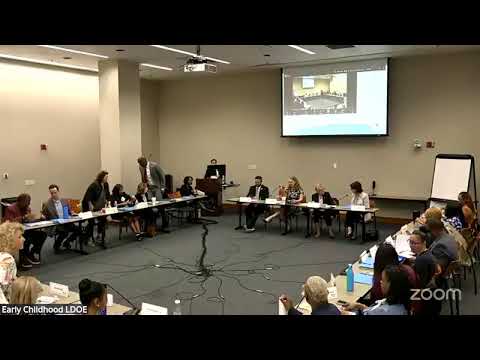
Shannon Garrett, senior program advisor for the Tri Share Program for the Michigan Department of Lifelong Education, Advancement and Potential, told the Early Childhood Care and Education Commission that My Tri Share "is a program. It's a public private partnership" that "splits the cost of an employee's childcare equally between the employer, the employee, and the state of Michigan." Garrett joined the commission by videoconference and outlined the program's history, eligibility rules, administrative structure and early evaluation results.
The program began as a FY2021 pilot funded by a $1,100,000 appropriation and expanded in later budgets, Garrett said. Subsequent state appropriations and private foundation contributions let Michigan grow the pilot from three regions into multiple regions and then toward a statewide approach. Garrett said the program moved administratively from regional hubs to a single statewide administrative partner, the United Way of Northwest Michigan, which now processes applications, collects employer and employee contributions and pays providers.
Garrett said the program targets households she described using the ALICE (asset‑limited, income‑constrained, employed) framework and sets eligibility at roughly 200 to 325 percent of the federal poverty line; families under 200 percent are referred to the Child Development and Care Program (Michigan's child‑care scholarship), she said. She described a waiver process for families above the 325 percent threshold who face undue hardship. Garrett stressed parental choice: employers do not buy slots or dictate which licensed providers families must use.
Karen Powell, the department's Deputy Assistant Superintendent for the Office of Early Childhood Care and Education, introduced the presenter and Barry Carter, the department's new assistant superintendent. Carter said he was "happy to be here" and to learn about the commission's work.
Garrett provided key operational details: regional facilitator hubs recruit employers and do outreach, while the statewide administrative partner signs employer agreements, takes invoices from licensed Michigan providers, pays providers (Garrett said payments are made within a week of receiving an invoice) and collects the thirds from employers and employees. Employers set an overall budget but "cannot cap the amount per employee," Garrett said; to participate an employer must commit to contributing one third of actual child‑care costs for at least one child of at least one employee for at least one year.
On participation and early outcomes, Garrett cited a third‑party evaluation of 2024: 71 percent of employers reported improved retention, 80 percent said the program would be helpful in the future, and 97 percent of participating families said the program improved their financial stability. Garrett provided program counts as of January (numbers compiled while the statewide administrative transition was ongoing): roughly 210 participating employers, 799 approved families, 610 active families receiving care and 775 children currently served. She also reported the administrative partner’s February data showing 1,465 applicants and 819 approved applications in the most recent tracking dataset.
Garrett estimated that, at roughly $3.4 million per year in state funding (after administrative fees), the program could sustainably serve about 1,000 to 1,500 children annually, but she said the estimate is provisional because earlier tracking occurred across 12 hubs with differing reporting practices. Garrett cautioned that employer recruitment can take six months to a year and that program growth had been slow initially but was gaining momentum once administrative work centralized.
Commissioners and attendees asked technical and policy questions. Garrett said United Way of Northwest Michigan is the statewide administrative partner and that payroll deduction is the common method employers use to collect the employee one‑third share, though it is not strictly required. On tax and benefit questions she said Michigan's Department of Treasury reviewed federal tax guidance for families; Garrett said the state does not offer additional tax incentives and that questions about the Employer Child Care Tax Credit at the federal level remain unresolved for participating employers. She also discussed flexible participation by providers (providers keep market rates and submit invoices to the statewide partner).
Several participants noted interest in whether an employer could use flexible benefits (such as FSAs) with Tri Share and Garrett said FSAs vary by vendor; some work when the FSA vendor will treat the United Way of Northwest Michigan as an approved child‑care payee. Garrett also said the program covers licensed child‑care options (including before/after school care and licensed summer camps) for children roughly ages 0–12 and that providers must be licensed and located in Michigan; employers must have a Michigan location and employees must be Michigan residents.
No formal votes or policy changes were taken during the presentation. The commission thanked Garrett for the briefing; a few commissioners discussed adapting elements of the Tri Share concept (for example, leveraging underused state employer tax credits) as part of future policy conversations.
The commission adjourned after closing remarks and scheduling discussion items for future meetings.