Get Full Government Meeting Transcripts, Videos, & Alerts Forever!
Get email alerts on the Behavioral Health Contracts topic
No spam. Unsubscribe anytime.
Senate committee hears broad support for bill that tightens behavioral-health contracting and penalizes uncertified recovery housing
Summary
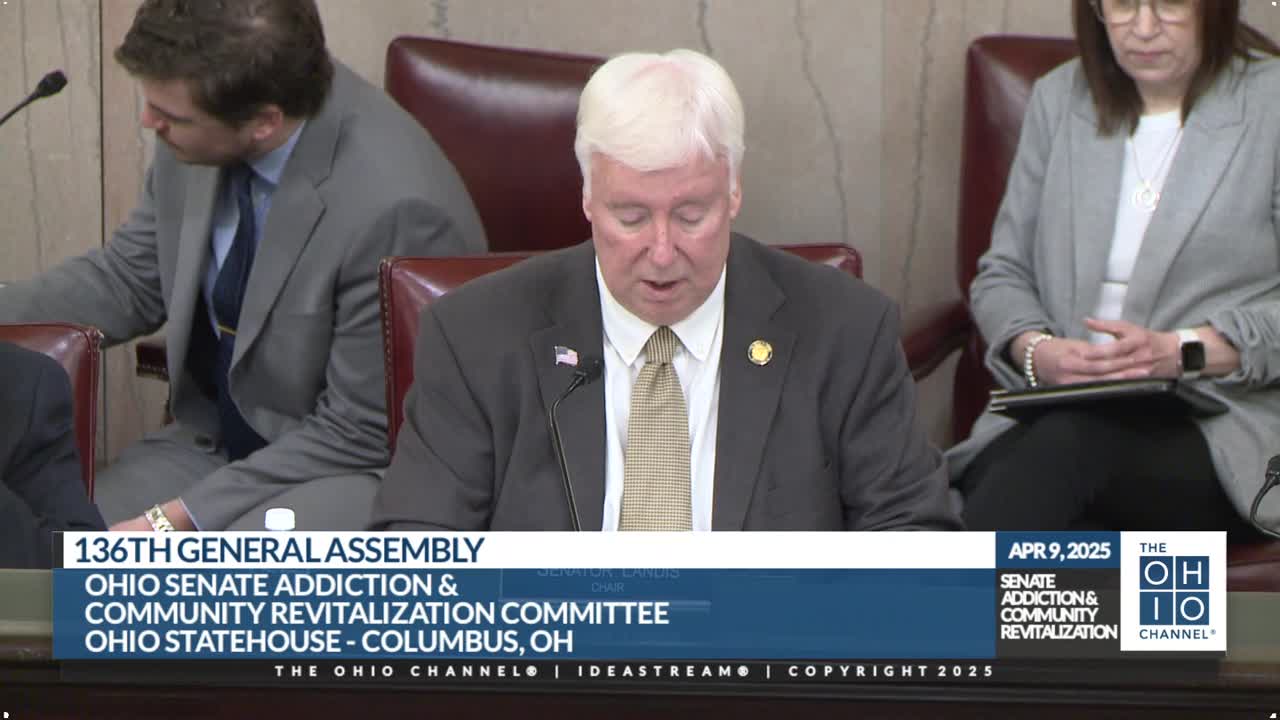
On April 9 the Senate Addiction and Community Revitalization Committee heard proponent testimony on Senate Bill 138, which would clarify local board contracting, require data collaboration, establish a 60-day transition-of-care period for contract changes and create criminal penalties for operators of uncertified recovery housing.
COLUMBUS — The Senate Addiction and Community Revitalization Committee on April 9 heard testimony from behavioral-health providers and local boards backing Senate Bill 138, a measure that would revise Ohio law governing alcohol, drug addiction and mental health services to clarify contracting, data sharing and oversight and to add criminal penalties for certain uncertified recovery housing operations.
Proponents told the committee the bill is the product of extended negotiations among providers, county boards and state agencies and said it aims to protect patients, reduce disputes and improve continuity of care. "The updates made in this bill that address the board and provider contracting, audit and investigation guidance, and transition of care protections for patients in need of behavioral health services have been in the works for over many years," said Teresa Lampeau, CEO of the Ohio Council of Behavioral Health and Family Services Providers.
The bill would, according to witnesses, clarify how Alcohol, Drug Addiction and Mental Health (ADAMs) boards determine eligibility for services, modernize contracting and procurement language, require certain guardrails for competitive procurements, and create a defined transition-of-care period of up to 60 days when a contract is not renewed. "A 60 day window to coordinate continuity of care [will ensure] that individuals receiving behavioral health services are not left behind due to changes in business arrangements," said Kate Rossman, policy manager for the Ohio Children's Alliance.
Witnesses also emphasized improved data sharing among boards, providers and the Ohio Department of Mental Health and Addiction Services as central to monitoring outcomes and stewarding public dollars. "To be able to understand how individuals access services, what the success of those services are... the only way that we can get to a point that we can give you the confirmation that you need... is to have access to that information," said Liz Henrick, CEO of the Ohio Association of County Behavioral Health Authorities.
Several provider groups said Senate Bill 138 fills a statutory gap left after the most recent state operating budget. "Recovery housing needs to provide safe and stable environment," said Brian Bayless, CEO of Thrive Peer Recovery Services and president of the Ohio Alliance of Recovery Providers. Bayless and other proponents told the committee House Bill 33, the state operating budget enacted two years earlier, removed a criminal penalty for operating uncertified recovery housing; SB 138 would restore criminal sanctions for entities operating recovery housing without certification by the Department of Mental Health and Addiction Services or an authorized credentialing agency.
Scott Silek, executive director of the Mental Health and Recovery Services Board of Lucas County and president of the Ohio Behavioral Healthcare Association, told senators the bill’s contracting and data provisions could reduce litigation and improve local planning. "Current language relative to contracting, processing, and oversight activities... have spawned multiple lawsuits in recent years. These proposed changes... will likely eliminate those conflicts," Silek said.
Committee work on SB 138 was presented as a compromise reached after months of stakeholder negotiation. Speakers repeatedly framed the bill as intended to keep the focus on patients and local service continuity rather than on organizational disputes. No committee vote on the bill occurred at the hearing; proponent testimony concluded and written testimony from additional stakeholders was made available to members.
At the start of the meeting, committee members agreed without objection to the minutes from the March 26 meeting. The committee chair called SB 138 for a second hearing and accepted the in-person proponent testimony during the April 9 session; senators did not take a final vote on the measure that day.
Supporters encouraged continued legislative and stakeholder collaboration as the bill advances. The committee adjourned after concluding in-person testimony and directing members to additional written testimony available on committee materials.