Get Full Government Meeting Transcripts, Videos, & Alerts Forever!
Get email alerts on the Group 8 Work Requirement topic
No spam. Unsubscribe anytime.
Ohio Medicaid director says Group 8 work‑requirement request submitted to CMS; department estimates about 800,000 could meet new eligibility criteria
Summary
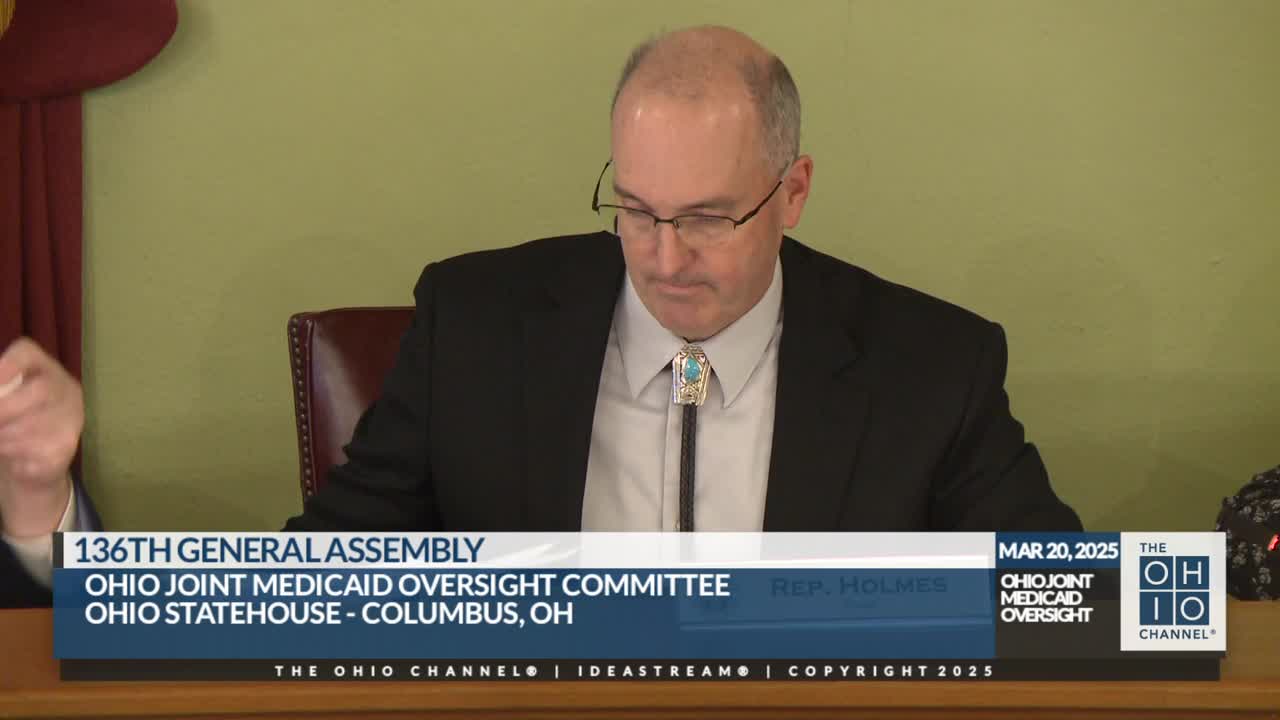
Director Corcoran told the Joint Medicaid Oversight Committee the department submitted the Group 8 eligibility request required by House Bill 33 to CMS and estimates roughly 799,000 Ohioans could meet the new criteria.
Director Corcoran, director of the Ohio Department of Medicaid, told the Joint Medicaid Oversight Committee that the department submitted the Group 8 eligibility request required by House Bill 33 to the Centers for Medicare and Medicaid Services (CMS) on the timeline set by the Legislature.
Corcoran said the department’s best estimate, based on data pulled in December, is that about "the total population's about 800,000" Ohioans (roughly 799,000) would meet the Group 8 eligibility criteria under the proposal. He said approximately 41 percent of that group were already working (including those at 10–20 hours weekly), about 12.6 percent have severe chronic conditions or serious mental illness, and roughly 27 percent would require additional individualized assessment because administrative data alone is insufficient to determine whether they meet the new criteria.
Why it matters: House Bill 33 requires the department to set new eligibility limits for Group 8 (the adult expansion population), and the department’s estimates inform county assessment workload, IT changes, managed‑care planning and the state budget. Corcoran told the panel his team is proceeding while CMS’s federal comment period is open; CMS’s comment window, he said, runs through April 7 and the department will begin formal discussions after that.
Corcoran described the statutory Group 8 criteria included in the submission: at least 55 years of age, employment, enrollment in school or occupational training, participation in an alcohol or drug treatment program, or having intensive physical health care needs or serious mental illness. He cautioned the committee that the department’s estimates rely on current administrative assumptions and that final definitions approved by CMS could change who qualifies.
On implementation, Corcoran outlined two streams: new applicants after implementation would be evaluated against the revised criteria at application; current Group 8 enrollees would be re‑evaluated at their next regular eligibility renewal (the annual redetermination). He said the department is integrating the new criteria into the routine renewal workflow and working closely with managed‑care organizations (MCOs) to reduce administrative burden and improve outreach.
Corcoran said the department has begun IT planning and can build on work from prior waiver efforts, subject to final federal approval. In response to questions from Senator Tim Romanchuk about whether prior IT work (about $20 million appropriated for a prior waiver) could be reused, Corcoran said much of the planning and requirements work is underway and that the team expects to build on earlier investments where possible but cannot finish implementation design until CMS issues a final approval.
County and plan roles: Corcoran said counties will perform many of the individual assessments and that the department has county tracking dashboards developed during the unwinding period. He warned counties may bear the primary administrative impact and said the department can supply county maps and assessment counts by county. On redetermination frequency, Corcoran told Chair Hoffman that moving to six‑month renewals would likely be cost‑prohibitive based on experience during the unwinding, but the department offered to produce specific cost estimates for the committee.
Budget and caseload estimates: Corcoran said the department’s budget estimates incorporate both federal and state dollars and listed line items including county effort payments and IT/admin costs. He cited figures the department has presented in budget hearings: a year‑one GRF cost of $630,535 and a year‑two savings estimate of $7,200,000, and separately said the department expects about 62,000 enrollees could lose eligibility in the upcoming biennium under the new rules. Corcoran also noted an expected “lag” in disenrollments because of due‑process protections and normal eligibility timing.
Public comment and comparative lessons: Corcoran said the state received 654 public comments in its state comment period; themes of opposition included administrative burden, loss of coverage and reduced health outcomes, childcare and transportation barriers, and concerns about efficacy. Supportive comments focused on the belief that some enrollees could work and should have work expectations. He reviewed lessons from Georgia and Arkansas: Georgia spent more than $40 million and had high administrative costs when it launched a different work program, while Arkansas experienced increases in uninsurance and financial barriers to care without measurable employment gains in early analyses.
Next steps: Corcoran told the committee there are three components CMS must approve for a full demonstration: implementation/design (IT and operational processes), an independent evaluation (rigorous research with control groups), and a federal monitoring plan. He said the department has begun the front‑end planning for each but cannot finalize details until CMS provides direction and completes its review of public comments.
Sources and attribution: Statements and data in this article are drawn from Director Corcoran’s presentation and subsequent committee questions during the Joint Medicaid Oversight Committee meeting. Direct quotes and figures are attributed in the text to the speakers who used them during the meeting.