Get Full Government Meeting Transcripts, Videos, & Alerts Forever!
Get email alerts on the Workers Compensation Formulary topic
No spam. Unsubscribe anytime.
JCAR members press BWC on changes to outpatient medication formulary; officials say workers and providers will be notified
Summary
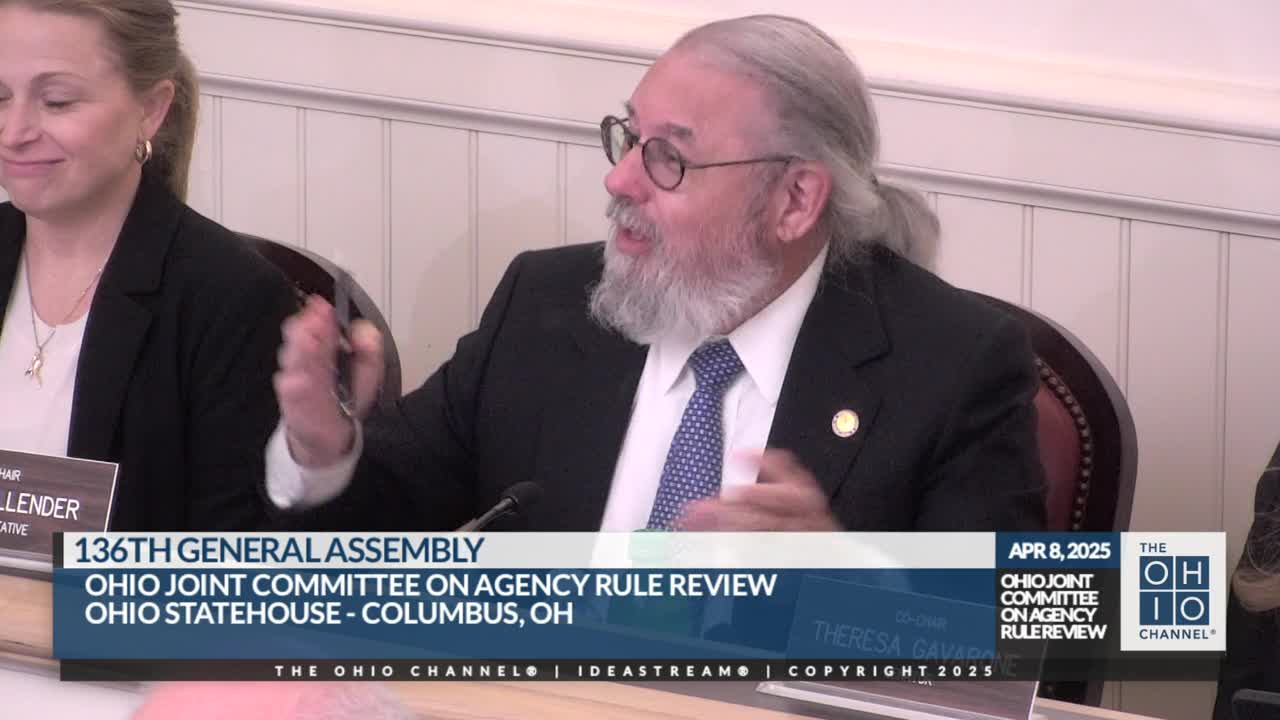
Representative Brenner raised concerns about the Bureau of Workers' Compensation's updated outpatient medication formulary appendix during a Joint Committee on Agency Rule Review meeting, asking whether prescriptions covered under the old appendix could lose coverage under the new version.
Representative Brenner raised concerns about the Bureau of Workers' Compensation's updated outpatient medication formulary appendix during a Joint Committee on Agency Rule Review meeting, asking whether prescriptions covered under the old appendix could lose coverage under the new version.
Pete Mahaley, director of enterprise legal services at the Bureau of Workers' Compensation, said the bureau maintains a formulary and a Pharmacy and Therapeutics (P&T) committee that recommends which drugs the bureau should cover. "We started out back in 02/2011 by looking at every drug we had paid for in the last 3 years," Mahaley said, and the bureau rescinds the prior appendix and enacts a new one with only the changes recommended by the P&T committee and approved by the bureau.
Freddie Johnson, chief medical service and appliance officer, said the P&T committee advises the bureau on coverage and any restrictions, and that the bureau updates the formulary through rulemaking. Mahaley told the committee the bureau now aims to update the formulary twice a year because rulemaking takes time; previously the committee was required to meet three times a year and now meets twice.
On whether workers could lose coverage when a drug is removed, Mahaley said the bureau reviews prior payments and would not remove the only available drug to treat an allowed condition. "If we're taking a drug off the formulary, 1, we wouldn't do it unless there were other drugs that could treat the same condition that are on the formulary," Mahaley said. He added that the bureau sends letters to injured workers for whom the bureau has paid for a prescription when that drug is scheduled to stop being paid for and that providers may also be copied on those notices.
Representative Brenner pressed on coverage for mental-health medications, citing examples such as bank tellers held at gunpoint, first responders, and employees who experience harassment but have no accompanying physical injury. Freddie Johnson said the bureau relies on the P&T committee's recommendations. He added that the bureau can pay for services or medications not on the formulary on a case-by-case basis if medical documentation shows necessity.
Committee members were told that, under current practice described at the meeting, an allowance for a mental-health claim generally requires an accompanying physical injury to qualify under workers' compensation rules discussed by staff. The committee did not take a formal vote on the rule at this meeting.
The discussion also included statements that the bureau documents changes in its rule summary, fiscal analysis and business impact analysis filed with the Common Sense Initiative Office when the formulary is changed.
Committee members did not adopt any formal action during the discussion; staff committed to providing clarifications and follow-up information about provider notifications and the timeline for notices to injured workers.