Get Full Government Meeting Transcripts, Videos, & Alerts Forever!
Get email alerts on the Property Tax Reform topic
No spam. Unsubscribe anytime.
Auditor and Taxpayer Coalition Back Bill to Limit Property-Tax Growth at 20-Mill Floor
Summary
Proponent testimony for House Bill 186 argued the bill would tie allowable revenue growth in districts at the state’s 20-mill floor to inflation (GDP deflator), restoring protections intended by earlier law and reducing rapid unvoted increases driven by soaring property values.
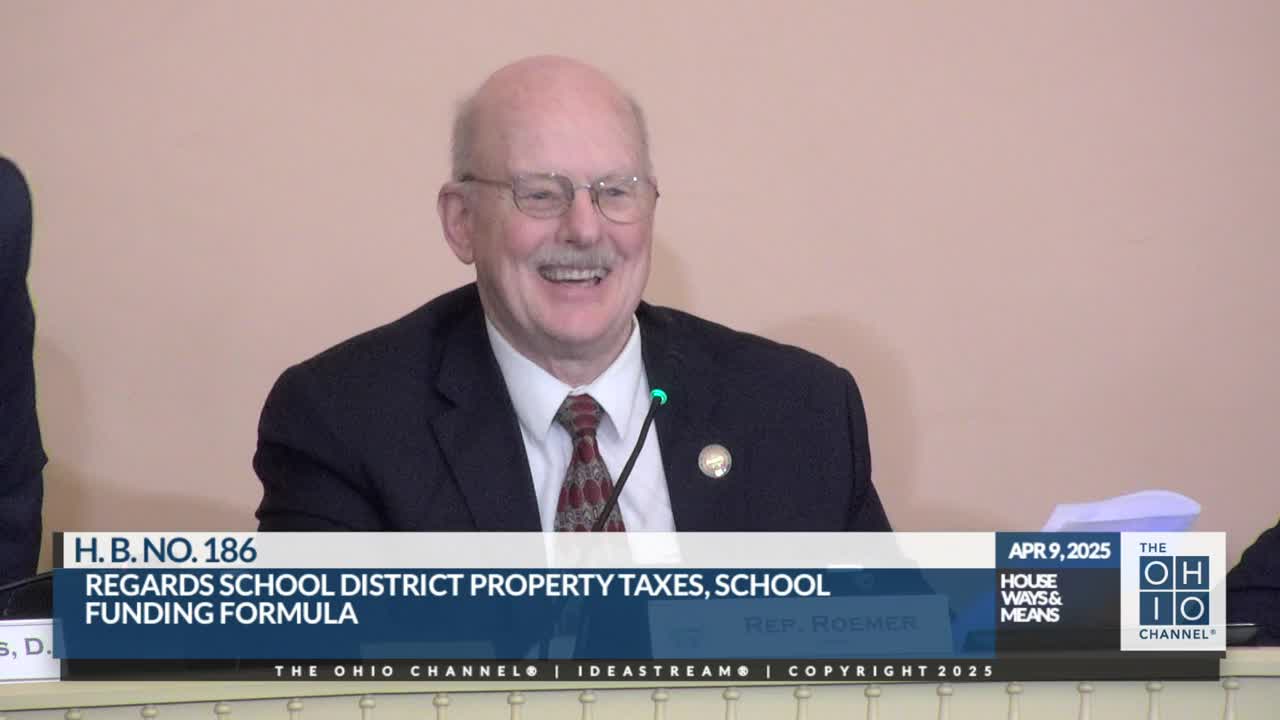
The House Ways and Means Committee heard proponent testimony on House Bill 186, which would change how school districts at Ohio’s 20-mill floor experience revenue growth by tying allowable increases to the cumulative rate of inflation between mandated valuation updates.
Chris Klein, chief deputy auditor for Lawrence County and a representative of the County Auditor’s Association of Ohio, told the committee HB186 would "break the automatic link between soaring property values and equally soaring property tax bills." Klein said the bill preserves constitutionality and uniformity while allowing inflation-based revenue growth rather than letting market-driven valuation increases directly raise local property-tax bills.
Tom Zano and Brian Pereira of the Ohio Taxpayer Protection Coalition testified in support, presenting data the coalition said shows a majority of Ohio school districts are at or approaching the 20-mill floor and that many districts have grown cash reserves. Zano and Pereira argued HB186 would not reduce current school revenues but would slow future unvoted growth, providing predictability to taxpayers while still permitting reasonable inflationary increases.
Witnesses traced the problem to the interaction between House Bill 920 (1970s) and subsequent practices that let unvoted taxes rise with valuations; they said emergency and substitute levies and reallocation of inside millage have allowed districts to capture additional revenue without explicit voter approval. The coalition presented department-of-education data showing rising cash reserves in many districts and urged the committee to advance HB186 as a measured reform.
Ranking member Troy and others asked about the bill’s interaction with other tax measures and whether broader reform—such as changes to house bill 920—should also be considered. Testimony noted potential trade-offs: altering protections in one statute can have effects across taxing authorities.
The committee concluded proponent testimony; written testimony from the Ohio Chamber of Commerce and Ohio Realtors was noted. No committee vote was taken during this hearing.