Get Full Government Meeting Transcripts, Videos, & Alerts Forever!
Get email alerts on the Hb186 20 Mill Inflation Cap topic
No spam. Unsubscribe anytime.
Auditors, Tax Groups Back Bill to Cap Revenue Growth for Districts at 20‑Mill Floor to Inflation
Summary
County auditors and taxpayer groups urged the committee to advance House Bill 186, which would limit revenue growth for school districts already at the 20‑mill floor by tying allowable growth to cumulative inflation between valuations; proponents said the change restores intended protections of HB 920 and curbs steep, market‑driven tax increases.
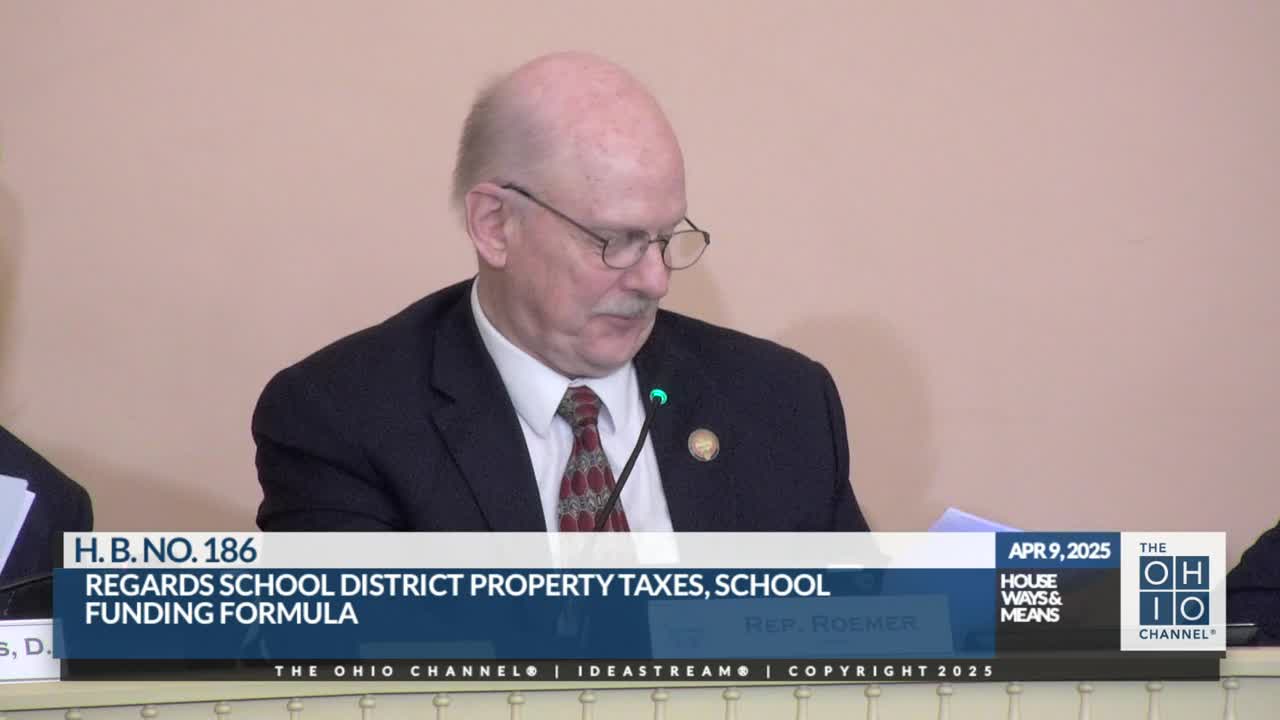
Proponent witnesses, including Lawrence County deputy auditor Chris Klein and representatives of the Ohio Taxpayer Protection Coalition, told the House Ways and Means Committee that House Bill 186 would rein in unvoted property tax increases in school districts that have reached the 20‑mill floor by capping future revenue growth to the cumulative rate of inflation between mandated valuation updates.
Chris Klein, chief deputy auditor for Lawrence County, said the 20‑mill floor—created as an exception to House Bill 920’s reduction factor scheme—now produces large, automatic tax increases when property values surge. "House Bill 186 addresses this issue by tying the allowable revenue growth in 20 mill floor districts to the cumulative rate of inflation between mandated valuation updates," Klein said.
Tom Zano of the Ohio Taxpayer Protection Coalition and other coalition witnesses argued the bill would not claw back current revenues but would limit future unvoted revenue growth, giving predictability to taxpayers while allowing inflationary adjustments. Coalition testimony included Department of Education data showing school cash reserves have risen in recent years; witnesses argued now is an appropriate time to change the growth mechanism.
Supporters emphasized the change would preserve constitutionality and uniform tax treatment while breaking the automatic link between rising market values and rising tax bills in affected districts. They also cited research showing many school districts are at or nearing the 20‑mill floor and that the problem has intensified with recent valuation updates.
Ranking member Troy and other members asked historical questions about why emergency and substitute levies were excluded from the 20‑mill calculation; witnesses said emergency levies began as true short‑term measures but have been used more continuously in practice. Proponents urged the committee to advance HB 186 as part of broader property tax reform work.
The proponents submitted written materials; the committee concluded proponent testimony with no immediate vote recorded.